OPINIONCOMMENTARYEU REGULATION AND PACKAGING
Brussels bans what Beijing, London and the US food authority allow – the BPA can, even for export
Since 20 July 2026 no new cans with a BPA inner coating may be placed on the market in the EU. Two European expert authorities are a factor of 1,000 apart in their assessment, and the United States considers BPA in cans safe. A commentary on proportionality.
By Andreas W. Herb, Founder and CEO MBG Group, Paderborn
8 minutes read31 sources1 correctionDisclosure
Share
Contents
0.2 ng
tolerable per kilogram of body weight per day according to EFSA
2023, previously 4,000 nanograms[4]
200 ng
the same value according to the BfR and the British COT
20/07/2026
last day for new BPA cans in the EU
Since 20 July 2026 no new drinks cans whose inner coating was made with bisphenol A may be placed on the market in the European Union. What was delivered before that may still be filled until 20 July 2027.[1][2] After that no drinks can with a BPA inner coating may be filled in the EU.
One might take this for a detail of food chemistry. I take it for an object lesson in how regulation comes about in Europe: from the strictest value available, without regard to the fact that other expert authorities arrive at an entirely different result, and with consequences far beyond the internal market.
A factor of 1,000, among experts
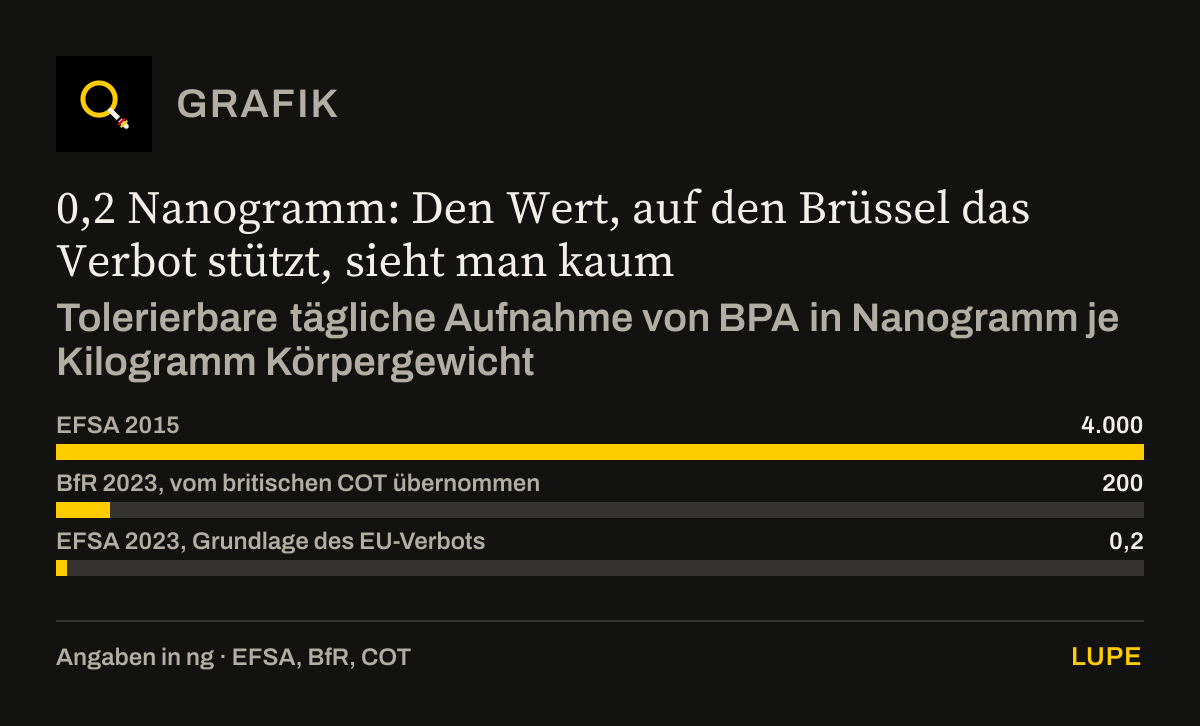
In 2023 the European Food Safety Authority, EFSA, determined that a person can take in 0.2 nanograms of BPA per kilogram of body weight a day without a health risk being expected. Previously the value stood at 4 micrograms, that is 20,000 times higher.[4] The German Federal Institute for Risk Assessment considers 200 nanograms appropriate and contradicts the derivation of the EFSA value on several points.[5] The British expert committee COT has adopted the German value.[6] The EU Commission based its ban on EFSA’s assessment that BPA could harm the immune system.[3]
0.2 nanograms: the value on which Brussels bases the ban is barely visible
Tolerable daily intake of BPA in nanograms per kilogram of body weight
EFSA[4], BfR[5], COT[6]. Chart redrawn from the figures in the text.
Limits of the data: The axis begins at zero. The bar for 0.2 nanograms is there, but narrower than a pixel. A factor of 1,000 separates the BfR and EFSA, a factor of 20,000 EFSA’s old and new assessments.
Download the chart as an image (PNG)
Show data table3 rows
| Tolerable daily intake (ng) | |
|---|---|
| EFSA 2015 | 4,000 |
| BfR 2023, adopted by the British COT | 200 |
| EFSA 2023, the basis of the EU ban | 0.2 |
The disagreement is no trifle. The BfR considers even the endpoint unsuitable on which EFSA bases its value: a change in particular immune cells in mice. No health hazard for humans can be predicted from that, it says.[5] The COT takes the same view and considers effects in humans up to the German value unlikely.[6] The US food authority FDA writes that BPA is safe in the quantities that occur in food today; coatings containing BPA in metal cans remain permitted there.[7]
To be clear: the factor of 1,000 does not mean that 1,000 times more BPA may be in a can in the United Kingdom. It describes how differently expert authorities assess the same body of studies. That is precisely why it is politically so explosive.
The risk is not invented
Anyone declaring BPA harmless is making it too easy for themselves. The Endocrine Society, the world’s largest professional association in hormone research, expressly supported the EU ban.[11] A study published in 2026 found a reduction in insulin sensitivity of around 9 per cent in 40 young adults after five days of targeted BPA administration.[12] The dose, however, was 50 micrograms per kilogram of body weight, 250 times the German and 250,000 times the European value. The study did not examine long-term illness or normal consumption from cans.[12]
Neither “all perfectly safe” nor “every can makes you ill” is therefore an honest summary. What is honest is this: science is in dispute about the relevant dose. And where science is in dispute, politics has to give reasons for choosing the strictest reading and say what it costs.
Outside Europe hardly anyone is following
| Market | Rule |
|---|---|
| European Union | Banned. New cans with BPA only until 20 July 2026, filling until 20 July 2027; preserved fruit, vegetables and fish until 20 January 2028.[1][2] |
| Norway | Banned as in the EU, with the same deadlines. Adopted via the EEA agreement, in force since 14 June 2025.[15] |
| Iceland | Banned as in the EU, with the same deadlines. Adopted via the EEA agreement, in force since 14 June 2025.[15] |
| Switzerland | Banned since the amendment of the consumer goods ordinance of 2 June 2025, with the same deadlines as in the EU.[16] |
| Northern Ireland | Banned. EU law applies there via the Windsor Framework.[9] |
| USA, State of Washington | Drinks cans with a bisphenol-based inner coating banned since 1 January 2025. For food cans only a notification duty applies.[17] |
| Great Britain without Northern Ireland | Permitted. The food authority has announced restrictions.[9] |
| USA, federal law | Permitted; the FDA considers today’s quantities safe.[7] Individual states ban BPA in cans and jars for infant food, for instance Connecticut and Minnesota.[18][19] In California BPA is on the list under Proposition 65, which can trigger warning notices.[20] |
| China | Permitted with a migration limit of 0.05 milligrams per kilogram of food; new standard from 2 September 2026.[8] |
| Indonesia | Permitted with a migration limit of 0.05 milligrams per kilogram for cans with an inner coating, under the packaging regulation of 23 June 2026. Banned in bottles and polycarbonate for children under three.[21] |
| Brazil | Permitted with a migration limit of 0.05 milligrams per kilogram. Not authorised in baby bottles and similar articles for children up to three.[22] |
| South Korea | Permitted with a migration limit of 0.6 milligrams per litre for epoxy resins. Banned in all articles for children under 36 months.[23] |
| Japan | Permitted. No statutory limit for can coatings could be found; in 2008 the industry set itself low migration values voluntarily.[24] |
| Canada | Permitted. Only polycarbonate baby bottles with BPA are banned, since 2010. Health Canada expects no health risk from packaging.[25][26] |
| Australia | Permitted; there is no rule of its own for BPA. The authority FSANZ considers the exposure harmless; for polycarbonate baby bottles there was a voluntary phase-out in 2010.[27] |
| New Zealand | Permitted; there is no rule of its own for BPA. The same authority, FSANZ, is responsible as for Australia.[27] |
| Malaysia | Permitted. Only baby bottles with BPA are banned, since 2012.[28] |
| Philippines | Permitted. Only baby bottles and sippy cups with BPA are banned, since 2019.[29] |
| Mexico | Permitted. The standard for preserve cans names epoxy resins as a suitable inner coating; there is no federal rule for BPA.[30] |
| South Africa | Permitted. Only polycarbonate baby bottles with BPA are banned, since 2011.[31] |
Those who have followed are the neighbours who align their food law with the EU anyway: Norway and Iceland via the EEA, Switzerland by its own decision.[15][16] Outside Europe no state on this list has a comparable ban. Stricter is only a single American state, Washington, and even that only for drinks cans.[17]
European bottlers can still export, to every country in the world. But only in the can that Brussels prescribes. The regulation prohibits not only sale but already the use of BPA in manufacture, and every can a filler buys in the EU is placed on the market here. There is no exemption for export goods.[1][2] Anyone shipping drinks from Germany to America or Asia therefore bears the cost of the switch even where local competitors may carry on using the authorised BPA can.
This concern is not mine alone. In a British consultation on a ban of its own, participants expressly warned of competitive disadvantages and trade barriers, because the United Kingdom and the EU would thereby diverge from the United States, China and Japan.[10]
Who earns from the switch
Every switch has winners. AkzoNobel has put 32 million euros into a new plant in Vilafranca in Spain that makes bisphenol-free coatings for the can industry.[13] The European coatings association CEPE has a BPA working group of its own; in March 2025 its board included representatives of PPG, Sherwin-Williams and AkzoNobel.[14]
The association itself writes that its talks with the authorities led to a “workable outcome” for can and heavy-duty coatings.[14] The regulation does indeed contain exactly one permanent exemption for coatings: for containers of more than 1,000 litres.[1] But the same report also shows that CEPE contradicted EFSA’s assessment and fought for adequate transitional periods, not for a ban.[14] That the coatings lobby brought the ban about is not supported by the documents. That lobbying took place, and who did it, is.
What I expect
Protecting health needs robust science, and regulation needs proportionality. Anyone forcing a whole supply chain to switch has to disclose three things: what additional protection the ban brings, what it costs companies and consumers, and why the differing assessment of two expert authorities was rejected. We found no such calculation for the BPA can.
For me this is an example of regulation that burdens Europe’s drinks industry without anyone doing the sums. More on European packaging regulation is in my open letter to the federal chancellor and in the background piece Verpackungsverordnung aussetzen.
Andreas W. HerbFounder and CEO MBG Group, Paderborn
What I expressly do not claim
I do not claim that BPA is harmless, nor that export to countries outside the EU is impossible; drinks in BPA-free cans may be sold everywhere. How much the switch costs per can has not been published by anyone; that it burdens the sector is my assessment. I do not claim that the coatings industry bought the ban. The factor of 1,000 describes differing assessments by the authorities, not differing limits for a can.
METHOD
Method
Factors: 200 ÷ 0.2 = 1,000 (BfR against EFSA 2023). 4,000 ÷ 0.2 = 20,000 (EFSA 2015 against 2023; 4 micrograms are 4,000 nanograms). The dose in the 2026 study: 50 micrograms = 50,000 nanograms per kilogram; 50,000 ÷ 200 = 250 and 50,000 ÷ 0.2 = 250,000.
Deadlines under Article 11 of Regulation (EU) 2024/3190 as amended by corrigendum (EU) 2026/250: single-use articles with BPA may be placed on the market for the first time until 20 July 2026 and filled for 12 months thereafter; for preserved fruit, vegetables and fish and for purely external coatings until 20 January 2028. The exemptions in Annex II concern epoxy resins for containers over 1,000 litres and filters with polysulfone membranes.
CHECK
What was checked before publication
- Regulation (EU) 2024/3190 and its corrigendum (EU) 2026/250 were read in the wording of the Official Journal on 26 October 2026, as were the assessments of EFSA, the BfR and the British committee COT, the page of the US authority FDA, the British government’s information of 25 June 2026 and the annual report of the coatings association CEPE.
- The author’s draft said that export to the rest of the world was impossible because cans with BPA were banned and no longer available. Export is not impossible: drinks in BPA-free cans may be sold everywhere. What is documented is that cans for export goods must be BPA-free in the EU as well. The text says it that way.
- That the ban also covers cans for export follows from the wording: what is prohibited is already the use of BPA in manufacture, and every can that a filler obtains in the EU is placed on the market here. The regulation contains no exemption for export goods. We found no interpretation by the Commission on this question.
- For China the text relies on the unofficial translation of standard GB 4806.10-2025 by the US Department of Agriculture. The standard applies from 2 September 2026.
- On 26 October 2026 the country table was expanded with the list the author supplied subsequently. Every row has been checked against an official source: an act, an official gazette, a standard or an authority’s website. For Malaysia it is the version consolidated by the health ministry, for Brazil the image of the official gazette. Where a country has no rule of its own for BPA, the entry reads “permitted”; that is inferred from the absence of a rule. For Japan the voluntary industry rule comes from an authority’s information from 2010; whether the positive list applying since 2025 governs BPA in can coatings specifically could not be clarified.
- What the switch costs per can has not been published by anyone, neither by the manufacturers nor by the authorities. That it places a burden on the drinks industry is the author’s assessment. The Commission, the coatings manufacturers and the can manufacturers were not asked for comment.
SOURCES
Sources
Every number in the text leads to its source. The origin is given at each entry: official, media report, trade association, institute or data portal. Titles stay in the original language, so that each document can still be found.
[1] Europäische Kommission, 19.12.2024, ABl. L vom 31.12.2024
Verordnung (EU) 2024/3190 über die Verwendung von Bisphenol A (BPA) und anderen Bisphenolen in Lebensmittelkontaktmaterialien (Artikel 1, 3, 11 und Anhang II)Official source↑ back to the text
[2] Europäische Kommission, 02.02.2026, ABl. L vom 03.02.2026
Verordnung (EU) 2026/250 zur Berichtigung der Verordnung (EU) 2024/3190 (neue Fassung von Artikel 3 und 11)Official source↑ back to the text
[3] Europäische Kommission, 19.12.2024
Commission adopts ban of Bisphenol A in food contact materialsOfficial source↑ back to the text
[4] Europäische Behörde für Lebensmittelsicherheit (EFSA), 19.04.2023
Bisphenol A in food is a health riskOfficial source↑ back to the text
[5] Bundesinstitut für Risikobewertung (BfR), 13.07.2023
Bisphenol A in everyday products: answers to frequently asked questionsOfficial source↑ back to the text
[6] Committee on Toxicity (COT), Vereinigtes Königreich
Supplementary statement to the COT's position paper on bisphenol A (BPA), Randnummern 43, 66, 67 und 73Official source↑ back to the text
[7] U.S. Food and Drug Administration (FDA), Stand 20.04.2023
Bisphenol A (BPA): Use in Food Contact ApplicationOfficial source↑ back to the text
[8] U.S. Department of Agriculture, Foreign Agricultural Service, 19.11.2025
National Food Safety Standards for Food Contact Materials (GAIN-Bericht CH2025-0216 mit inoffizieller Übersetzung von GB 4806.10-2025)Official source↑ back to the text
[9] Britische Regierung, 25.06.2026
BPA in food contact materials: EU rules and UK implicationsOfficial source↑ back to the text
[10] Britische Regierung
Summary of responses: consultation on the proposal to implement a ban on the use of BPA and its analogues in food contact materialsOfficial source↑ back to the text
[11] Endocrine Society, 07.03.2024
Submission to the European Commission public consultation on restrictions on bisphenol A (BPA) and other bisphenols in food contact materialsTrade association↑ back to the text
[12] The Journal of Clinical Endocrinology & Metabolism, 20.03.2026
Seal, Phelan, Malin u. a.: Bisphenol A decreases peripheral insulin sensitivity in normal weight adults: a double-blind randomized controlled trial (Band 111, Heft 9)Institute or public body↑ back to the text
[13] AkzoNobel, 16.11.2023
AkzoNobel invests in coatings technology to support beverage can industry transitionInstitute or public body↑ back to the text
[14] CEPE (Europäischer Verband der Lack-, Druckfarben- und Künstlerfarbenhersteller), April 2025
Annual Report 2024 (Vorstand S. 4, BPA-Arbeitsgruppe S. 27, Dosenbeschichtungen S. 36)Trade association↑ back to the text
[15] EFTA, EEA-Lex, 13.06.2025
Regulation (EU) 2024/3190: übernommen in das EWR-Abkommen durch Beschluss des Gemeinsamen EWR-Ausschusses Nr. 127/2025Official source↑ back to the text
[16] Schweizerische Eidgenossenschaft, 02.06.2025, in Kraft 01.07.2025
Verordnung des EDI über Materialien und Gegenstände (Bedarfsgegenständeverordnung), Änderung vom 2. Juni 2025, AS 2025 395 (Anhang 13, Art. 43c)Official source↑ back to the text
[17] Washington State Legislature, in Kraft 01.07.2023
WAC 173-337-114: Bisphenols in drink and food can linings (WSR 23-12-044)Official source↑ back to the text
[18] Connecticut General Assembly, 03.06.2009
Public Act 09-103: An Act Concerning Bisphenol-A in Reusable Food and Beverage Containers, Infant Formula and Baby FoodOfficial source↑ back to the text
[19] Minnesota Office of the Revisor of Statutes, 2013
Minnesota Statutes § 325F.174: Bisphenol-A in infant formula and baby food containersOfficial source↑ back to the text
[20] Office of Environmental Health Hazard Assessment, Kalifornien, 31.07.2026
Proposition 65: Chemicals known to the State to cause cancer or reproductive toxicity (Liste mit Bisphenol A)Official source↑ back to the text
[21] Badan Pengawas Obat dan Makanan (BPOM), Indonesien, 23.06.2026
Peraturan BPOM Nr. 11 Tahun 2026 über Lebensmittelverpackungen (Anhang: spezifische Migration bei innen beschichtetem Weißblech, S. 29)Official source↑ back to the text
[22] Agência Nacional de Vigilância Sanitária (ANVISA), Brasilien, 22.12.2021
Resolução RDC Nr. 589/2021 (Positivliste für Kunststoffe und Beschichtungen, Eintrag Bisphenol A), Abbild des Diário Oficial da UniãoOfficial source↑ back to the text
[23] Ministry of Food and Drug Safety (MFDS), Südkorea, 27.03.2026
Standards und Spezifikationen für Geräte, Behälter und Verpackungen, Bekanntmachung Nr. 2026-24 (Abschnitte III.2, V.1 und V.5)Official source↑ back to the text
[24] Consumer Affairs Agency, Japan, Stand 15.01.2010
Bisphenol A: Fragen und Antworten (mit der freiwilligen Branchenregel von 2008)Official source↑ back to the text
[25] Regierung von Kanada, Stand 2026
Canada Consumer Product Safety Act, Schedule 2, Nr. 15 (Babyflaschen aus Polycarbonat mit BPA)Official source↑ back to the text
[26] Health Canada
Bisphenol A (Lebensmittelverpackungen)Official source↑ back to the text
[27] Food Standards Australia New Zealand (FSANZ), Stand 02.10.2025
Bisphenol A (BPA)Official source↑ back to the text
[28] Gesundheitsministerium Malaysia, August 2026
Food Regulations 1985, Regulation 27A (konsolidierte Fassung, Stand August 2026)Official source↑ back to the text
[29] Food and Drug Administration Philippines, 09.08.2019
FDA Circular No. 2019-004: Ban of Bisphenol A (BPA) from infant feeding bottles and sippy cupsOfficial source↑ back to the text
[30] Secretaría de Salud, Mexiko, DOF 21.11.1997
NOM-130-SSA1-1995: Alimentos envasados en recipientes de cierre hermético (Nr. 6.2 und Anhang A)Official source↑ back to the text
[31] Department of Health, Südafrika, 21.10.2011
Government Notice R. 879: Regulations relating to the prohibition of bisphenol A in infant feeding bottles, Government Gazette Nr. 34698Official source↑ back to the text
CORRECTIONS
Corrections
What was wrong: The headline read “Brussels bans what Washington, Beijing and London allow”. What was meant was the American federal government. But the US state of Washington has banned bisphenol-based inner coatings in drinks cans since 1 January 2025; the headline was therefore misleading. The country table named only five markets.
What was changed: The headline now names the US food authority instead of Washington. The country table covers 20 markets, among them Norway, Iceland, Switzerland and the state of Washington, which also ban BPA in cans. Added to this is a paragraph on who has followed the EU ban.
Why: While checking the complete country list that the author supplied subsequently, the ban in the state of Washington came to light.
This page is opinion. Our fact checks are not.