OPINIONCOMMENTARYLETTER POSTAGE
A letter will soon cost 1.15 euros. The framework for it is set by the state.
Deutsche Post wants to raise postage on 1 January 2027 by more than it has in over 20 years. Most of it is explained by falling letter volumes. But how much a letter may cost is calculated by a federal authority under rules written by the legislator – with a profit mark-up and the legacy burdens of the old Bundespost.
By Andreas W. Herb, Founder and CEO MBG Group, Paderborn
7 minutes read22 sources0 correctionsDisclosure
Share
Contents
From 1 January 2027 a standard letter is to cost 1.15 euros instead of 0.95 euros. That is 21 per cent more, the biggest rise in over 20 years.[1][2][3][4][5] The postcard rises by the same amount, the large letter by 31 per cent, the maxi letter up to 1,000 grams from 2.90 to 5.00 euros.[1] My annoyance is not with Deutsche Post. It is with the rules by which the state calculates its postage, and with the costs the state adds for all businesses year after year.
€1.15
standard letter from 1 January 2027, previously 0.95 euros
+21 per cent, Deutsche Post[1]
20.35%
price latitude for 2027 and 2028 according to the Federal Network Agency’s draft
2024: 10.48 per cent[6]
−37%
letters in Germany in 2025 against 2017
Federal Network Agency[7]
+109%
standard letter 2027 against 2012, then 0.55 euros
The new prices
The standard letter is to cost 1.15 euros, the maxi letter 5 euros
Domestic letter prices, previously and from 1 January 2027, in euros
- Previously
- From 1 January 2027
Source: Deutsche Post, changes in 2027[1]. Chart redrawn from the figures in the text.
Limits of the data: The large letter will in future go up to 1,000 grams and 3 centimetres instead of up to 500 grams and 2 centimetres. Maxi letter: previously 2.90 euros up to 1,000 grams, in future 5.00 euros up to 2,000 grams, but at most 3 instead of 5 centimetres high.
Download the chart as an image (PNG)
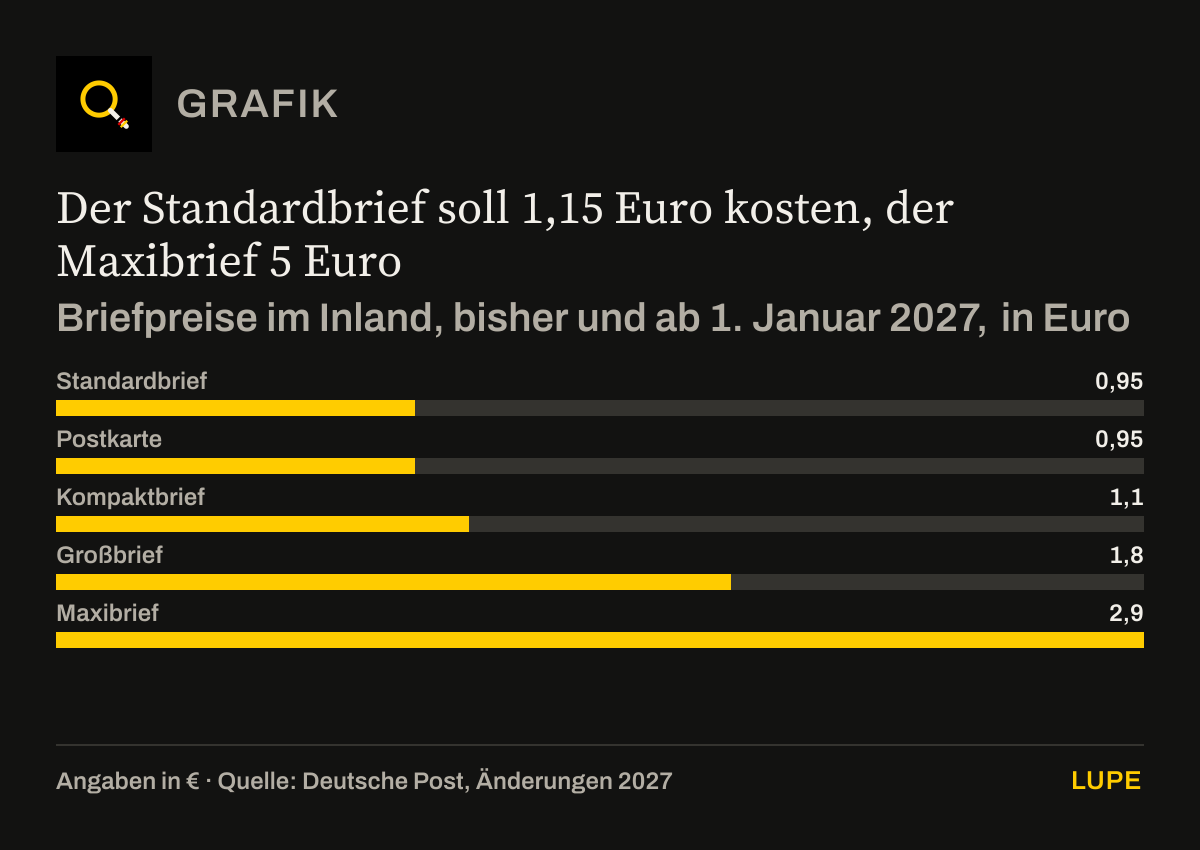
Show data table5 rows
| Previously (€) | From 1 January 2027 (€) | |
|---|---|---|
| Standard letter | 0.95 | 1.15 |
| Postcard | 0.95 | 1.15 |
| Compact letter | 1.1 | 1.25 |
| Large letter | 1.8 | 2.35 |
| Maxi letter | 2.9 | 5 |
| Product | Previously | From 1/1/2027 | Change |
|---|---|---|---|
| Domestic: standard letter | €0.95 | €1.15 | +21% |
| Domestic: postcard | €0.95 | €1.15 | +21% |
| Domestic: compact letter | €1.10 | €1.25 | +14% |
| Domestic: large letter (in future up to 1,000 g) | €1.80 | €2.35 | +31% |
| Domestic: maxi letter up to 1,000 g | €2.90 | €5.00 | +72% |
| Domestic: maxi letter 1,001 to 2,000 g (in future at most 3 cm high) | €5.10 | €5.00 | −2% |
| Domestic: registered, drop-in delivery, advice of receipt, insured | €2.65 / €2.35 / €4.85 / €4.45 | unchanged | 0% |
| International: standard letter | €1.25 | €1.45 | +16% |
| International: postcard | €1.25 | €1.45 | +16% |
| International: compact letter | €1.80 | €2.10 | +17% |
| International: up to 500 g (in future “midi letter”, previously large letter) | €3.30 | €3.80 | +15% |
| International: up to 1,000 g (in future large letter, previously maxi letter) | €6.50 | €6.80 | +5% |
| International: maxi letter up to 2,000 g | €17.00 | discontinued | – |
| International: registered international | €3.70 | €3.95 | +7% |
| International: registered with advice of receipt | €5.90 | €6.35 | +8% |
| Source: Deutsche Post[1]; change our own calculation, rounded |
This is not yet final. The Federal Network Agency published its price framework as a draft on 12 October and intends to decide in November; after that it has to approve every individual price. The new prices are then to apply for two years, until the end of 2028.[1][6]
Why it is getting more expensive
Deutsche Post points first to its volumes and costs. Board member Nikola Hagleitner: “Letter volumes have been falling markedly for years, while staff, energy and material costs are rising.” If ever fewer letters pass through the same infrastructure, the cost per letter rises. Deutsche Post also points to “rising burdens imposed by the state”, without quantifying them.[8]
The figures confirm the first part. In 2017, 14.9 billion letters were sent in Germany, in 2025 only 9.4 billion.[7] The Federal Network Agency sees the main reason in this: “The essential reason for rising postage is the strongly declining letter volumes.”[6]
37 per cent fewer letters are sent in Germany than in 2017
Letter items up to 2,000 grams in billions, all providers and of those Deutsche Post
- All providers
- of those Deutsche Post
Source: Federal Network Agency, postal data portal[7]. Chart redrawn from the figures in the text.
Limits of the data: As at 8 December 2025; the value for 2025 is presumably an estimate.
Download the chart as an image (PNG)
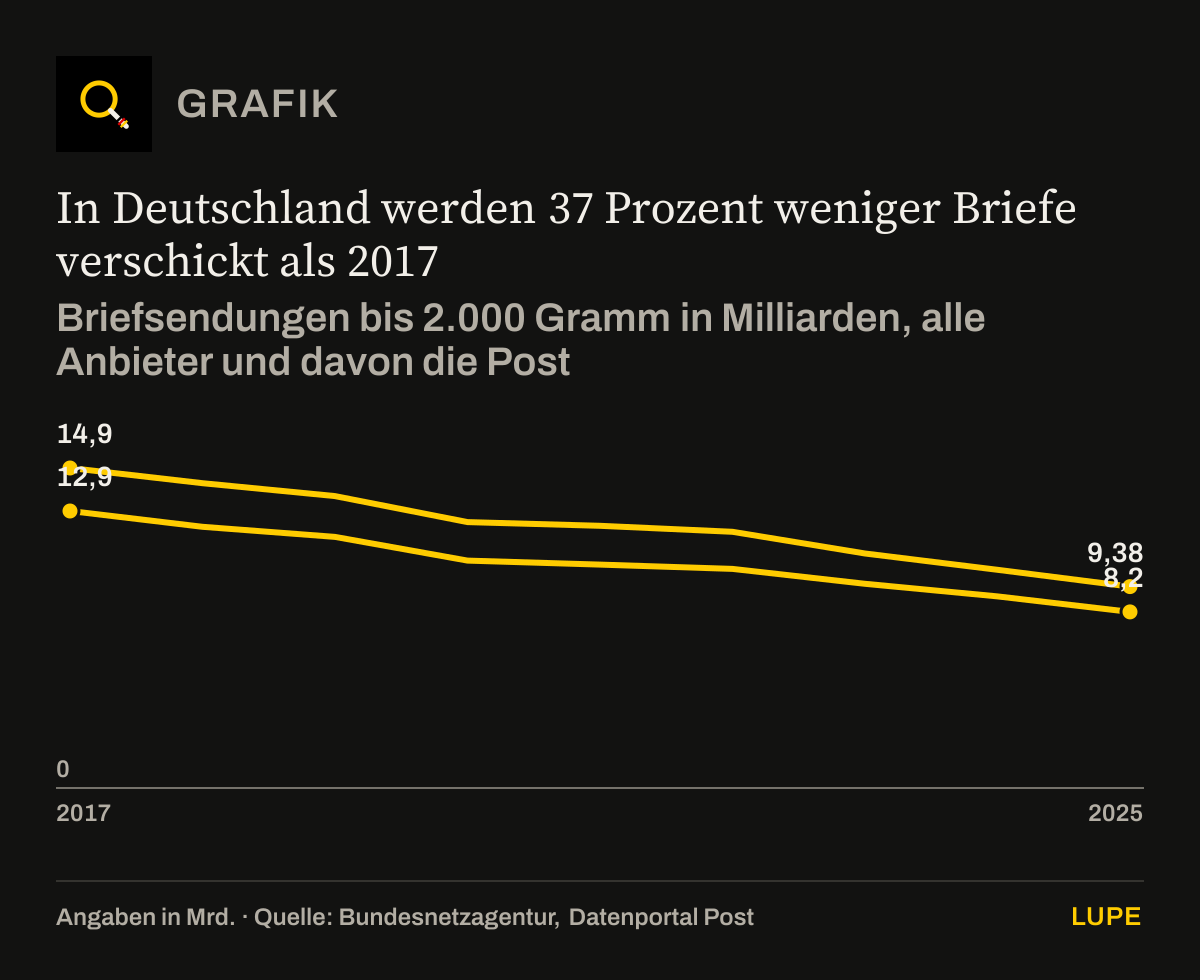
Show data table9 rows
| All providers (bn) | of those Deutsche Post (bn) | |
|---|---|---|
| 2017 | 14.9 | 12.9 |
| 2018 | 14.19 | 12.16 |
| 2019 | 13.59 | 11.69 |
| 2020 | 12.38 | 10.59 |
| 2021 | 12.21 | 10.4 |
| 2022 | 11.93 | 10.2 |
| 2023 | 10.92 | 9.51 |
| 2024 | 10.16 | 8.92 |
| 2025 | 9.38 | 8.2 |
But behind the volumes too stands the state. The Federal Network Agency names as a reason not only digitalisation but expressly the obligation to use electronic invoices, which applies to companies from 2028.[6] That is politically intended and sensible in itself. But the bill stays with those who still have to or want to write letters: anyone sending fewer letters pays more for each one.
Postage for the standard letter has more than doubled since 2012
Price for a standard letter up to 20 grams within Germany, in euros
Sources: Federal Network Agency[2][3][4][5], Deutsche Post[1]. Chart redrawn from the figures in the text.
Limits of the data: Price at the end of each year; 0.80 euros has applied since 1 July 2019. 2027: planned price from 1 January, not yet approved.
Download the chart as an image (PNG)
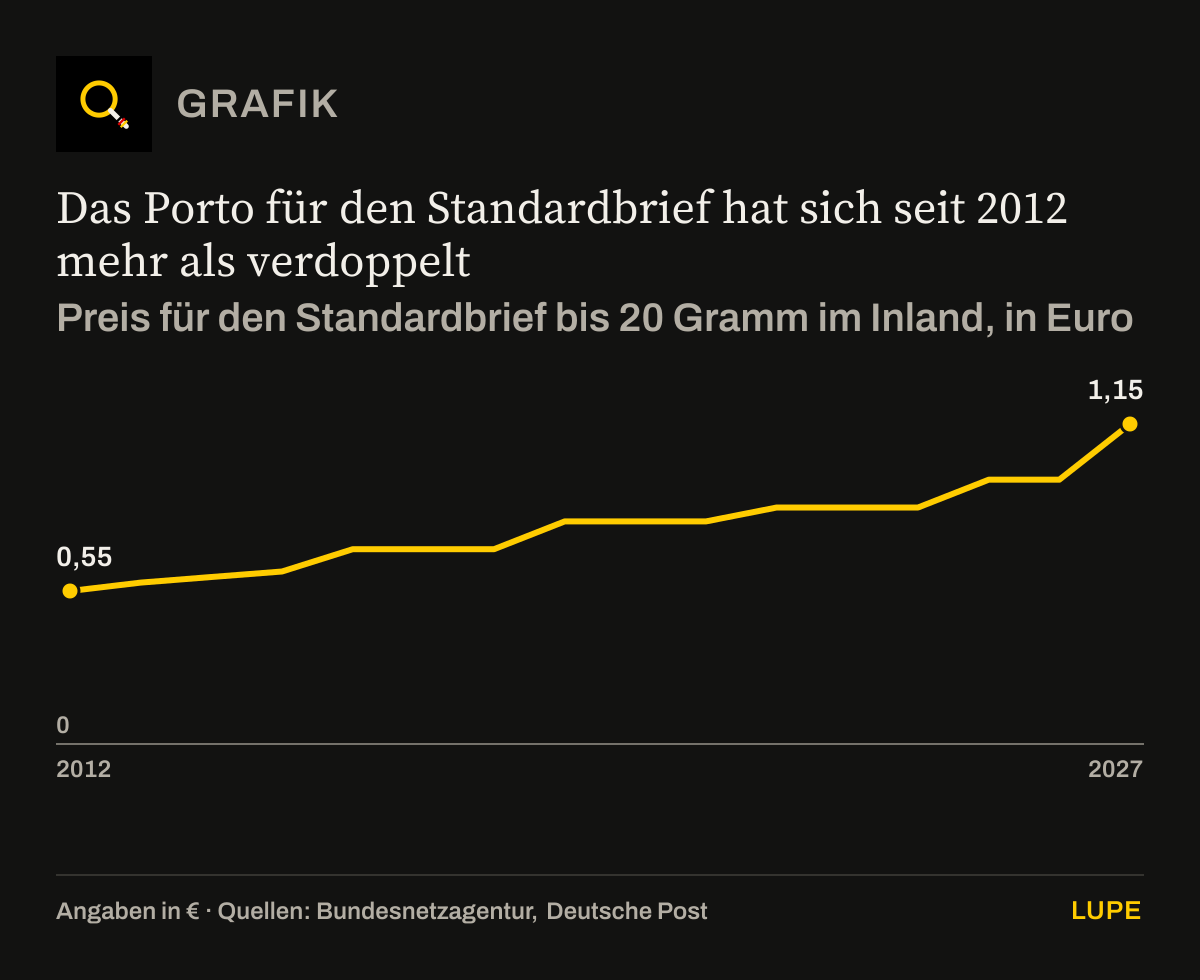
Show data table16 rows
| Standard letter (€) | |
|---|---|
| 2012 | 0.55 |
| 2013 | 0.58 |
| 2014 | 0.6 |
| 2015 | 0.62 |
| 2016 | 0.7 |
| 2017 | 0.7 |
| 2018 | 0.7 |
| 2019 | 0.8 |
| 2020 | 0.8 |
| 2021 | 0.8 |
| 2022 | 0.85 |
| 2023 | 0.85 |
| 2024 | 0.85 |
| 2025 | 0.95 |
| 2026 | 0.95 |
| 2027 | 1.15 |
Where the state does the arithmetic
How much a letter may cost is not decided by Deutsche Post alone. The Federal Network Agency calculates it, under the postal act that the Bundestag recast in 2024. That act says a profit mark-up is to be included, measured against the risk-adjusted average of the return on sales of the companies in a European share index over ten years. Costs arising solely for ecologically sustainable delivery count as efficient from the outset under the act.[9] The monopolies commission calls this one of the federal government’s “generous provisions”: the profit mark-ups are oriented “to the returns on sales of, among others, Ferrari, L’Oréal and Adidas rather than to market-standard returns on capital”.[10]
The act also requires the burdens from the era of the Deutsche Bundespost to be taken appropriately into account.[9] The Federal Network Agency therefore recognises all the staff, social and pension burdens that Deutsche Post bears as legal successor to the Bundespost.[6] Put differently: burdens from the era of the state postal service are paid for today by letter customers, through the stamp.
On top come costs the state imposes on all businesses. The CO₂ price on fuels stood at 55 euros per tonne in 2025. Since 2026 it has been auctioned in a corridor of 55 to 65 euros, and that stays in 2027; the Bundestag decided this on 15 October.[11] At 65 euros per tonne it accounts for around 20 cents per litre of diesel, including VAT.[12] Since December 2023 the lorry toll has contained a CO₂ surcharge of 200 euros per tonne of CO₂, and since July 2024 it has applied to lorries from 3.5 tonnes.[13] In its parcel business Deutsche Post passes both on openly: business customers pay a “toll and CO₂ surcharge” of 19 cents per parcel.[14]
And the wage floor is rising. In 2022 the previous coalition raised the statutory minimum wage by act from 10.45 to 12 euros. The minimum wage commission then set 12.41 and 12.82 euros, and on 1 January 2026 13.90 and on 1 January 2027 14.60 euros.[15][16] The coalition agreement of the Union and the SPD had called 15 euros “achievable” for 2026.[17] Deutsche Post pays under a collective agreement of its own with ver.di; it expires at the end of 2026.[18] Anyone raising the floor politically year after year also raises the expectations above it in every round of bargaining.
What reaches the citizen
Deutsche Post reckons on around 75 cents of extra cost a month for a household.[8] That sounds like little, and for the inflation rate on its own postage is indeed insignificant. But it shows in miniature how things run on a large scale: the state promises relief, and at the same time the costs it sets itself are rising – the CO₂ price, the toll, the wage floor, obligations to digitalise, profit mark-ups and legacy burdens in regulated prices. Every step can be explained on its own. Together they land on the citizen: at the letterbox, at the parcel, at the filling station.
How strongly the state as a whole is growing and what that costs is set out in the commentary „Der Staat wächst. Die Rechnung zahlen wir.“.
The editorial team’s assessment
The Federal Network Agency explains the largest part of the rise by the fall in letter volumes. Neither Deutsche Post nor the Federal Network Agency names the minimum wage, the CO₂ price or the toll as a reason for letter postage.[6][8] Deutsche Post levies the toll and CO₂ surcharge in its parcel business on business customers, not on letter postage.[14] Delivery vehicles up to 3.5 tonnes are not subject to the toll.[13] By its own account the Federal Network Agency stayed below Deutsche Post’s demands and did not recognise several of the costs claimed.[6]
The EU packaging regulation does not affect letter postage. Envelopes containing letters, invoices and other correspondence do not count as packaging under the EU Commission’s guidance; that is how the association of European postal operators reports it.[19] For parcels the obligations fall on the sender who fills the packaging.
For the inflation rate postage hardly matters. In the harmonised consumer price index for Germany, postal services have a weight of 1.89 per mille.[20] Even if all of them became 21 per cent more expensive, inflation would rise by around 0.04 percentage points. In September 2026 it stood at 3.3 per cent.[21]
In 2025 the Post & Parcel Germany division achieved earnings before interest and taxes of 1.03 billion euros, 5.8 per cent of turnover.[22]
METHOD
Method
Changes in per cent: new price divided by previous price, rounded. Standard letter 1.15 ÷ 0.95 = 1.211, that is +21 per cent. Against 2012: 1.15 ÷ 0.55 = 2.09, that is +109 per cent.
Maxi letter up to 2,000 grams previously: 2.90 euros plus a 2.20 euro surcharge for 1,001 to 2,000 grams, together 5.10 euros. For international post, up to 500 grams the previous large letter is compared with the future midi letter, and up to 1,000 grams the previous maxi letter with the future large letter.
Letter volumes: 9.38 ÷ 14.9 = 0.63, that is 37 per cent less.
Contribution to inflation, our own rough calculation: a weight of 1.89 per mille for postal services in the harmonised consumer price index for 2025 × 21 per cent = 0.040 percentage points. That is an upper limit, because registered letters and parcels do not rise by 21 per cent.
Legal status 21 October 2026: the prices are announced, and the Federal Network Agency’s price framework is a draft. The CO₂ price corridor for 2027 has been adopted by the Bundestag; the Bundesrat has not yet concluded its deliberations.
CHECK
What was checked before publication
- All the prices were checked on 21 October 2026 against Deutsche Post’s overview of the 2027 changes (source 1). They are subject to approval by the Federal Network Agency; its price framework is so far available only as a draft of 12 October 2026 (source 6). Deutsche Post’s subheading saying that the Federal Network Agency has given “the green light” goes beyond that position.
- Deutsche Post’s press release of 20 October 2026 was not directly accessible; its wording has been checked via a verbatim reproduction and the dpa report.
- Not taken over, because not documented: that the minimum wage, the CO₂ price, the road toll or the EU packaging regulation cause letter postage. Neither Deutsche Post nor the Federal Network Agency names them as a reason. The text presents them as costs the state imposes on all businesses; the assessment at the end says what is documented.
- For the large letter and the maxi letter, the weight and height change along with the prices. The table therefore compares the same weight steps, not merely the same names.
- The price for a post office box and the “Wert International” surcharge are not named in Deutsche Post’s figures for 2027 and therefore do not appear in the table. The letter volume for 2025 was published by the Federal Network Agency in December 2025; it is presumably an estimate.
SOURCES
Sources
Every number in the text leads to its source. The origin is given at each entry: official, media report, trade association, institute or data portal. Titles stay in the original language, so that each document can still be found.
[1] Deutsche Post, abgerufen 21.10.2026
Änderungen zum 1. Januar 2027: Porto und Produkte (Preise vorbehaltlich der Genehmigung durch die Bundesnetzagentur)Institute or public body↑ back to the text
[2] Bundesnetzagentur, abgerufen 21.10.2026
Historie der Bundesnetzagentur (Standardbrief ab Januar 2003: 55 Cent)Official source↑ back to the text
[3] Bundesnetzagentur, 2019
Tätigkeitsbericht Post 2018/2019 (Tabelle 5: Entwicklung des Portos für den Standardbrief)Official source↑ back to the text
[4] Bundesnetzagentur, 10.12.2021
Neue Briefporti ab 2022 (Pressemitteilung)Official source↑ back to the text
[5] Bundesnetzagentur, 11.12.2024
Genehmigung der Briefporti ab 2025 (Pressemitteilung: Standardbrief 0,95 Euro, bisher 0,85 Euro)Official source↑ back to the text
[6] Bundesnetzagentur, 12.10.2026
Bundesnetzagentur veröffentlicht geplanten Spielraum für Porti (Pressemitteilung zum Entwurf der Price-Cap-Maßgrößenentscheidung ab 2027)Official source↑ back to the text
[7] Bundesnetzagentur, Stand 08.12.2025
Datenportal Post: Sendungsmengen im Briefbereich 2017 bis 2025Official source↑ back to the text
[8] Deutsche Post / DHL Group, 20.10.2026
Deutsche Post AG passt Briefporto und Produkte zum 1. Januar 2027 an (Pressemitteilung)Institute or public body↑ back to the text
[9] Bundesministerium der Justiz
Postgesetz vom 15. Juli 2024, § 44 (Gewinnzuschlag, Berücksichtigung der Lasten)Official source↑ back to the text
[10] Monopolkommission, 10.12.2025
Monopolkommission warnt: Umsatzsteuer-Privileg für Deutsche Post könnte Wettbewerber verdrängen (Pressemitteilung)Official source↑ back to the text
[11] Deutscher Bundestag, 15.10.2026
Brennstoffemissionshandelsgesetz: Preiskorridor auch 2027 (Textarchiv, namentliche Abstimmung)Official source↑ back to the text
[12] ADAC, 26.08.2026
CO₂-Preis: Was er für Benzin, Diesel und Heizöl bedeutetTrade association↑ back to the text
[13] Bundesregierung
Lkw-Maut mit CO₂-Aufschlag und Ausweitung auf Lkw über 3,5 TonnenOfficial source↑ back to the text
[14] DHL Paket, abgerufen 21.10.2026
Zuschläge für Geschäftskunden (Maut- und CO₂-Zuschlag)Institute or public body↑ back to the text
[15] Bundesministerium für Arbeit und Soziales, abgerufen 21.10.2026
Einführung und Anpassungen des MindestlohnsOfficial source↑ back to the text
[16] Bundesministerium der Justiz, 05.11.2025
Fünfte Verordnung zur Anpassung der Höhe des Mindestlohns (MiLoV5), § 1Official source↑ back to the text
[17] Deutscher Bundestag, 28.08.2025
Drucksache 21/1403: Antwort der Bundesregierung (mit dem Satz des Koalitionsvertrags zum Mindestlohn)Official source↑ back to the text
[18] ver.di, 04.03.2025
Tarifeinigung bei der Deutschen Post AG (Pressemitteilung: plus 2 Prozent ab April 2025, plus 3 Prozent ab April 2026, Laufzeit bis 31.12.2026)Trade association↑ back to the text
[19] PostEurop, 17.07.2026
Joint industry statement on the status of communication items under Regulation (EU) 2025/40 (PPWR)Trade association↑ back to the text
[20] Eurostat, abgerufen 21.10.2026
HVPI – Gewichte der Indizes, Deutschland, Postdienste (CP081): 1,89 Promille 2025Data portal↑ back to the text
[21] Statistisches Bundesamt (Destatis), 13.10.2026
Inflationsrate im September 2026 bei +3,3 % (Pressemitteilung Nr. 364)Official source↑ back to the text
[22] DHL Group, 05.03.2026
Geschäftsbericht 2025: Unternehmensbereich Post & Paket DeutschlandInstitute or public body↑ back to the text
CORRECTIONS
Corrections
No corrections since publication on 21/10/2026. Every substantive change appears here with its date, reason and previous wording.
This page is opinion. Our fact checks are not.