OPINIONESSAYTAX ON SUGARY DRINKS
The tax that refutes itself
How a health idea became a source of revenue, and a source of revenue a bureaucracy monster
By Andreas W. Herb, CEO MBG Group, Paderborn
15 minutes read28 sources1 correctionDisclosure
Share
Contents and Documents
There are laws that solve a problem. There are laws that postpone a problem. And there are laws that reach their own goal only if they fail. The sugar tax that the federal finance ministry wants to introduce on 1 July 2027 belongs in the third category.[7] It is supposed to bring Germans to drink less sugar, and at the same time to bring in more money every year. Both at once is impossible. Anyone promising the one while planning on the other has to accept the question of what they are actually after.
I am not writing this text as an opponent of less sugar. In our group of companies we are reformulating recipes, we are expanding our sugar-free range, and we are doing it because our customers want it, not because a ministry demands it. I am writing this text because as an entrepreneur I see what a law means when it comes out of the conference room and into the warehouse. And because in this case nobody in that conference room seems ever to have seen a warehouse from the inside.
I. Ten professors and an empty chair
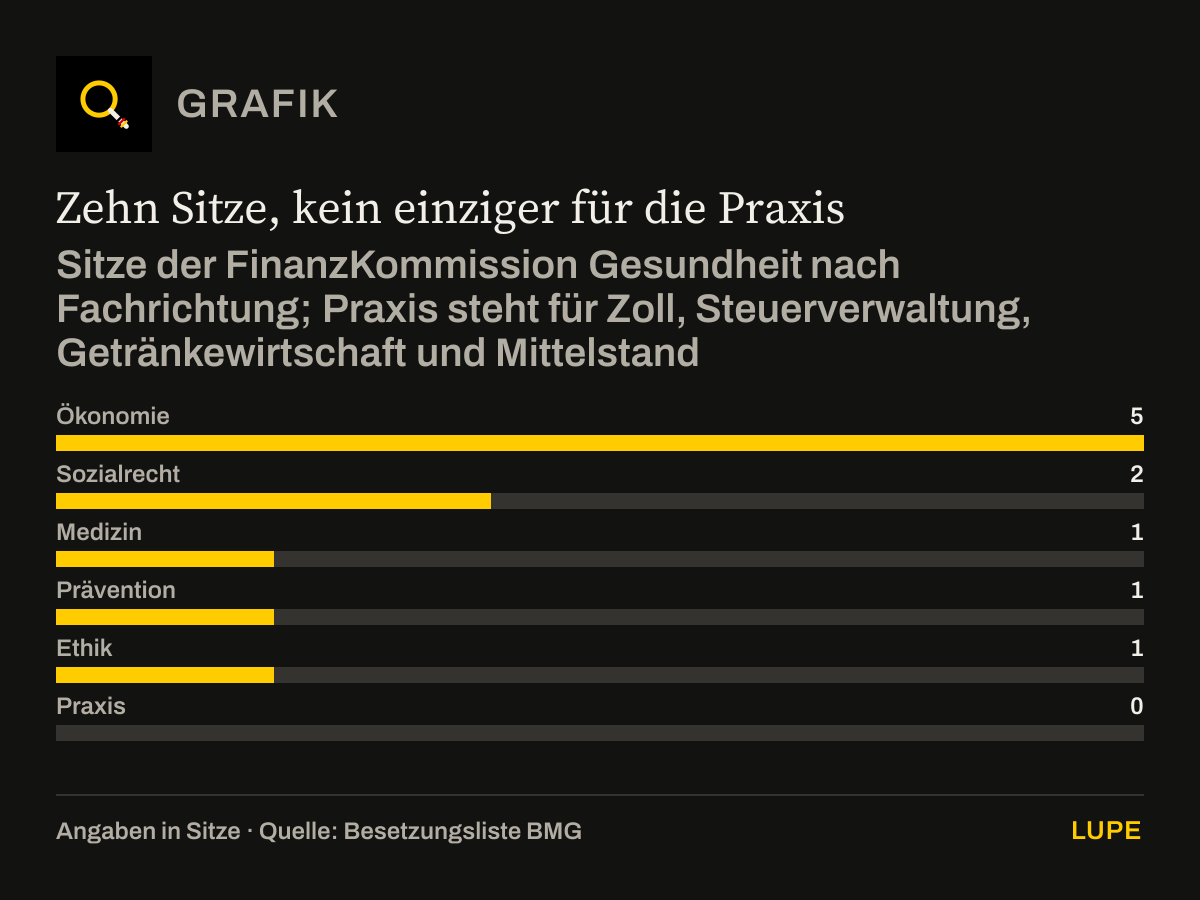
At the beginning there was a commission. In September 2025 federal health minister Nina Warken appointed the health finance commission. Its remit: proposals on how the contribution rates of statutory health insurance can be stabilised in the long term.[1] An honourable aim, an urgent task. Ten professors were appointed: five from economics, two from social law, and one each for medicine, prevention and ethics.[2]
One need not dispute these people’s expertise. They are recognised specialists in their disciplines. But one has to look at what is missing. On this commission there was nobody from customs, which is supposed to collect the tax. Nobody from the tax administration. Nobody who has ever run a duty warehouse, filled in an excise duty return or accompanied an external inspection. Nobody from the drinks industry. Nobody from small and medium-sized business.[2]
Macroeconomics is not business management. An economic model knows price elasticities, but no storage bays. It knows falls in consumption, but no ERP interface. It knows tax revenue, but no customs officer standing at the door on a Tuesday morning wanting to see the stock records. You can design a tax at a seminar table. You have to collect it in 2,500 businesses.[16]
Ten seats, not one for practice
Seats on the health finance commission by discipline; practice stands for customs, the tax administration, the drinks industry and small and medium-sized business
Source: BMG membership list[2]. Chart redrawn from the figures in the text.
Download the chart as an image (PNG)
Show data table6 rows
| Seats | |
|---|---|
| Economics | 5 |
| Social law | 2 |
| Medicine | 1 |
| Prevention | 1 |
| Ethics | 1 |
| Practice | 0 |
In March 2026 the commission presented a report with 66 recommendations.[3] The sugar tax is recommendation number 66, the last on the list. Its expected contribution: 0.1 billion euros in 2027 and 0.5 billion euros in 2030.[21] In an overall package with a financial effect of 42.3 billion euros it was a footnote.[3] Within half a year that footnote has become a billion-euro project of the finance minister.
II. A health commission, a finance minister and a hole in the budget
The commission had a clear idea: the additional revenue from the sugar tax should benefit statutory health insurance.[3] That was the logic of a health commission. Whoever makes people ill should contribute to financing the health system. One can argue about it, but it is a self-contained idea.
Then the subject changed department. On 29 April 2026 the federal cabinet adopted the benchmarks for the 2027 federal budget and the financial plan up to 2030. The sugar levy appears in it, as one of several consolidation measures.[4] Consolidation is a polite word for plugging holes in the budget. A prevention measure became an item of revenue.
Since then the lead has lain not with the health ministry but with the federal finance ministry under Lars Klingbeil. And with the change of department it was not only responsibility that changed. The scale changed.
| Health finance commission | Finance ministry’s draft | |
|---|---|---|
| Tax bands | 2 bands: 26 and 32 cents per litre[5] | 3 bands: 26, 32 and 38 cents per litre[7] |
| Expected revenue | around €450m a year[4] | around €1.2bn a year from 2028[8] |
| Lead time | around 12 months between decision and start[4] | start 1 July 2027, around 9 months after the draft became known[7] |
| Original start date | from 2028 according to the budget benchmarks[4] | brought forward to mid-2027[7] |
So the revenue expectation has almost tripled. The tax bands have grown, the lead time has shrunk. According to media reports the tax is also designed so that the costs are passed on to consumers.[8] The commission additionally wanted the level of the tax adjusted for inflation every year.[6] A tax that rises automatically is not steering. It is a subscription.
III. The paradox: less consumption, more money
Here lies the heart of the matter, and it is so simple that one could almost overlook it. A steering tax has a single purpose: it is supposed to change behaviour. If it works, people buy less of the taxed product, or manufacturers change their recipes until the product no longer falls under the tax. In both cases the revenue falls. A successful steering tax abolishes itself.
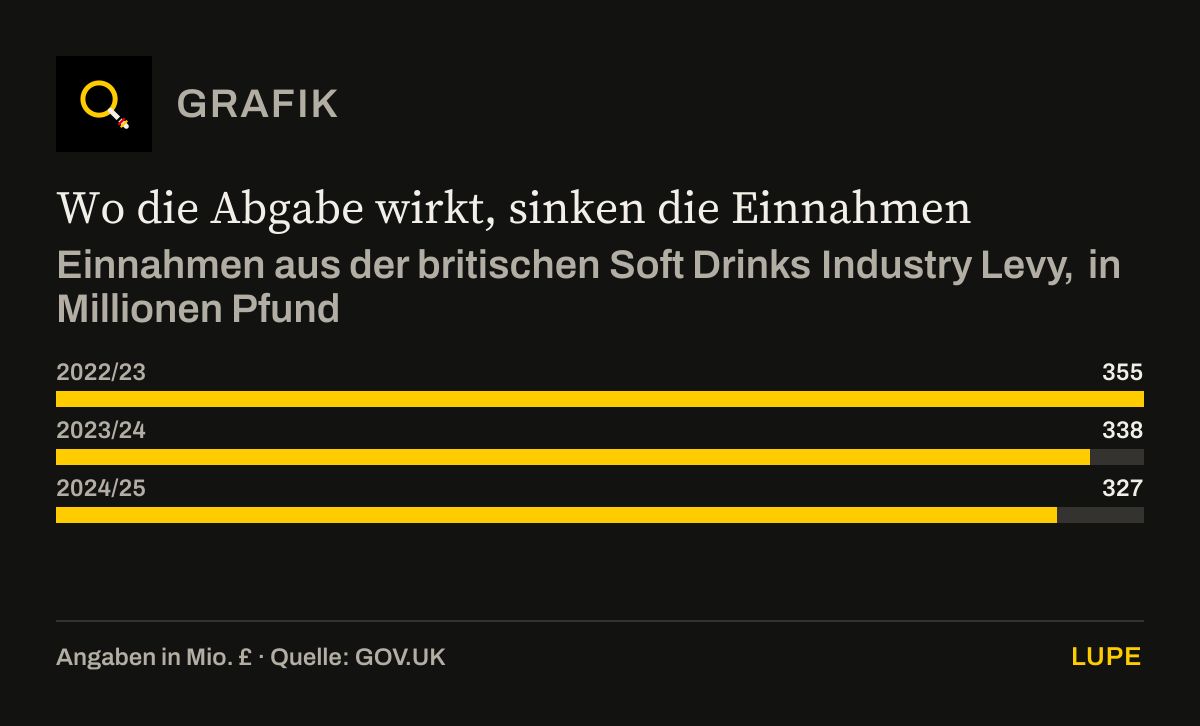
That is not theory. The United Kingdom has shown it, and the commission expressly invokes that example.[4] There around 65 per cent of drinks with more than 5 grams of sugar per 100 millilitres were reformulated to values below that; by now 89 per cent of the market lies below that threshold.[18] The consequence: the revenue is falling. From 355 million pounds in the 2022/23 financial year through 338 million to 327 million pounds in 2024/25.[17]
Where the levy works, the revenue falls
Revenue from the British Soft Drinks Industry Levy, in millions of pounds
Source: GOV.UK[17]. Chart redrawn from the figures in the text.
Download the chart as an image (PNG)
Show data table3 rows
| Revenue (£m) | |
|---|---|
| 2022/23 | 355 |
| 2023/24 | 338 |
| 2024/25 | 327 |
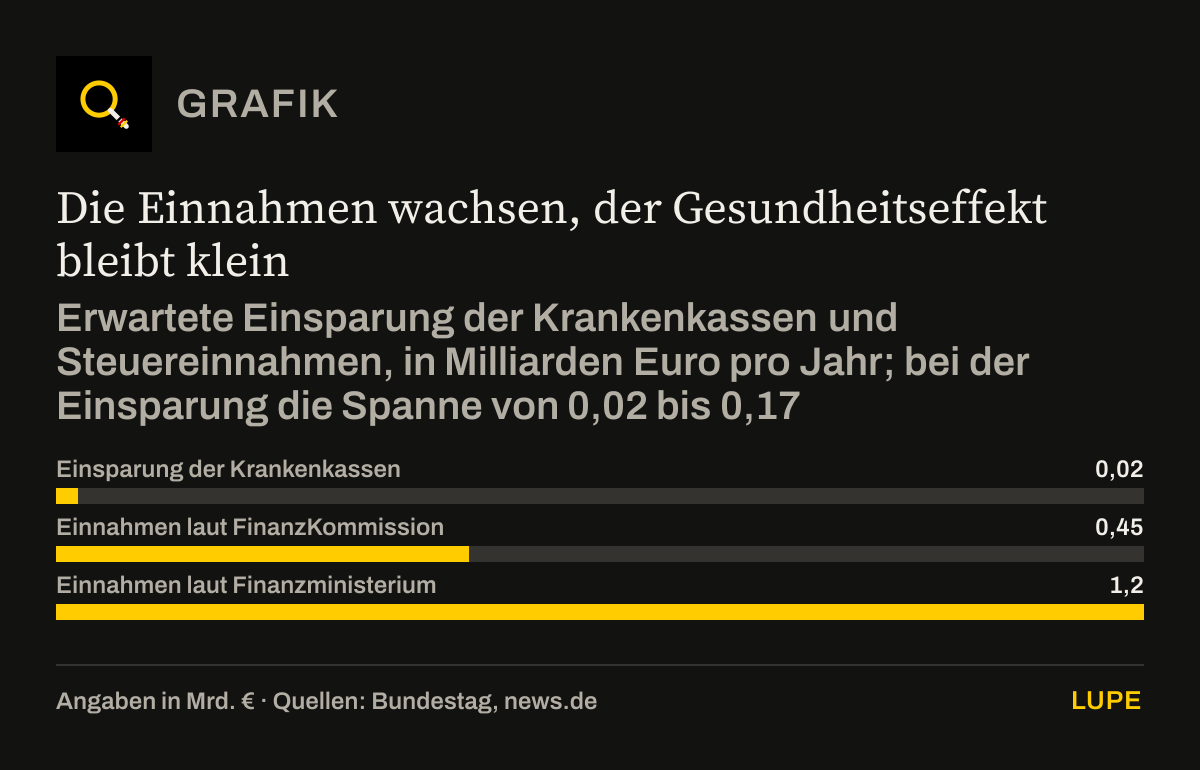
And in Germany? The commission reckons on revenue rising from 0.1 billion euros to 0.5 billion euros.[21] The finance ministry reckons on 1.2 billion euros a year.[8] The health effect, by contrast, the commission itself puts at a saving of 20 to 170 million euros a year for the health insurance funds, and only in the medium to long term.[4]
The revenue grows, the health effect stays small
Expected saving for the health insurance funds and tax revenue, in billions of euros a year; for the saving the range from 0.02 to 0.17
- Value or lower limit
- Upper limit
Sources: Bundestag[4], news.de[8]. Chart redrawn from the figures in the text.
Download the chart as an image (PNG)
Show data table3 rows
| Value or lower limit (€bn) | Upper limit (€bn) | |
|---|---|---|
| Saving for the health insurance funds | 0.02 | 0.17 |
| Revenue according to the finance commission | 0.45 | – |
| Revenue according to the finance ministry | 1.2 | – |
Anyone planning on rising revenue either does not believe in their own steering effect, or they simply need the money. In the first case the health justification is a pretext. In the second case too. I therefore put a simple question to the federal finance minister: is this about health, or is it about the budget?
And yet in Germany what the tax is supposed to force is long since happening. The federal government’s Max Rubner Institute measures regularly how much sugar is in the best-selling soft drinks. Weighted by sales volume, the content fell from 6.2 grams per 100 millilitres in 2018 to 5.3 grams in 2024.[22] That is almost 15 per cent less.[25] There was no sugar tax during that period. In fairness this belongs here too: the fall came almost entirely in the first year, and the institute points out that part of the difference may be due to method, because the first survey covered a smaller part of the market.[22]
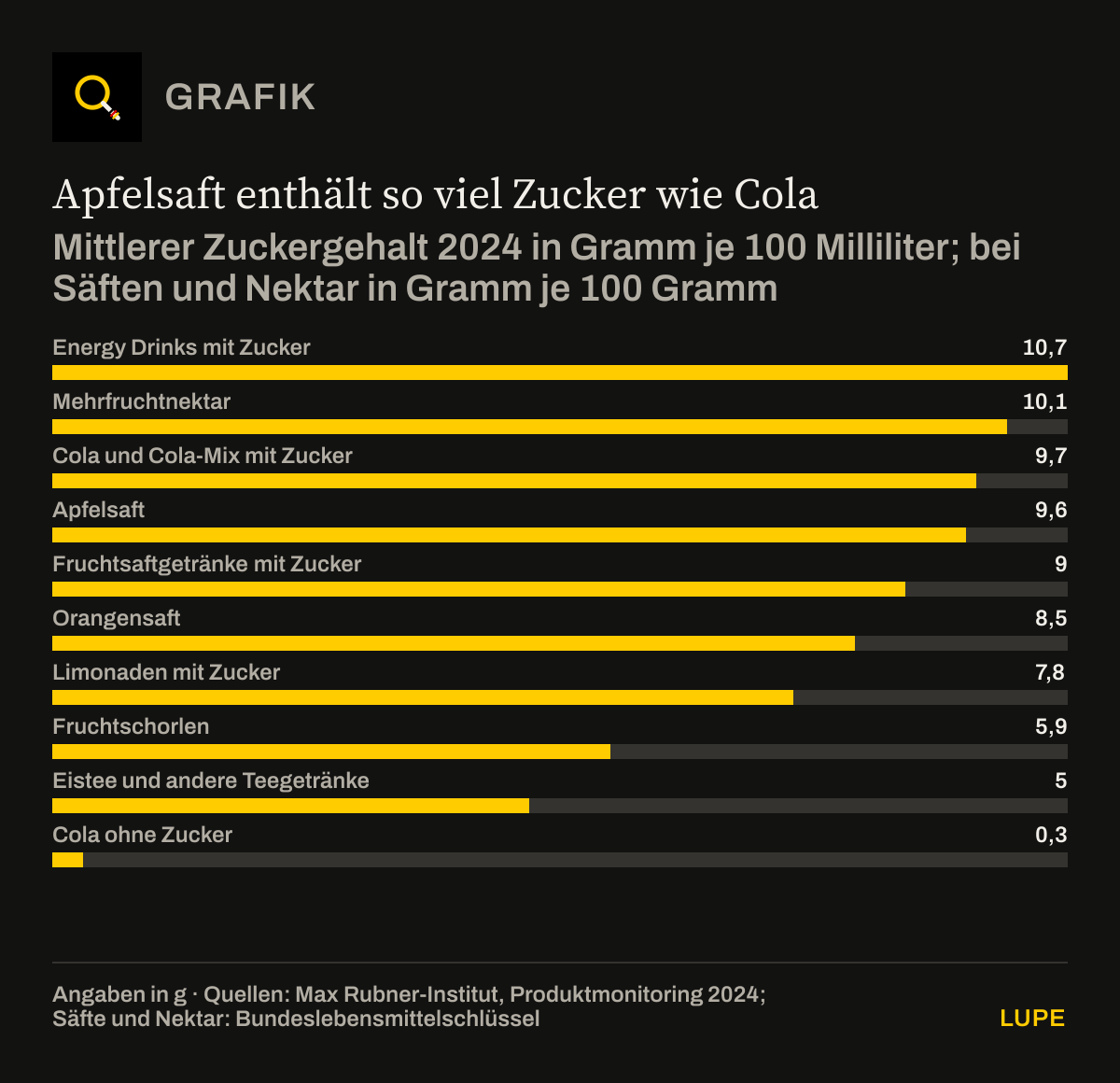
Apple juice contains as much sugar as cola
Mean sugar content in 2024 in grams per 100 millilitres; for juices and nectar in grams per 100 grams
Sources: Max Rubner Institute, product monitoring 2024[22]; juices and nectar: German nutrient database[23]. Chart redrawn from the figures in the text.
Limits of the data: Soft drinks: mean of the best-selling products weighted by sales volume. Juices and nectar: sum of glucose, fructose and sucrose per 100 grams; a litre of juice weighs somewhat more than a kilogram, so the value per 100 millilitres is somewhat higher
Download the chart as an image (PNG)
Show data table10 rows
| Sugar (g) | |
|---|---|
| Energy drinks with sugar | 10.7 |
| Multi-fruit nectar | 10.1 |
| Cola and cola mixes with sugar | 9.7 |
| Apple juice | 9.6 |
| Fruit juice drinks with sugar | 9 |
| Orange juice | 8.5 |
| Lemonades with sugar | 7.8 |
| Fruit spritzers | 5.9 |
| Iced tea and other tea drinks | 5 |
| Cola without sugar | 0.3 |
The comparison also shows where sugar sits that hardly anyone talks about. Apple juice naturally contains about as much sugar as cola, and orange juice barely less.[22][23] Even so, the finance commission recommends exempting pure fruit juices, and likewise drinks consisting only of juice and water.[26] The federal government says it is guided by this recommendation.[27] According to media reports the finance ministry’s draft also leaves pure juices and spritzers without added sugar untaxed.[28] So the tax asks not only how much sugar is in the glass, but also where it comes from.
A second figure belongs to the truth. According to provisional figures, in the 2024/25 marketing year sugar factories and traders sold around 513,000 tonnes of sugar to the makers of soft drinks, fruit juice and fruit wine. That is a good 2 per cent more than the year before. Five of the six other food sectors that the statistics report bought less, the makers of confectionery almost 10 per cent.[24]
The drinks sector buys slightly more sugar, almost all the others less
Sugar sold by sugar factories and trading companies to manufacturers in Germany, in thousands of tonnes; marketing year October to September, 2024/25 provisional
- 2023/24
- 2024/25
Source: Federal Office for Agriculture and Food[24]. Chart redrawn from the figures in the text.
Limits of the data: Sucrose in white sugar equivalent only, no glucose or fructose syrup. The statistics do not show the wine and sparkling wine or the beer and spirits sectors for 2024/25
Download the chart as an image (PNG)
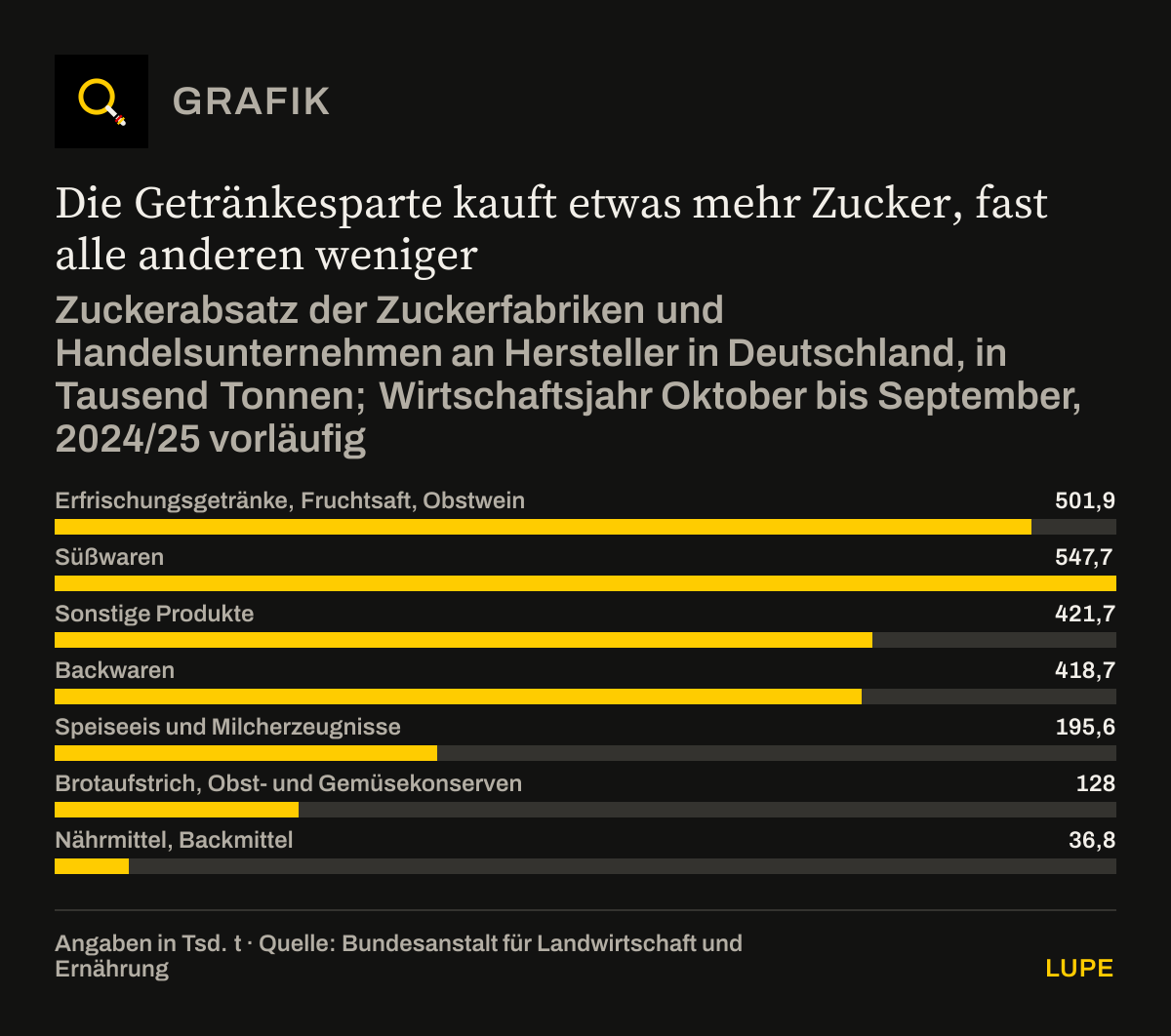
Show data table7 rows
| 2023/24 (k t) | 2024/25 (k t) | |
|---|---|---|
| Soft drinks, fruit juice, fruit wine | 501.9 | 512.8 |
| Confectionery | 547.7 | 495.1 |
| Other products | 421.7 | 427 |
| Bakery products | 418.7 | 393.3 |
| Ice cream and dairy products | 195.6 | 184.7 |
| Spreads, preserved fruit and vegetables | 128 | 125.9 |
| Cereal products, baking agents | 36.8 | 27.9 |
This figure measures manufacturers’ purchases, not the sugar in the glass. It covers only sucrose, that is ordinary sugar, no glucose or fructose syrup. Whether the drinks are consumed in Germany or exported it does not show.[24] Less sugar per litre and more sugar purchased therefore do not rule each other out. The drinks sector accounts for just under a quarter of the sugar that food manufacturers buy in this country. A good three quarters goes into confectionery, bakery products, dairy products and other foods.[24]
IV. The ministry’s arithmetic
Every law has to state what it costs citizens, business and administration. This is called compliance cost. The finance ministry’s draft puts it for the whole of business at around 940,000 euros one-off and around 2.3 million euros a year.[7] For the entire sector. For all manufacturers, bottlers, importers and the affected parts of the wholesale trade together.
How many businesses the ministry assumed is not public. Taking 1,000 companies affected, that leaves 940 euros per business, one-off, for everything. For the application for a duty warehouse authorisation. For recording the sugar content of every single article, including naturally occurring sugar. For reprogramming the merchandise management system, separating goods under duty suspension from taxed goods, the reporting system, training staff.
An IT day costs 1,500 to 2,000 euros in practice. With 940 euros a business therefore gets half a programming day. Ten to twenty are realistic. Dividing 940 euros by ten programming days, that is 80 hours, gives an hourly rate of 11.75 euros. The statutory minimum wage in 2027, the tax’s first year, is 14.60 euros.[13] With 2,000 businesses it would be 5.88 euros.
IT work below the minimum wage
Implied hourly rate at 10 programming days (80 hours) per business, in euros per hour
Own calculation based on the draft[7], minimum wage: federal government[13]. Chart redrawn from the figures in the text.
Download the chart as an image (PNG)
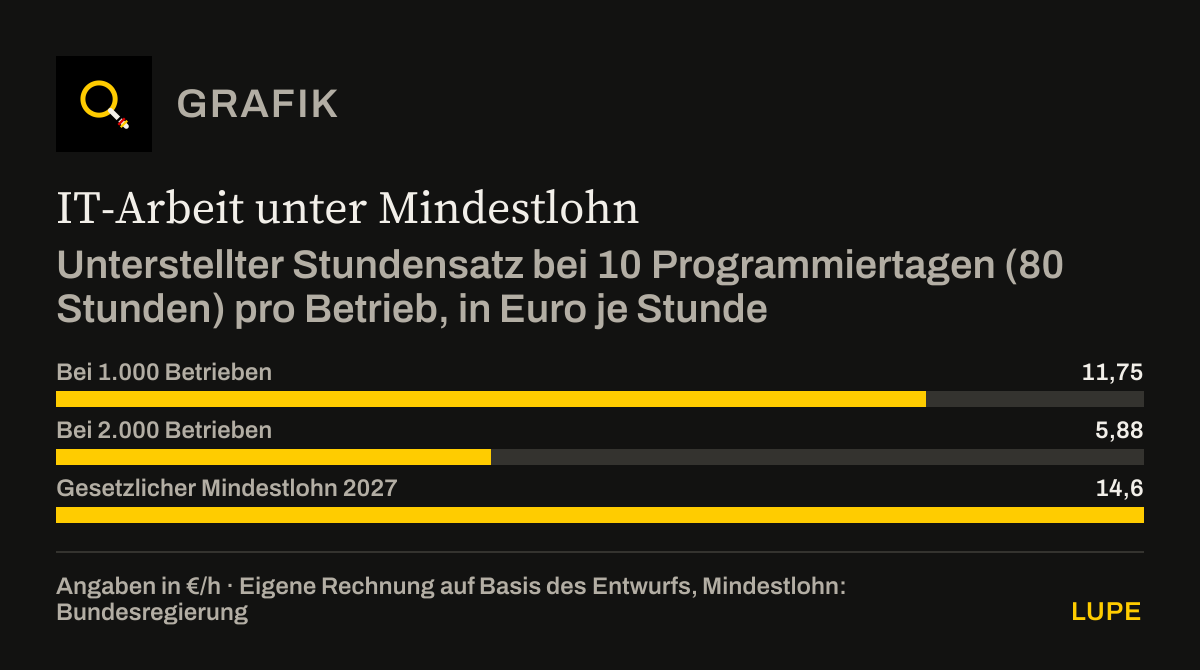
Show data table3 rows
| Euros per hour (€/h) | |
|---|---|
| With 1,000 businesses | 11.75 |
| With 2,000 businesses | 5.88 |
| Statutory minimum wage 2027 | 14.6 |
As soon as more than around 800 companies are affected, the ministry’s arithmetic effectively assumes IT work below the minimum wage. Either nobody in this ministry has ever seen an ERP system from the inside, or they know IT service providers who work below the minimum wage. A third explanation does not occur to me.
By our own estimate the switch costs 18,000 to 45,000 euros per business as a one-off: 15,000 to 40,000 euros for IT and 3,000 to 5,000 euros for the application, the documentation and liaison with the main customs office. Scaled up to 1,000 businesses that is 18 to 45 million euros, and to 2,000 businesses 36 to 90 million euros. That is 19 to 96 times what the draft budgets for.
Up to 96 times more expensive than budgeted
One-off cost to business of the switch, in millions of euros
- Value or lower limit
- Upper limit
Draft[7] and MBG estimate. Chart redrawn from the figures in the text.
Download the chart as an image (PNG)
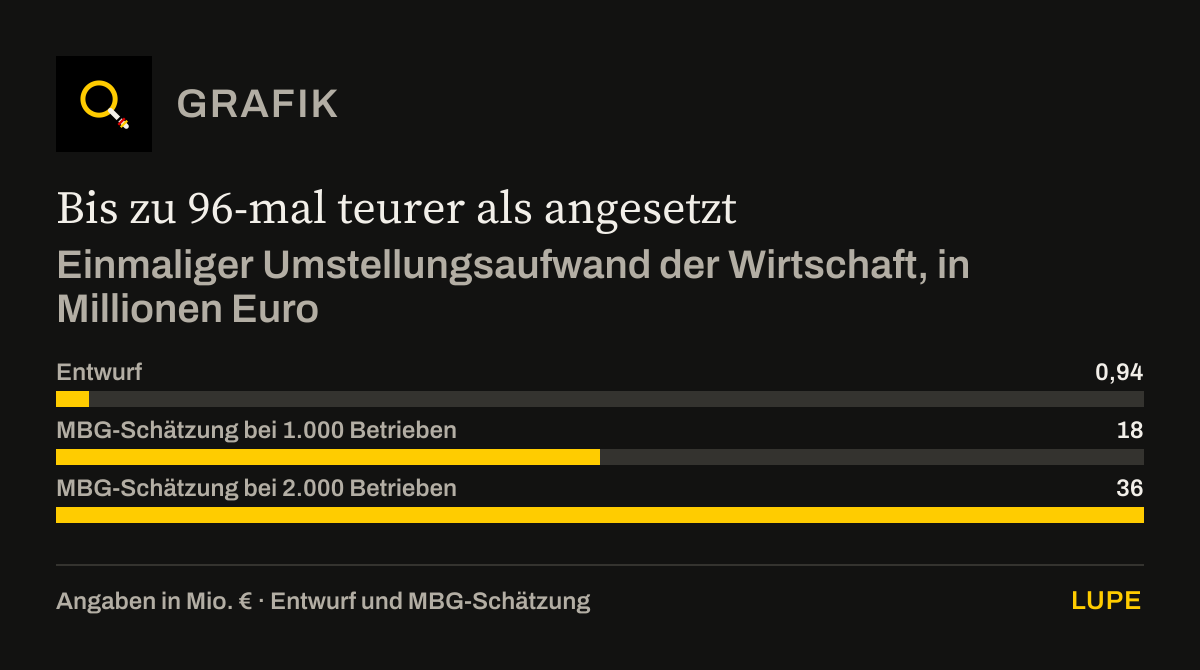
Show data table3 rows
| Value or lower limit (€m) | Upper limit (€m) | |
|---|---|---|
| Draft | 0.94 | – |
| MBG estimate with 1,000 businesses | 18 | 45 |
| MBG estimate with 2,000 businesses | 36 | 90 |
V. For itself the state calculates generously
It is striking how differently the ministry calculates depending on who pays. For its own apparatus the draft provides for 200 additional posts at customs and 23 at the federal IT service provider. The costs for customs and IT come to around 89 million euros up to 2029.[8] Back in August the customs union had considered at least 300 additional posts necessary and warned of the next bureaucracy monster.[9]
To business the same draft allows around 6.7 million euros in total up to the end of 2029: 0.94 million one-off and 2.3 million a year from July 2027. So for its own administration the state allows itself a good thirteen times what it grants the entire drinks industry. Yet every single business has to build exactly the processes that customs then inspects.
For itself the state calculates generously
Budgeted cost up to the end of 2029, in millions of euros
Customs and IT: ministerial draft according to news.de[8]; business: own calculation based on the draft[7]. Chart redrawn from the figures in the text.
Download the chart as an image (PNG)
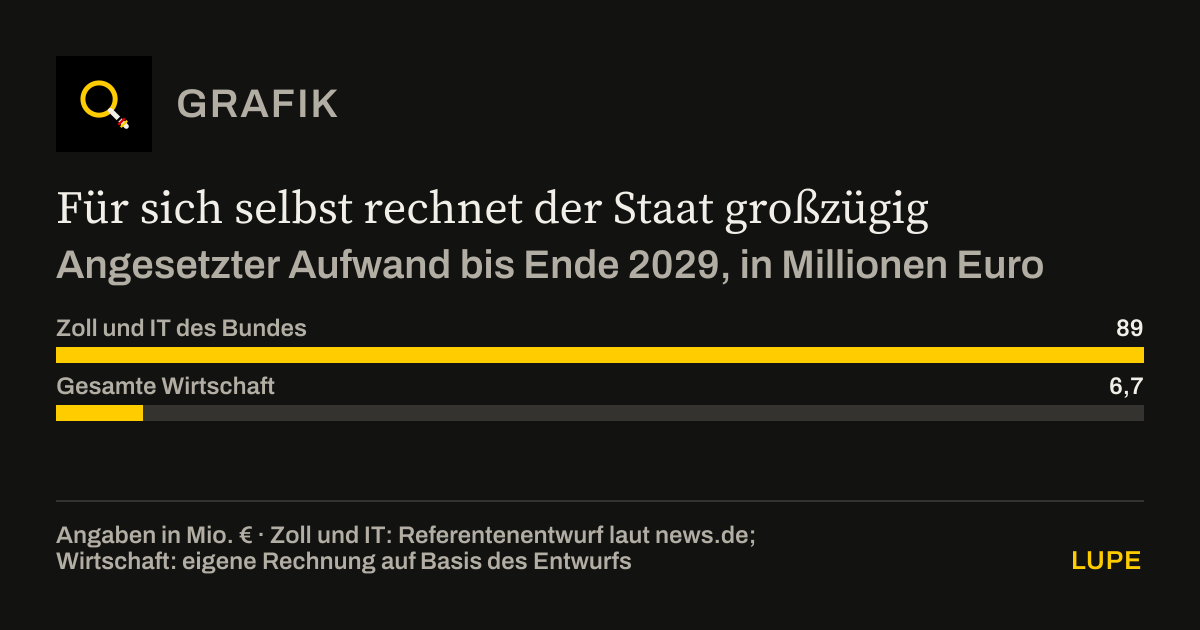
Show data table2 rows
| Cost up to the end of 2029 (€m) | |
|---|---|
| Customs and federal IT | 89 |
| The whole of business | 6.7 |
VI. The customs monster: what nobody at the table thought about
An excise duty is not a surcharge on an invoice. It is levied through duty warehouses. Goods are produced and stored under duty suspension, and the duty arises only when they leave the warehouse into free circulation.[7] That sounds technical, and it is technical. It means: authorisation procedures, tax returns, IT connections, payment monitoring and subsequent checks by tax supervision and inspection services.[9]
Customs may enter businesses during business hours, take stock, draw samples and inspect the books. Anyone who does not cooperate faces enforcement measures.[11] External inspections need no particular occasion; even a period already inspected can be inspected again.[12]
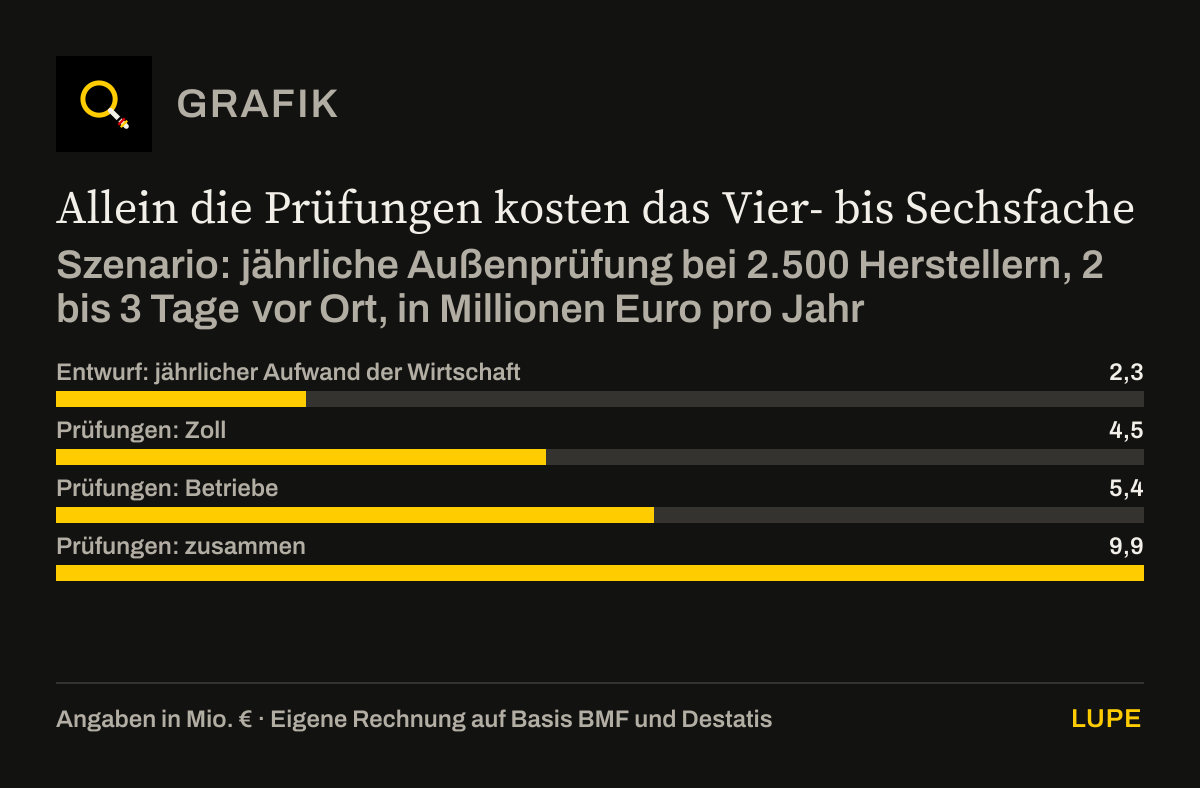
Let us work through a scenario, on our assumption: customs inspects each of the roughly 2,500 drinks manufacturers once a year, two to three days on site. With preparation and follow-up that gives 10,000 to 15,000 inspector days a year. At 194 working days per post, derived from the federal finance ministry’s staff cost rates, customs needs 52 to 78 full-time staff for it. At around 87,200 euros per post in the senior service including overheads, that is 4.5 to 6.8 million euros a year.[14]
And while customs inspects, the office stands still. Two employees accompany the inspection, plus two days of preparation. At average labour costs of 45 euros an hour[15] that costs 2,160 to 2,880 euros per inspection, and for the sector 5.4 to 7.2 million euros a year.
The inspections alone cost four to six times as much
Scenario: annual external inspection at 2,500 producers, 2 to 3 days on site, in millions of euros a year
- Value or lower limit
- Upper limit
Own calculation based on BMF[14] and Destatis[15]. Chart redrawn from the figures in the text.
Download the chart as an image (PNG)
Show data table4 rows
| Value or lower limit (€m) | Upper limit (€m) | |
|---|---|---|
| Draft: annual cost to business | 2.3 | – |
| Inspections: customs | 4.5 | 6.8 |
| Inspections: businesses | 5.4 | 7.2 |
| Inspections: together | 9.9 | 14 |
For the inspections alone, then, the state and business together face 9.9 to 14 million euros a year. That is four to six times the entire annual cost that the draft shows for business. Not yet included: the authorisation procedures, the tax returns, maintaining the sugar values, the questions of classification. Is a Fassbrause a beer mix? Is a malt drink taxable? The answer hangs on the customs tariff classification,[7] and every one of these questions will sooner or later land before a case officer, an objection or a tax court.
VII. A law at top speed
How little thought has gone into this project is shown not only by the cost calculation but also by the timetable. Programming an IT procedure at customs alone takes, in the customs union’s assessment, usually a year, and it can only begin once the text of the act is settled.[10] Until the planned start on 1 July 2027 there are nine months.
The ministry apparently knows this itself. The draft provides that duty warehouse authorisations for 2027 may be granted subject to revocation even without the documentation and other conditions laid down.[7] Imagine a company working that way: we authorise first, check later and revoke if need be. In the assessment of the German Brewers’ Association the tax would at first even have to run on paper, until the IT is ready.[7] A paper procedure, in 2027, in a country with a ministry of its own for digitalisation.
According to media reports the finance ministry gave the other federal ministries a full 24 hours for their comments on the draft. Several departments raised objections, and the procedure has been halted for now.[7] That is the first piece of good news in this story. It gives time to rethink the project fundamentally.
VIII. The promise of less bureaucracy
On 14 May 2025 Federal Chancellor Friedrich Merz stood before the German Bundestag and promised: “We will reduce the countless documentation, reporting and notification obligations quickly and noticeably.”[19] The coalition has set itself the aim of cutting the bureaucracy costs of business by 25 per cent, around 16 billion euros, and of reducing compliance cost by at least 10 billion euros. It has also discussed extending the “one in, one out” rule to new measures.[20] Every new burden is therefore to be offset by relief somewhere else.
The sugar tax is the exact opposite: new authorisations, new duty warehouses, new reporting obligations, new inspections, 223 new posts. I therefore ask the federal chancellor respectfully but plainly: does your promise still hold? And if so, where is the relief that offsets this new burden?
IX. What now has to happen
I have no problem with the state talking about sugar. I have a problem with it making a law whose costs it does not know, whose effect it itself rates as small, and whose revenue it nevertheless budgets firmly. I therefore demand five things before this law is pursued any further.
First: disclose the arithmetic. How many companies, what case numbers, what cost per case lie behind 940,000 euros? Second: have it recalculated independently. The national regulatory control council should examine the compliance cost with a practical test in real businesses. Third: bring practice to the table. Customs, the tax administration and the drinks industry belong on every body that deliberates on collecting an excise duty. Fourth: at least 18 months of lead time from the final text of the act and from customs IT ready for use, digital from day one, with no paper procedure and no authorisations subject to revocation. Fifth: honesty about the purpose. Anyone who wants a health tax has to devote the revenue to health and must not plan on growing revenue. Anyone who needs money for the budget should say so.
Epilogue: the sugar stays, the bureaucracy comes
The United Kingdom has shown that manufacturers respond when you give them time and clear rules. We are responding already, even without a tax. What this law adds is not less sugar. It is more administration: at customs, in the businesses and in the end on the consumer’s receipt.
Ten professors developed an idea, a finance minister turned it into a source of revenue, and 2,500 businesses are to implement it in nine months. Nobody at the table had ever done this work. The result is a tax that brings in its revenue only if it misses its health target. An enormous effort for alarmingly little.
Less sugar? We are on it. A new bureaucracy monster? No.
Andreas W. HerbCEO MBG Group, Paderborn
METHOD
Method
The figures from the bill come from media reports on the ministerial draft; the full original text was not available to us. Amounts per business, IT days, hourly rates and period comparisons are our own calculations based on the overall amounts named. The number of companies affected is not official; we therefore calculate with 1,000 and 2,000 businesses. IT day rates of 1,500 to 2,000 euros, 10 to 20 programming days, 3,000 to 5,000 euros for the application and the authorisation, and the scope of inspections, are estimates by the MBG Group from practice. The inspection scenario assumes an annual external inspection of every producer; the draft does not fix the actual frequency of inspections. In the comparison of the state and business the amounts come from different cost categories and are not fully equivalent. Legal status: draft in interdepartmental consultation, procedure halted for now; details may change.
On the addition to section III: the sugar contents of soft drinks are means of the best-selling products weighted by sales volume, from the product monitoring of the Max Rubner Institute. The values for juices and nectar come from the German nutrient database and relate to 100 grams. The sales figures of the Federal Office for Agriculture and Food for 2024/25 are provisional and rounded to the nearest hundred tonnes; changes and shares are our own calculations. For wine and sparkling wine as well as beer and spirits the statistics keep the 2024/25 values confidential; we do not derive them.
CHECK
What was checked before publication
- Every step of the arithmetic in the text has been recalculated and follows from the starting values named.
- The 21 sources were accessed on 4 October 2026 and checked against the text. In four places the linked source does not support the statement, or supports it only in part (sources 10, 14, 16 and 18); after checking, the author has kept the wording.
- According to the author the statements about the bill come from media reports on the ministerial draft, whose full text was not available (see Method).
- The charts have been redrawn from the figures in the text; the data tables below them contain the same values.
- On 10 October 2026 the author added figures on sugar in drinks to section III. Every value has been checked against the tables of the Max Rubner Institute and the Federal Office for Agriculture and Food, and the exemption for juices against the report of the health finance commission (sources 22 to 28). We know the finance ministry’s draft only from media reports.
SOURCES
Sources
Every number in the text leads to its source. The origin is given at each entry: official, media report, trade association, institute or data portal. Titles stay in the original language, so that each document can still be found.
[1] Bundesministerium für Gesundheit, 12.09.2025
Bundesgesundheitsministerin Warken stellt GKV-Kommission vorOfficial source↑ back to the text
[2] Bundesministerium für Gesundheit
Besetzung der FinanzKommission GesundheitOfficial source↑ back to the text
[3] FinanzKommission Gesundheit, 30.03.2026
Management Summary des Ersten BerichtsOfficial source↑ back to the text
[4] Deutscher Bundestag, hib, 16.06.2026
Bundesregierung nennt Details zu Plänen einer ZuckersteuerOfficial source↑ back to the text
[5] taz, 29.04.2026
Bundesregierung für Abgabe auf gezuckerte GetränkeMedia report↑ back to the text
[6] Pharmazeutische Zeitung, 09.04.2026
Wissenswertes zum Thema ZuckersteuerMedia report↑ back to the text
[7] Getränke News, 30.09.2026
Zuckersteuer – Verbände kritisieren PläneMedia report↑ back to the text
[8] news.de, 01.10.2026
Finanzministerium plant Zuckersteuer mit Milliarden-Einnahmen (nach BILD)Media report↑ back to the text
[9] BDZ Deutsche Zoll- und Finanzgewerkschaft, 25.08.2026
Zollgewerkschaft warnt vor BürokratiemonsterTrade association↑ back to the text
[10] Wissenschaftliche Dienste des Deutschen Bundestages
Fragen zur geplanten Einführung einer ZuckersteuerOfficial source↑ back to the text
[11] Zoll online
ÜberwachungsmaßnahmenOfficial source↑ back to the text
[12] Zoll online
Zulässigkeit der PrüfungOfficial source↑ back to the text
[13] Bundesregierung
Mindestlohn steigtOfficial source↑ back to the text
[14] Bundesministerium der Finanzen
Personal- und Sachkosten 2025 für WirtschaftlichkeitsuntersuchungenOfficial source↑ back to the text
[15] Statistisches Bundesamt
Eine Arbeitsstunde kostete 2025 durchschnittlich 45,00 EuroOfficial source↑ back to the text
[16] Listflix auf Basis Destatis
Getränkehersteller in DeutschlandData portal↑ back to the text
[17] GOV.UK, Januar 2026
Soft Drinks Industry Levy statistics commentaryOfficial source↑ back to the text
[18] GOV.UK, 25.11.2025
Strengthening the Soft Drinks Industry Levy – Summary of responsesOfficial source↑ back to the text
[19] Bundesregierung, 14.05.2025
Regierungserklärung von Bundeskanzler Friedrich MerzOfficial source↑ back to the text
[20] Bundesministerium für Digitales und Staatsmodernisierung
BürokratierückbauOfficial source↑ back to the text
[21] Deutsches Ärzteblatt, 30.03.2026
Lob und Kritik an Sparliste der Finanzkommission GesundheitMedia report↑ back to the text
[22] Max Rubner-Institut, 02.07.2025
Ergebnisbericht Produktmonitoring 2024, Tabellen 17 und 18Official source↑ back to the text
[23] Max Rubner-Institut
Bundeslebensmittelschlüssel 4.0, Einträge Apfelsaft (F110600), Orangensaft (F603600) und Mehrfruchtnektar (F012700)Official source↑ back to the text
[24] Bundesanstalt für Landwirtschaft und Ernährung, Juni 2026
Bericht zur Markt- und Versorgungslage Zucker 2026, Abschnitt 3.1.2 und Tabelle 2Official source↑ back to the text
[25] Bundesministerium für Landwirtschaft, Ernährung und Heimat, 02.07.2025
Zwischenbilanz: Weniger Zucker, Fette und Salz in verarbeiteten LebensmittelnOfficial source↑ back to the text
[26] FinanzKommission Gesundheit, 30.03.2026
Erster Bericht, Reformempfehlung Nr. 66 (Fassung vom 01.06.2026)Official source↑ back to the text
[27] Deutscher Bundestag, 03.06.2026
Antwort der Bundesregierung auf eine Kleine Anfrage, Drucksache 21/6290Official source↑ back to the text
[28] Deutsches Ärzteblatt, 30.09.2026
Bundesregierung rechnet mit Einnahmen aus Steuer auf Zuckergetränke ab Sommer 2027Media report↑ back to the text
CORRECTIONS
Corrections
What was wrong: Nothing. The essay lacked figures on how much sugar the drinks contain and how much sugar the drinks manufacturers buy.
What was changed: At the end of section III there are now four new paragraphs and two new charts with figures from the Max Rubner Institute and the Federal Office for Agriculture and Food, together with sources 22 to 28. The remaining wording is unchanged. The original document available for download does not contain the addition.
Why: An addition by the author. The figures show that the sugar content of soft drinks fell without a tax. They also show that the drinks sector has lately bought slightly more sugar and that pure juices are to remain untaxed despite a similarly high sugar content.
This page is opinion. Our fact checks are not.