OPINIONCOMMENTARYEXCISE DUTIES AND THE PROTECTION OF MINORS
The absurdity of the alcopop duty
At 9.9 per cent alcohol a can carries 2.24 euros of excise duty, at 10 per cent 43 cents. Since 2004 the law has placed weaker mixed drinks at a disadvantage against stronger ones, and in 2027 the special duty is to rise rather than disappear. A commentary with a demand.
By Andreas W. Herb, Founder and CEO MBG Group, Paderborn
7 minutes read13 sources0 correctionsDisclosure
Share
Contents
€2.24
excise duty per 0.33 litre can at 9.9 % vol
€0.43
the same can at 10 % vol
−81%
duty with 0.1 percentage points more alcohol
own calculation under the law in force
Anyone selling a ready-mixed drink of spirits and lemonade in Germany pays duty twice on the same alcohol: the ordinary alcohol duty of 1,303 euros per hectolitre of pure alcohol and, as long as the drink contains less than 10 per cent alcohol, the alcopop duty of 5,550 euros on top.[1][2][3] From exactly 10 per cent the special duty falls away. What that means can be worked out to the cent.
| Alcohol content | Pure alcohol per container | Ordinary alcohol duty | Additional alcopop duty | Total excise duties |
|---|---|---|---|---|
| 3 % vol | 9.90 ml | €0.13 | €0.55 | €0.68 |
| 4 % vol | 13.20 ml | €0.17 | €0.73 | €0.90 |
| 5 % vol | 16.50 ml | €0.21 | €0.92 | €1.13 |
| 9.9 % vol | 32.67 ml | €0.43 | €1.81 | €2.24 |
| 10 % vol | 33.00 ml | €0.43 | €0.00 | €0.43 |
The row with 10 per cent is highlighted: more alcohol in the same container, markedly less duty. The calculation assumes that every drink below 10 per cent meets all the characteristics of an alcopop under the act. Amounts rounded to the cent.
A tenth of a percentage point more alcohol, and the excise duty falls by around 81 per cent. Even more striking is the comparison with an ordinary mixed drink at 5 per cent: the drink at 10 per cent contains twice as much alcohol and carries around 62 per cent less duty. An act meant to protect young people makes the weaker drink more expensive than the stronger one.
Why 10 per cent of all figures
The threshold is not a health threshold. The 2004 bill expressly sought to exempt classic spirits and mixed drinks such as whisky and soda or gin and tonic from the special duty, and drew the line for that purpose at less than 10 per cent.[4] No reason why a drink at 10 per cent should be less dangerous for young people than one at 5 is to be found there. It was a demarcation of products, not of risks.
2004: the switching was known, the arithmetic left it out
The bill’s financial calculation started from an assumption that appears in a footnote: “that sales of alcopops fall by 75 per cent and that there is no substitution by other alcoholic drinks”.[4] There had been warnings about this. At the finance committee hearing the manufacturers described how beer and wine mixes could take the place of the spirit mixes. The CDU/CSU and the FDP took this up.[5] Even the resolution that the committee proposed to the Bundestag reserved the possibility of extending the duty should “substitution effects occur, as feared by many experts”.[5]
Reported as a success in 2005, the switching confirmed in 2017
A year after it was introduced, the federal government reported success. The share of 12- to 17-year-olds drinking spirit-based alcopops at least once a month had fallen from 28 to 16 per cent, and weekly alcohol consumption from 43.9 to 35.7 grams. No substitution had taken place. Since November 2004 the manufacturers had reduced the alcohol content of their alcopops to 3 per cent on average.[6] These figures belong in an honest assessment.
Later it looked different. A study using the school surveys of 2003 and 2007 found that after the duty young people drank fewer alcopops and more spirits, and a shift towards drinks associated with riskier drinking. The authors recommended that alcohol policy be oriented towards the total quantity of alcohol rather than towards individual drinks.[7] In 2017 the federal government itself wrote: “Experience with the alcopop duty introduced in 2004 shows that a selective increase in alcohol duties leads to substitution effects and that consumers switch to other alcoholic drinks or to mixing their own.”[8]
The hospital cases kept rising
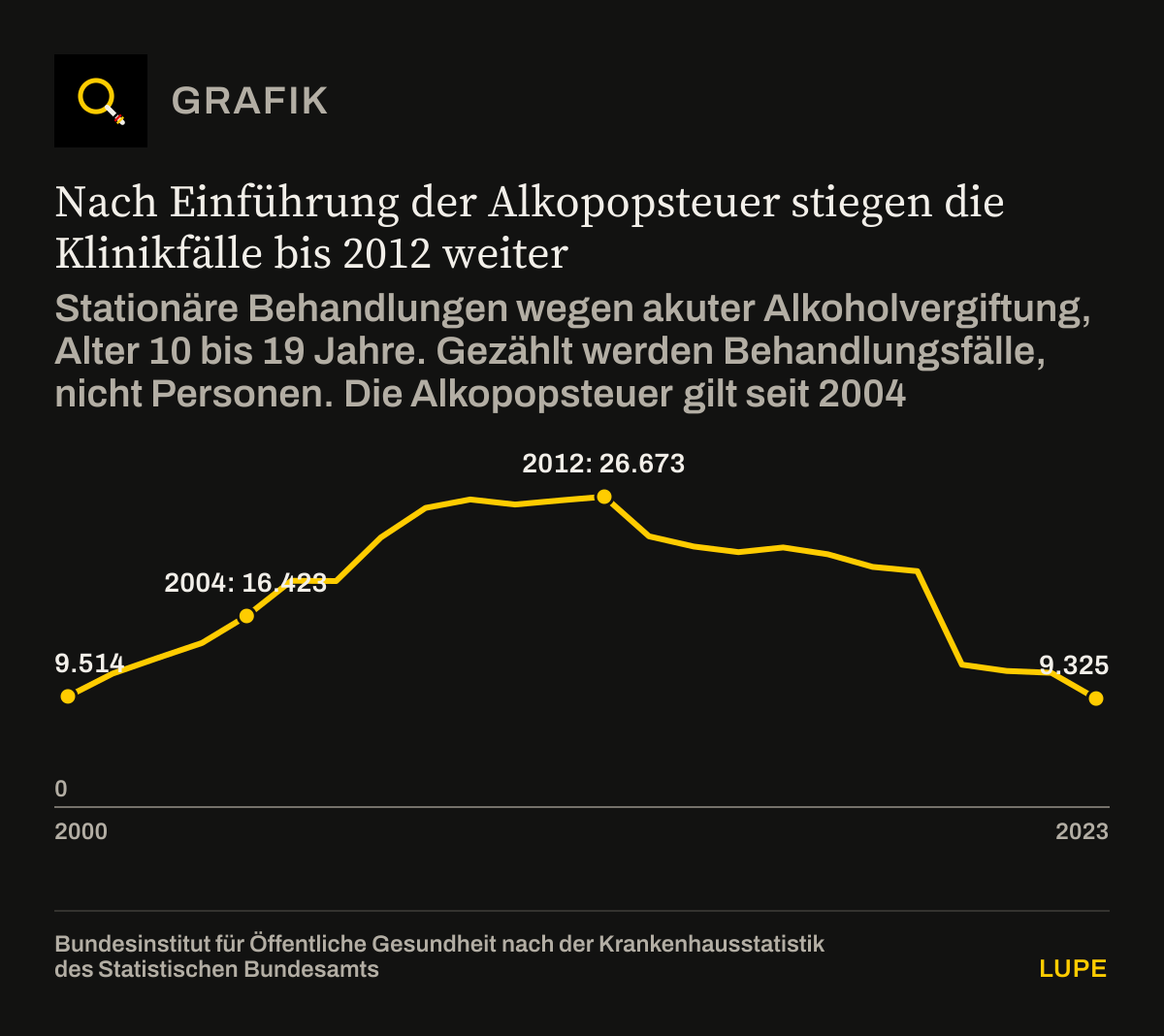
In the year it was introduced, children, adolescents and young adults between 10 and 19 years of age were treated as inpatients for acute alcohol poisoning 16,423 times. In 2012 there were 26,673 cases, more than in any other year of the series.[9] The rise had, however, begun before the duty, and after 2012 the figures fell markedly.
After the alcopop duty was introduced the hospital cases kept rising until 2012
Inpatient treatments for acute alcohol poisoning, ages 10 to 19. What is counted are cases of treatment, not people. The alcopop duty has applied since 2004
Federal Institute for Public Health, based on the hospital statistics of the Federal Statistical Office[9]. Chart redrawn from the figures in the text.
Limits of the data: Sum of the age groups 10 to 14 and 15 to 19 years; this includes 18- and 19-year-old adults. The statistics record neither the type of drink nor the mixing ratio nor the occasion. The rise began before the duty, the fall only years afterwards; neither can be attributed to the duty. 2020 and 2021 fall in the coronavirus pandemic.
Download the chart as an image (PNG)
Show data table24 rows
| Cases of treatment | |
|---|---|
| 2000 | 9,514 |
| 2001 | 11,466 |
| 2002 | 12,807 |
| 2003 | 14,105 |
| 2004 | 16,423 |
| 2005 | 19,449 |
| 2006 | 19,423 |
| 2007 | 23,165 |
| 2008 | 25,709 |
| 2009 | 26,428 |
| 2010 | 25,995 |
| 2011 | 26,351 |
| 2012 | 26,673 |
| 2013 | 23,267 |
| 2014 | 22,391 |
| 2015 | 21,907 |
| 2016 | 22,309 |
| 2017 | 21,721 |
| 2018 | 20,635 |
| 2019 | 20,272 |
| 2020 | 12,233 |
| 2021 | 11,692 |
| 2022 | 11,538 |
| 2023 | 9,325 |
One thing can be documented from this: the special duty did not prevent the rise over the following eight years. That it caused the rise is not documented by the figures either. The statistics do not know what was drunk, and they know no scenario without the duty. That is precisely why nobody should any longer invoke the alcopop duty as protection for young people, as long as its effect on health is not documented.
2027: higher rather than wiser
The federal government now wants not to abolish the special duty but to raise it. Under the draft of the 2027 budget accompanying act the alcopop duty rises to 6,660 euros and the alcohol duty to 1,564 euros per hectolitre of pure alcohol. The threshold of 10 per cent in § 1 of the Alkopopsteuergesetz stays as it is.[10] For the can in the table that would mean: 2.69 euros at 9.9 per cent, 52 cents at 10 per cent. The jump would remain at around 81 per cent.
On 9 November 2026 the Bundestag finance committee is hearing experts on the tax parts of this act.[11] That is the right place to put the 10 per cent threshold on the table, before the duty rises once again. How the act already works in an individual case is shown in my commentary Klingbeil verspricht Entlastung.
My demand
First: abolish the additional alcopop duty, with appropriate transitional arrangements and without new exemptions for particular brands or strengths. Second: keep the ordinary alcohol duty. Spirit-based drinks should continue to be taxed according to the quantity of alcohol they contain; I am not calling for exemption from duty for weaker mixed drinks.
Third: enforce the protection of minors rather than making things more expensive. Spirit-based drinks may already not be supplied to anyone under 18.[12] This prohibition must stay and be monitored better, in shops, online and in hospitality. The warning notice on alcopops currently hangs on the definition in the Alkopopsteuergesetz; in a reform it needs a basis of its own.[12]
Fourth: finance prevention reliably. The additional revenue from the alcopop duty is currently earmarked for the addiction prevention work of the federal centre;[13] on abolition this money must not simply fall away. Fifth: have the effect examined independently, after two and after four years, against the total quantity of alcohol, against binge drinking, against breaches of the supply ban and against the hospital cases.
And for now: the increase in the 2027 budget accompanying act should not be waved through without the 10 per cent threshold being examined. Anyone who takes the protection of minors seriously must be willing to correct a contradictory rule. The opponent is harmful drinking, not a product category.
Andreas W. HerbFounder and CEO MBG Group, Paderborn
What I expressly do not claim
I do not claim that the alcopop duty put young people in hospital; the data do not support that. Drinks at 10 per cent are not free of duty, it is only the special duty that falls away for them. Weaker mixed drinks are not harmless; for the same quantity drunk they simply contain less alcohol. The calculation is a model for comparable drinks, not a price comparison of particular products. And that abolition would reduce the hospital cases is not documented; that is why an independent examination is part of my demand.
METHOD
Method
Pure alcohol per container: 330 ml × alcohol content, so 330 ml × 9.9 % = 32.67 ml = 0.0003267 hectolitres. Alcohol duty: × 1,303 euros = 0.4257 euros; alcopop duty: × 5,550 euros = 1.8132 euros; together 2.2389 euros, rounded 2.24 euros. At 10 %: 0.00033 hectolitres × 1,303 euros = 0.4300 euros.
The jump: (2.2389 − 0.4300) ÷ 2.2389 = 80.8 per cent, that is around 81 per cent. Compared with 5 %: (1.1307 − 0.4300) ÷ 1.1307 = 62.0 per cent.
In 2027 under the draft: 0.0003267 hectolitres × (1,564 + 6,660) euros = 2.6868 euros; 0.00033 × 1,564 = 0.5161 euros. The jump is again 80.8 per cent, because both rates rise by 20 per cent.
Hospital cases: sum of the age groups 10 to 14 and 15 to 19 years from the table of the Federal Institute for Public Health, for instance 2012: 3,999 + 22,674 = 26,673. 2023: 1,483 + 7,842 = 9,325.
CHECK
What was checked before publication
- The author’s table was recalculated against the wording of the Alkopopsteuergesetz and the Alkoholsteuergesetz on 27 October 2026 and is correct to the cent. It is a model calculation: it assumes that every drink below 10 per cent meets all the characteristics of an alcopop, and it contains neither VAT nor deposit nor prices.
- The chart in the source material ended in 2012, the year with the most cases. We show the whole published series up to 2023. After that the cases fell below the level of 2000; ending in 2012 would have concealed that.
- The quotations from 2004, 2005 and 2017 have been read in the Bundestag printed papers. The study from 2010 has been checked against its abstract; its gram values are therefore not taken over.
- Not taken over is a personal recollection by the author of a warning of his own from 2004. There is no dated evidence for it; it is to appear only with expressly cleared wording.
- The text does not claim that the duty caused the hospital cases; the data do not support that. The finance ministry and the main customs office were not asked for comment.
SOURCES
Sources
Every number in the text leads to its source. The origin is given at each entry: official, media report, trade association, institute or data portal. Titles stay in the original language, so that each document can still be found.
[1] Bundesministerium der Justiz, Stand 27.10.2026
§ 1 Alkopopsteuergesetz: Steuergegenstand (Alkopops mit mehr als 1,2 und weniger als 10 Prozent vol)Official source↑ back to the text
[2] Bundesministerium der Justiz, Stand 27.10.2026
§ 2 Alkopopsteuergesetz: Steuertarif (5.550 Euro je Hektoliter reinen Alkohols)Official source↑ back to the text
[3] Bundesministerium der Justiz, Stand 27.10.2026
§ 2 Alkoholsteuergesetz: Steuertarif (Regelsatz 1.303 Euro je Hektoliter Alkohol)Official source↑ back to the text
[4] Deutscher Bundestag, 03.03.2004
Drucksache 15/2587: Gesetzentwurf der Fraktionen SPD und Bündnis 90/Die Grünen zur Verbesserung des Schutzes junger Menschen vor Gefahren des Alkohol- und Tabakkonsums (S. 2 Finanzberechnung, S. 7 Begründung der 10-Prozent-Grenze)Official source↑ back to the text
[5] Deutscher Bundestag, 05.05.2004
Drucksache 15/3084: Beschlussempfehlung und Bericht des Finanzausschusses (S. 7 Entschließung, S. 8 und 10 Beratung)Official source↑ back to the text
[6] Deutscher Bundestag, 18.07.2005
Drucksache 15/5929: Bericht der Bundesregierung über die Auswirkungen des Alkopopsteuergesetzes (S. 1 und 2)Official source↑ back to the text
[7] Addiction, Juli 2010
Müller, Piontek, Pabst, Baumeister, Kraus: Changes in alcohol consumption and beverage preference among adolescents after the introduction of the alcopops tax in Germany (Band 105, Heft 7, S. 1205–1213)Institute or public body↑ back to the text
[8] Deutscher Bundestag, 31.07.2017
Drucksache 18/13211: Antwort der Bundesregierung auf eine Kleine Anfrage der Fraktion Die Linke (S. 23, Antwort zu Frage 30a)Official source↑ back to the text
[9] Bundesinstitut für Öffentliche Gesundheit (BIÖG), Stand 2025
Krankenhauseinweisungen wegen Alkoholvergiftung, 10- bis 24-Jährige, 2000 bis 2023 (nach der Krankenhausstatistik des Statistischen Bundesamts)Official source↑ back to the text
[10] Deutscher Bundestag, 07.09.2026
Drucksache 21/7860: Entwurf eines Haushaltsbegleitgesetzes 2027 (Artikel 1 und 3)Official source↑ back to the text
[11] Deutscher Bundestag (hib 811/2026), 12.10.2026
Anhörung zum Haushaltsbegleitgesetz 2027 (mit dem Termin der Anhörung des Finanzausschusses am 9. November 2026)Official source↑ back to the text
[12] Bundesministerium der Justiz, Stand 27.10.2026
§ 9 Jugendschutzgesetz: Alkoholische Getränke (Abgabeverbot, Absatz 4 Warnhinweis auf Alkopops)Official source↑ back to the text
[13] Bundesministerium der Justiz, Stand 27.10.2026
§ 4 Alkopopsteuergesetz: Aufkommensverwendung (Suchtprävention der Bundeszentrale für gesundheitliche Aufklärung)Official source↑ back to the text
CORRECTIONS
Corrections
No corrections since publication on 27/10/2026. Every substantive change appears here with its date, reason and previous wording.
This page is opinion. Our fact checks are not.