OPINIONPOSITION PAPERONLINE RETAIL FROM CHINA
A customs deficit. A tax deficit. A jobs deficit.
Position paper to Federal Chancellor Friedrich Merz ahead of the European Council on 15 and 16 October 2026. On low-value consignments from China, Germany loses customs duty, VAT and value added.
By Andreas W. Herb, CEO MBG Group, Paderborn
9 minutes read29 sources0 correctionsDisclosure
Share
Contents
40,000
jobs are missing in Germany, through Temu and Shein alone
IW study for the HDE: posts that would exist if the money were spent at retailers within Germany.[3]
€2.4bn
of value added is missing in Germany every year
The same study; plus €429m in taxes.[3]
5.9bn
low-value consignments up to €150 entered the EU in 2025; in 2022 it was 1.4bn
EU Commission; 93 per cent of the volume from China.[1]
65
out of every million goods imported were checked by EU customs for product safety in 2025
EU Commission; in 2022 it was still 203.[8]
Chancellor, stop the duty-free sell-off of German retail.
Every order from Temu, Shein or AliExpress is turnover that no German company makes – with everything that depends on it: profit, trade tax, corporation tax, wage tax, social contributions and jobs. The €3 flat charge is no answer to that. On 15 and 16 October the European Council deals with the EU budget from 2028.[16][17] Push three things through there:
First: real duty on the real value. The regular customs rate on goods plus freight at the market price, immediately and permanently.
Second: the money follows the consumer. Collection costs and fees go to the country where the goods arrive, not to the port.
Third: platforms are liable. For the value of the goods, for VAT and for product safety, with real checks instead of 65 checks per million goods.[8]
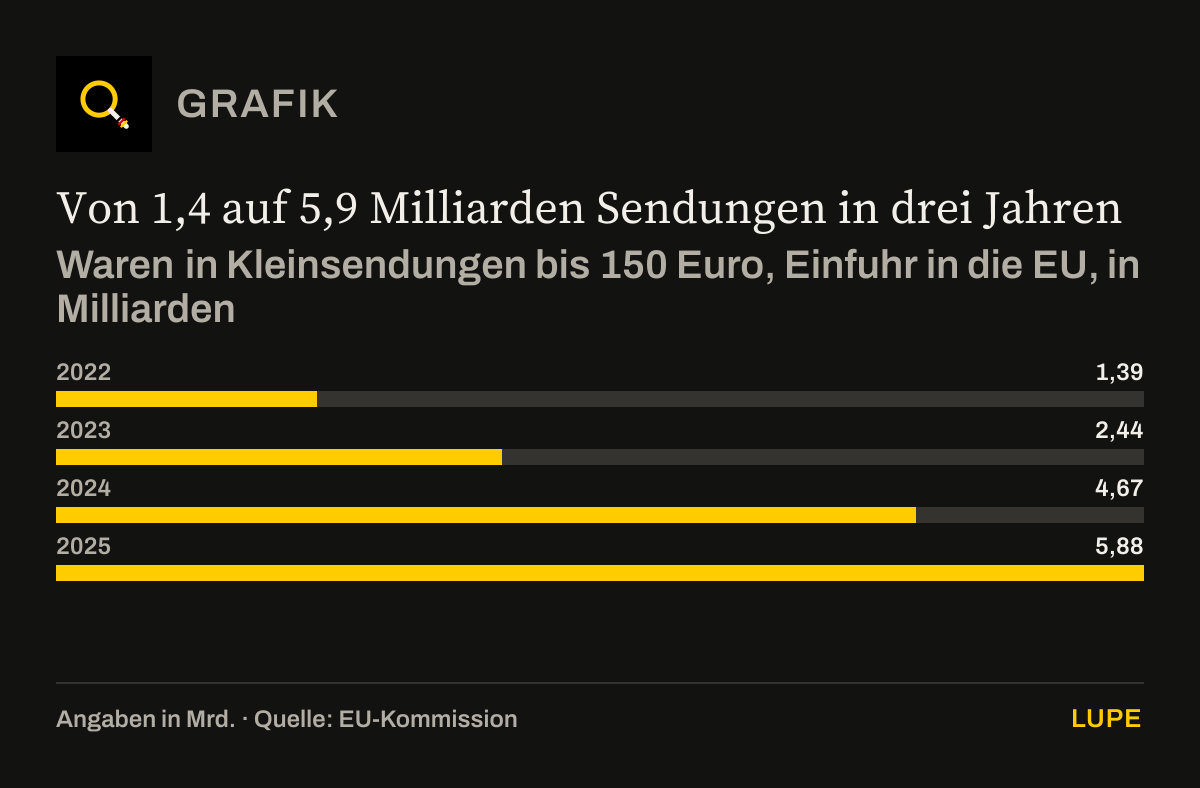
The volume: from 1.4 to 5.9 billion consignments in three years
Until 30 June 2026 consignments up to 150 euros were duty-free throughout the EU. In 2022, 1.4 billion such consignments arrived, and in 2025 it was 5.9 billion.[1] In 2024, 91 per cent came from China.[2] From 2022 to 2025 a total of around 14.4 billion consignments entered the EU duty-free. Including the first half of 2026 it is likely to be over 17 billion; official figures for 2026 do not yet exist.
From 1.4 to 5.9 billion consignments in three years
Goods in low-value consignments up to 150 euros, imports into the EU, in billions
Source: EU Commission[1]. Chart redrawn from the figures in the text.
Limits of the data: The Commission counts goods (“items”); the German version of its communications speaks of consignments. Average declared value in 2025: 8.82 euros
Download the chart as an image (PNG)
Show data table4 rows
| Consignments (bn) | |
|---|---|
| 2022 | 1.39 |
| 2023 | 2.44 |
| 2024 | 4.67 |
| 2025 | 5.88 |
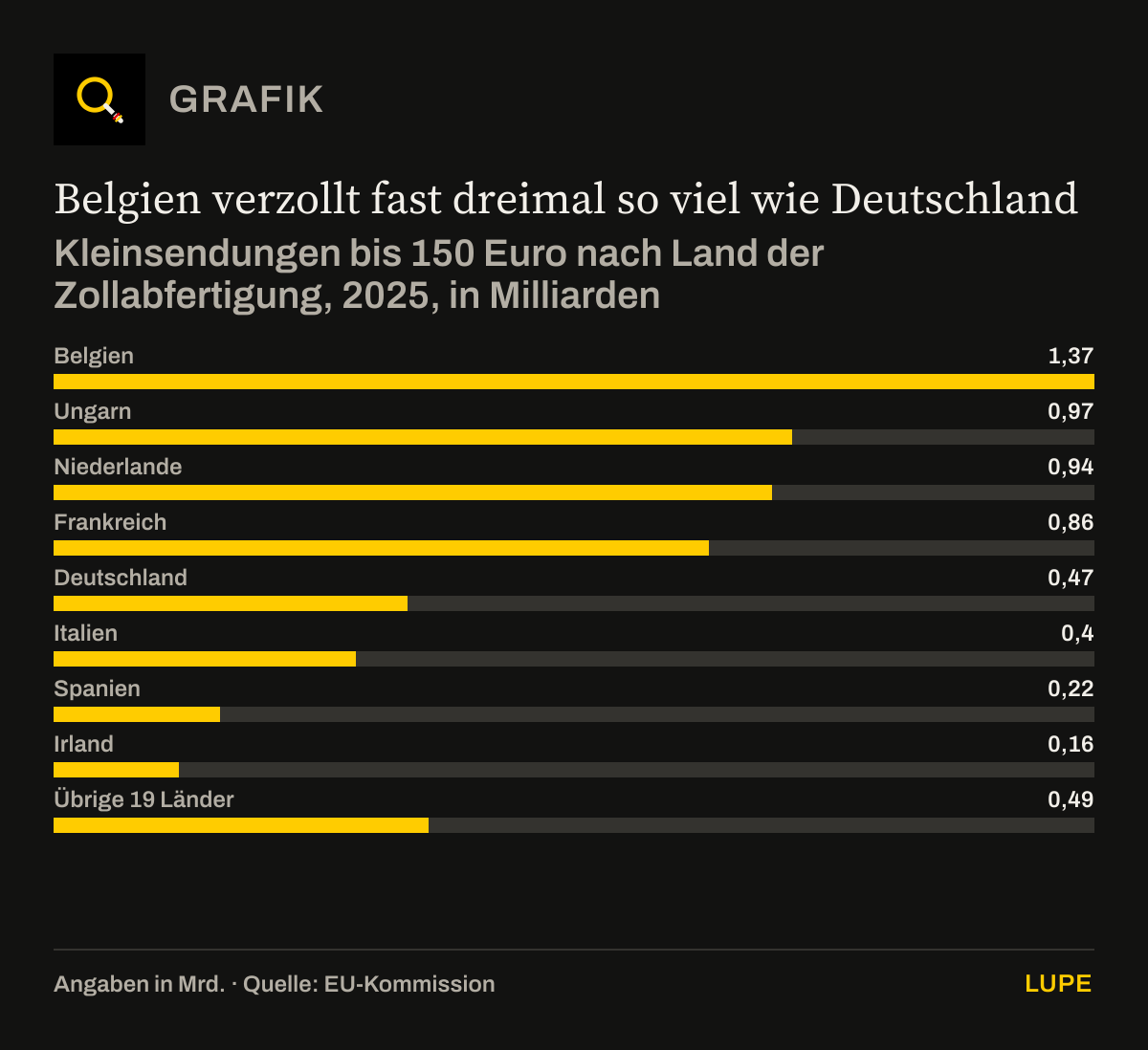
Most of these consignments are not cleared in Germany. In 2025 almost a quarter ran through Belgium, with Hungary, the Netherlands and France on top. In Germany itself 8 per cent were cleared.[1] How many consignments end up with customers in Germany nobody publishes.
Belgium clears almost three times as much as Germany
Low-value consignments up to 150 euros by country of customs clearance, 2025, in billions
Source: EU Commission[1]. Chart redrawn from the figures in the text.
Limits of the data: The Commission names the country where the goods enter; that is usually the country of customs clearance, not where the buyers live
Download the chart as an image (PNG)
Show data table9 rows
| Consignments 2025 (bn) | |
|---|---|
| Belgium | 1.37 |
| Hungary | 0.97 |
| Netherlands | 0.94 |
| France | 0.86 |
| Germany | 0.47 |
| Italy | 0.4 |
| Spain | 0.22 |
| Ireland | 0.16 |
| The other 19 countries | 0.49 |
The deficit balance for Germany – per year
The statistics record where clearance takes place, not where consumption takes place. The paper therefore calculates with a documented lower bound and a scenario in which 30 to 35 per cent of all EU consignments arrive in Germany. The basis is 2025 with 5.88 billion consignments at an average declared value of 8.82 euros.[1]
| Documented lower bound | Scenario 30–35% | |
|---|---|---|
| Consignments to Germany | 168m parcels, Temu and Shein only[5] | 1.76–2.06bn |
| Declared value of goods | €3.1bn excluding VAT (Temu, Shein, AliExpress)[6] | €15.6–18.2bn |
| Customs value with freight and undervaluation | €3.8–4.3bn | €26.4–41.3bn |
| Customs duty at 10 per cent | €0.38–0.43bn | €2.6–4.1bn |
| of which the 25 per cent that would stay in the federal budget if cleared in Germany | €0.09–0.11bn | €0.66–1.03bn |
| VAT on the declared value, payable | €0.59bn | €2.96–3.45bn |
| VAT lost through undervaluation | – | €0.72–1.66bn |
| VAT on freight at Temu’s cost (€7–10 per consignment) | €0.22–0.32bn | €2.35–3.91bn |
| VAT on freight at the market price (€30 per consignment), the demand | €0.96bn | €10.1–11.7bn |
| Value added that is missing | €2.4bn (IW)[3] | no robust extrapolation |
| Jobs that are missing | around 40,000 (IW)[3] | no robust extrapolation |
| Taxes of the federal government, the Länder and the municipalities that are missing | €429m (IW)[3] | no robust extrapolation |
Assumptions by the author: Germany’s share 30 to 35 per cent; 65 per cent of consignments declared 30 to 50 per cent too low (the 65 per cent was estimated by a study from 2016, while the 30 to 50 per cent is not documented[9]); air freight of 4 to 7 euros per consignment counted fully in the customs value; a customs rate of 10 per cent, with the duty one fifth lower at 8 per cent. VAT on freight at the market price is not payable under the law as it stands; that is a demand of the paper. For scale: 1.76 to 2.06 billion consignments would correspond to 40 to 47 per cent of all 4.37 billion courier, express and parcel items in Germany.[28]
Three freight prices – and the smallest one reaches customs
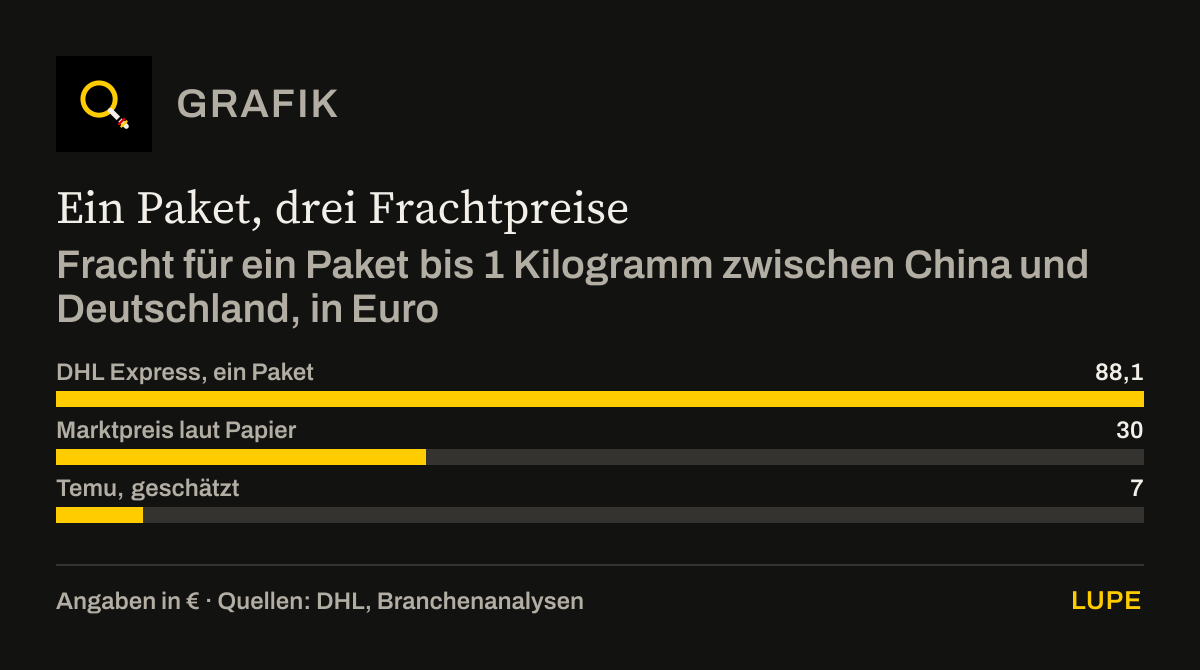
Which parcel flies from China to Germany for 8.82 euros including freight? None. A single express parcel with goods up to one kilogram costs 88.10 euros at DHL in the zone that includes China, in the opposite direction.[22] Temu bundles millions of consignments: industry analyses estimate 4 to 7 euros of air freight per consignment and a good 3 euros for delivery within Europe.[23][24] At customs the freight is not visible in the 8.82 euros.[1]
One parcel, three freight prices
Freight for a parcel up to 1 kilogram between China and Germany, in euros
- Price
- Upper limit
Sources: DHL[22], industry analyses[23][24]. Chart redrawn from the figures in the text.
Limits of the data: DHL Express: goods up to 1 kilogram, online price in the zone that includes China, direction Germany–China. Temu: 4 to 7 euros of air freight and a good 3 euros of delivery, estimated from industry analyses. The market price of 30 euros is the figure the paper uses
Download the chart as an image (PNG)
Show data table3 rows
| Price (€) | Upper limit (€) | |
|---|---|---|
| DHL Express, one parcel | 88.1 | – |
| Market price according to the paper | 30 | – |
| Temu, estimated | 7 | 10 |
Customs law counts the freight up to the EU border in the customs value; for air freight from China that is 70 per cent.[18] The platforms’ trick is called “shipping included”: the price paid then counts as the customs value, and freight is not added.[19] On top of this, according to an estimate from 2016 about 65 per cent of consignments in online retail were declared too low.[9] So goods pay duty and VAT on a value at which no European retailer could bring them to Germany.
| Declared | Scenario | Assumption | |
|---|---|---|---|
| Goods | €8.82 | €10.95–13.06 | 65% of consignments declared 30–50% too low |
| Freight up to the EU border | – | €4–7 | air freight according to industry estimates |
| Customs value per consignment | €8.82 | €14.95–20.06 | 70 to 127 per cent more |
| Customs value EU total, 5.88bn consignments | €51.9bn | €87.9–118.0bn |
What a real duty of 10 per cent would have brought – across the EU
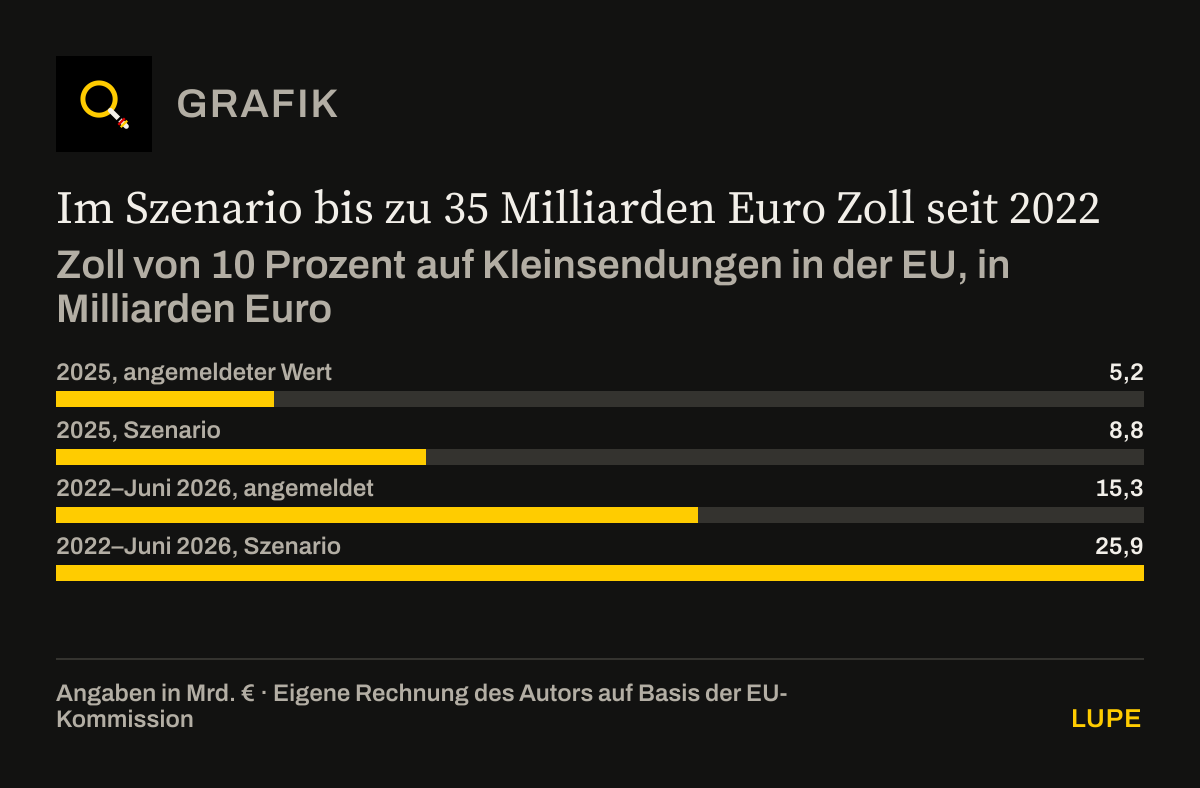
In the scenario, up to 35 billion euros of duty since 2022
Customs duty of 10 per cent on low-value consignments in the EU, in billions of euros
- Duty
- Upper limit
The author’s own calculation based on the EU Commission[1]. Chart redrawn from the figures in the text.
Limits of the data: The first half of 2026 is taken as half of 2025, as official figures are missing; the scenario uses undervaluation and freight as above. 10 per cent lies within the range of the standard duty for clothing (8 to 12 per cent)
Download the chart as an image (PNG)
Show data table4 rows
| Duty (€bn) | Upper limit (€bn) | |
|---|---|---|
| 2025, declared value | 5.2 | – |
| 2025, scenario | 8.8 | 11.8 |
| 2022–June 2026, declared | 15.3 | – |
| 2022–June 2026, scenario | 25.9 | 34.7 |
For textile clothing the customs administration gives a standard duty of 8 to 12 per cent, and for shoes of plastic or textile almost 17 per cent.[20] Germany also benefits indirectly from EU-wide customs duties: 75 per cent goes into the EU budget and reduces the member states’ contributions.[12] At 10 per cent duty on the value in the scenario, that would correspond to relief of 1.4 to 1.9 billion euros a year on Germany’s EU contribution; Germany bore around 21.5 per cent of the payments in 2025.[25]
The €3 solution: too late, blind to value, wrongly distributed
Since 1 July 2026 a duty of 3 euros per item of goods has applied to consignments up to 150 euros, limited until 1 July 2028.[10] An item of goods is everything with the same tariff number: five T-shirts cost 3 euros, a T-shirt and a watch 6 euros. From 1 November a processing fee of 2 euros per item of goods is to be added.[11]
Three years too late. The Commission proposed ending duty-free treatment in May 2023.[9] In 2024 and 2025 alone, over 10 billion consignments arrived duty-free after that.[1]
Blind to the value of the goods. 3 euros per item of goods, whether the goods cost 5 euros or 140 euros. Anyone packing a lot of identical goods into one parcel pays only once.
The money lands in the wrong place. Duty and fee count among the EU’s own resources; 25 per cent of the duty is kept by the country that clears it.[12] In the first seven weeks Belgian customs collected 223.7 million euros.[15] The Bundesbank calls these high collection costs a “hidden rebate” from which Belgium and the Netherlands benefit above all.[14] The Commission proposes cutting the share to 10 per cent from 2028.[13]
Freight and undervaluation remain unchecked. VAT still hangs on the declared value. The European Court of Auditors considers the checks in this procedure inadequate.[29]
It works – and proves the failure. In the third quarter of 2026 the turnover of Temu, Shein and AliExpress in Germany fell by 35.5 per cent to 566 million euros.[7] A real, value-based duty would have achieved that years earlier.
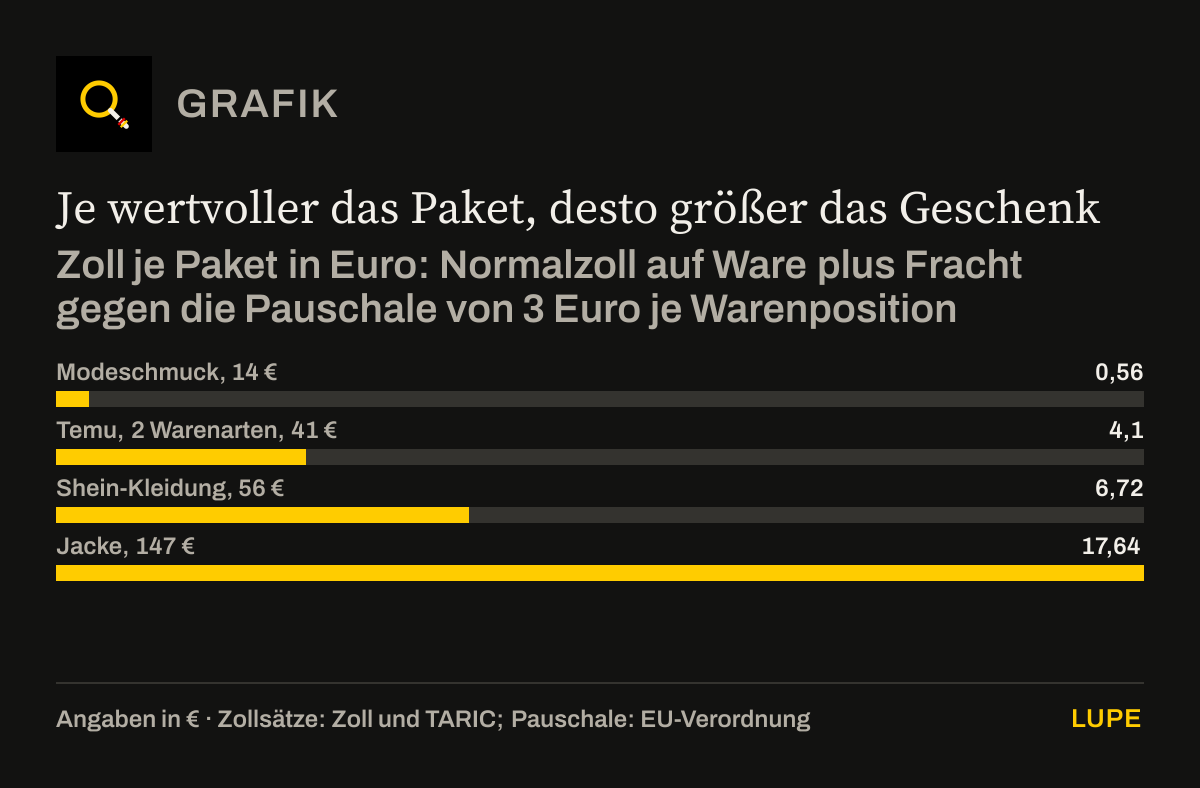
The more valuable the parcel, the larger the gift
Duty per parcel in euros: standard duty on goods plus freight against the flat charge of 3 euros per item of goods
- Standard duty
- Flat charge
Customs rates: customs administration[20] and TARIC[21]; flat charge: EU regulation[10]. Chart redrawn from the figures in the text.
Limits of the data: Customs value per parcel from goods and freight: costume jewellery 9 plus 5 euros, Temu order 35 plus 6 euros, Shein clothing 50 plus 6 euros, jacket 140 plus 7 euros. Standard duty 4 per cent for costume jewellery, 12 per cent for clothing; the 10 per cent on the Temu order is an assumption. For cheap goods the flat charge is higher: at 12 per cent duty, the standard duty is higher only from a customs value of 25 euros per item of goods. From 1 November a fee of 2 euros per item of goods is added
Download the chart as an image (PNG)
Show data table4 rows
| Standard duty (€) | Flat charge (€) | |
|---|---|---|
| Costume jewellery, €14 | 0.56 | 3 |
| Temu, 2 kinds of goods, €41 | 4.1 | 6 |
| Shein clothing, €56 | 6.72 | 3 |
| Jacket, €147 | 17.64 | 3 |
The higher the true value of the parcel, the larger the gift – precisely with clothing and shoes, where German retail suffers most.
What a German retailer would bring instead
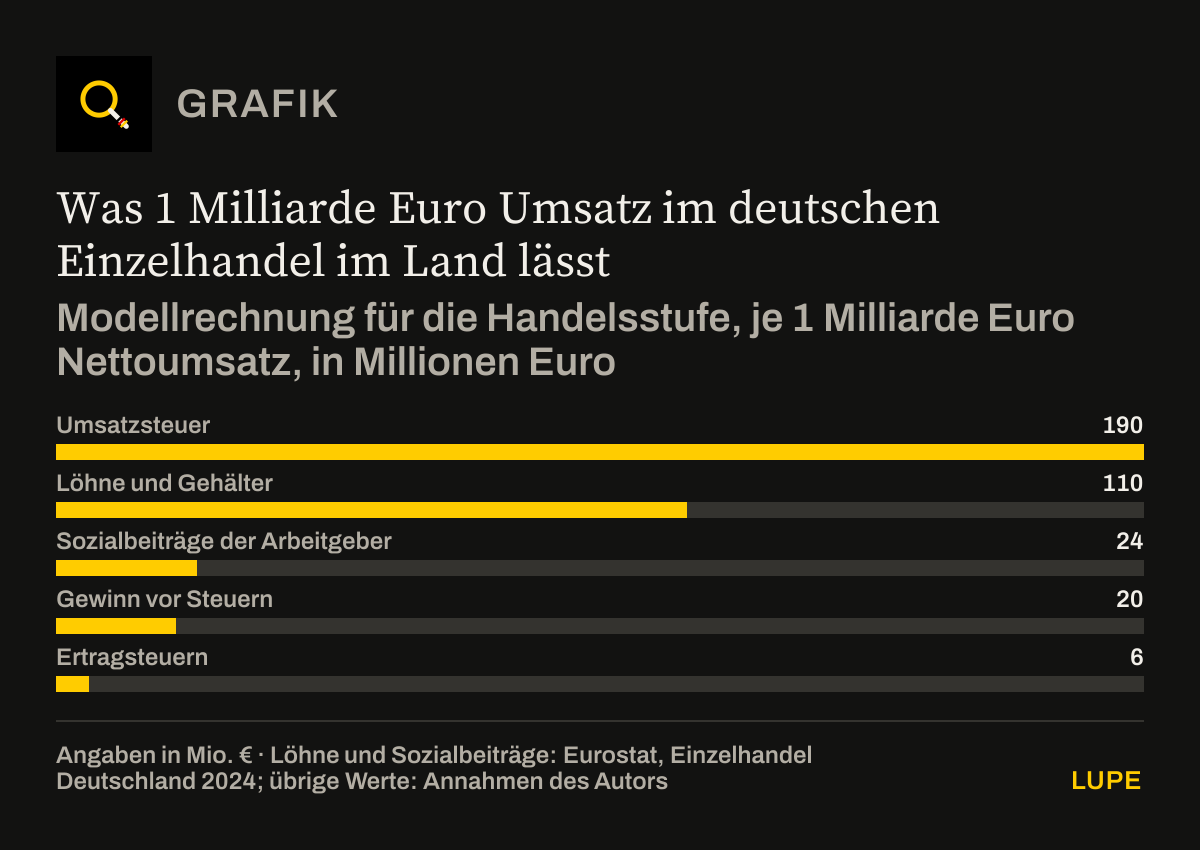
If the same goods are sold in Germany, the value added stays here: wages, profits, rents, logistics and the taxes on them. In German retail in 2024, 13.4 cents of every euro of turnover went on staff costs.[26] VAT is secured through bookkeeping and tax audits rather than through a declared parcel value. With platforms from China, wages and profits arise predominantly outside Germany.
What 1 billion euros of turnover in German retail leaves in the country
Model calculation for the retail stage, per 1 billion euros of net turnover, in millions of euros
- Amount
- Upper limit
Wages and social contributions: Eurostat, German retail 2024[26]; other values: assumptions by the author. Chart redrawn from the figures in the text.
Limits of the data: VAT 19 per cent; profit before tax assumed at 2 to 3 per cent of turnover; corporation and trade tax around 30 per cent of profit. The IW study additionally covers inputs and knock-on effects and therefore arrives at higher values
Download the chart as an image (PNG)
Show data table5 rows
| Amount (€m) | Upper limit (€m) | |
|---|---|---|
| VAT | 190 | – |
| Wages and salaries | 110 | – |
| Employers’ social contributions | 24 | – |
| Profit before tax | 20 | 30 |
| Taxes on income | 6 | 9 |
| Study | Finding |
|---|---|
| IW Consult for the HDE (Germany, Temu and Shein) | €2.4bn of value added, €1.3bn of it in retail; 40,558 jobs, 28,328 of them in retail; €429m of taxes a year[3] |
| IW Consult for the HDE, the same study | €2.5bn of turnover is lost to retail, and €5.0bn of turnover across the economy[3] |
| GAW for the Austrian retail association (Temu, AliExpress, Shein) | just under €570m of gross turnover, more than €170m of value added, 1,626 jobs[27] |
Demands on the federal government
Real duty on the real value: the regular customs rate on goods plus freight, immediately and without a time limit. The 3 euros remain as a minimum duty; the higher amount is levied.
Freight at the market price: with “shipping included” or “free shipping”, a fixed freight rate per kilogram is included in the customs value and in VAT.
The money follows the consumer: collection costs and the processing fee go to the country of destination; the data for this is available through the IOSS VAT procedure. In the new EU budget from 2028 the collection costs fall to the actual costs.
Platforms are liable: as importer for value, VAT and product safety, with noticeable inspection rates and sanctions.
Transparency: the federal government publishes annually how many low-value consignments arrive in Germany, where they were cleared and what they cost.
Andreas W. HerbCEO MBG Group, Paderborn
METHOD
Method
The volumes and the average value come from the EU Commission (5.88 billion consignments in 2025, 8.82 euros per consignment). There are no official statistics on the country of destination of consignments cleared in Belgium or the Netherlands; the scenario with 30 to 35 per cent is an assumption by the author, as are the undervaluation, the freight and the customs rate.
The documented lower bound calculates with 168 million parcels from Temu and Shein (460,000 a day according to the HDE, times 365) and 3.1 billion euros of goods value (3.7 billion euros of turnover from Shein, Temu and AliExpress according to bevh, excluding 19 per cent VAT).
The jobs, the value added and the taxes in the IW study rest on a survey in February 2026 and on a counterfactual. The paper’s extrapolation to the scenario has not been taken over: the study names no base turnover, and its ratio from a survey of buyers cannot be transferred to all low-value consignments.
Legal status 12 October 2026: flat customs charge of 3 euros since 1 July 2026, processing fee expected from 1 November 2026. Since July the platforms’ turnover has fallen sharply; the values for 2025 describe the period before that.
CHECK
What was checked before publication
- The basis is the MBG Group’s position paper of 12 October 2026. All the sources were accessed on 12 October 2026 and all the arithmetic has been recalculated.
- Against the paper, the extrapolation to 200,000 to 234,000 jobs has been dropped, because its base turnover does not come from the IW study. Made more precise are the inspection rate, the flat charge and the fee (each per item of goods), the freight prices, the customs law on “shipping included” and the Bundesbank quotation.
- The scenarios on customs duty and VAT rest on assumptions by the author. Not documented are Germany’s share of 30 to 35 per cent and the undervaluation by 30 to 50 per cent.
- According to the HDE the IW study is currently being revised (source 4). Its jobs are a counterfactual: posts that would exist if the money were spent within Germany.
SOURCES
Sources
Every number in the text leads to its source. The origin is given at each entry: official, media report, trade association, institute or data portal. Titles stay in the original language, so that each document can still be found.
[1] EU-Kommission, März 2026
Goods bought online – facts and figures (Customs Union in numbers 2025)Official source↑ back to the text
[2] Europäisches Parlament, 09.07.2025
EU targets low-value imports via e-commerce platformsOfficial source↑ back to the text
[3] IW Consult für den HDE, 17.04.2026
Temu und Shein – Impact auf die deutsche Wirtschaft (S. 9 bis 16)Institute or public body↑ back to the text
[4] Handelsverband Deutschland (HDE)
Temu und Shein (Themenseite mit Hinweis zur Überarbeitung der Studie)Trade association↑ back to the text
[5] Handelsverband Deutschland (HDE), 23.04.2026
Aktuelle Studie: Unfairer Wettbewerb mit Temu und Shein kostet deutsche Wirtschaft 2,4 Milliarden Euro im JahrTrade association↑ back to the text
[6] bevh, 22.01.2026
Wachstum im E-Commerce: Lichtblick in der deutschen WirtschaftTrade association↑ back to the text
[7] bevh, 08.10.2026
Nach Abschaffung der Zollfreigrenze: Asiatische Plattformen verlieren deutlich MarktanteileTrade association↑ back to the text
[8] EU-Kommission
E-commerce: product compliance and safety (Zollinterventionen je Million Waren)Official source↑ back to the text
[9] EU-Kommission, 17.05.2023
Vorschlag zur Abschaffung des Schwellenwerts für die Zollbefreiung, COM(2023) 259, Begründung Abschnitt 1Official source↑ back to the text
[10] EU-Kommission, 08.06.2026
Guidance and legal text: temporary flat fee on low-value imports until 1 July 2028 (Verordnung (EU) 2026/382)Official source↑ back to the text
[11] Irish Revenue, 29.09.2026
Union Handling Fee of €2 per distinct item from 1 November 2026Official source↑ back to the text
[12] EU-Kommission
Zölle (traditionelle Eigenmittel, 25 Prozent Erhebungskosten)Official source↑ back to the text
[13] EU-Kommission, 16.07.2025
Vorschlag für einen Beschluss über das Eigenmittelsystem, COM(2025) 574, Erwägungsgrund 5Official source↑ back to the text
[14] Deutsche Bundesbank, Oktober 2025
Monatsbericht Oktober 2025: EU-Finanzen und Mehrjähriger Finanzrahmen 2028 bis 2034, Abschnitt 2.3Official source↑ back to the text
[15] Aviation24, 04.09.2026
EU parcel levy sharply reduces e-commerce traffic at Liège AirportMedia report↑ back to the text
[16] Europäischer Rat, 14.09.2026
Notice of meeting and provisional agenda, 15 and 16 October 2026 (CM 6/26)Official source↑ back to the text
[17] Deutscher Bundestag, 09.10.2026
Regierungserklärung des Bundeskanzlers zum Europäischen Rat (Ankündigung)Official source↑ back to the text
[18] EUR-Lex, 01.07.2026
Durchführungsverordnung (EU) 2015/2447, Art. 138 und Anhang 23-01, konsolidierte FassungOfficial source↑ back to the text
[19] Zoll online
Voraussetzung für die Berücksichtigung von Beförderungs- und VersicherungskostenOfficial source↑ back to the text
[20] Zoll online
Beispiele für Warenarten und deren EinfuhrabgabensätzeOfficial source↑ back to the text
[21] EU-Kommission, 12.10.2026
TARIC, Maßnahmen für KN 7117 19 00, Ursprung ChinaData portal↑ back to the text
[22] DHL
Preise und Produkte für Ihren internationalen Versand (Express, Zone 8)Institute or public body↑ back to the text
[23] Vantage Forwarding
Temu EU Y2 Mode Explained (Y2 Seller Cost Model)Institute or public body↑ back to the text
[24] Tech Buzz China, 12.03.2026
Temu Watch #12: Update on Markets, Advertising & Logistics StrategiesMedia report↑ back to the text
[25] EU-Kommission, 29.09.2026
EU spending and revenue 2021–2027 (Daten 2000–2025)Official source↑ back to the text
[26] Eurostat, 30.09.2026
Unternehmen nach Wirtschaftszweigen, Einzelhandel (NACE G47), Deutschland 2024 (sbs_ovw_act)Official source↑ back to the text
[27] GAW für den Handelsverband Österreich, 05.06.2026
Temu, AliExpress und Shein und ihre negativen Auswirkungen auf die österreichische WirtschaftInstitute or public body↑ back to the text
[28] Logistik Heute, 23.06.2026
KEP: Anzahl der Sendungen stieg 2025 auf 4,37 Milliarden (KEP-Studie des BPEX)Media report↑ back to the text
[29] Europäischer Rechnungshof, 2025
Sonderbericht 08/2025: Mehrwertsteuerbetrug bei Einfuhren (Ziff. 59 bis 68)Official source↑ back to the text
CORRECTIONS
Corrections
No corrections since publication on 12/10/2026. Every substantive change appears here with its date, reason and previous wording.
This page is opinion. Our fact checks are not.