OPINIONCOMMENTARYSUGARY DRINKS TAX
The sugar tax customs monster
Who is supposed to check all this? And who pays for it?
By Andreas W. Herb, CEO MBG Group, Paderborn
2 minutes read8 sources0 correctionsDisclosure
Share
Contents
From 1 July 2027 a tax on sugary drinks is to apply in Germany.[1] What it costs is set out in detail in the essay Die Steuer, die sich selbst widerlegt. This second part asks only one question: who is supposed to check all this? And who pays for it?
The state is hiring
New posts
223
200 at customs, 23 at the federal IT service provider. For customs and IT the draft budgets around 89 million euros up to 2029.[2]
For a tax that does not yet exist.
What Berlin overlooks
There are around 2,500 drinks manufacturers in Germany.[3] Customs may inspect them without any specific cause.[4] Our scenario: every company is inspected once a year, two to three days on site.
Inspector days on site, every year
5,000 to 7,500
2,500 drinks manufacturers, two to three days of customs at each site. An inspection every year.
Scenario of the MBG Group. How often customs actually inspects is not fixed by the draft.
Customs officers doing nothing but inspecting
Full-time customs officers, for these inspections alone
52 to 78
With preparation and follow-up that becomes 10,000 to 15,000 inspector days a year. At 194 working days and around 87,200 euros per post in the senior service including overheads, that is 4.5 to 6.8 million euros a year.[5]
The 194 working days and 87,200 euros are derived from the 2025 staff cost rates of the Federal Ministry of Finance.
And the company?
While customs inspects, the office stands still. Two employees accompany the inspection, plus two days of preparation: six to eight person-days in total.
Cost per inspection at the company
up to €2,880
Six to eight person-days of eight hours each at average labour costs of 45 euros per hour[6]: 2,160 to 2,880 euros. For the sector, 5.4 to 7.2 million euros a year.
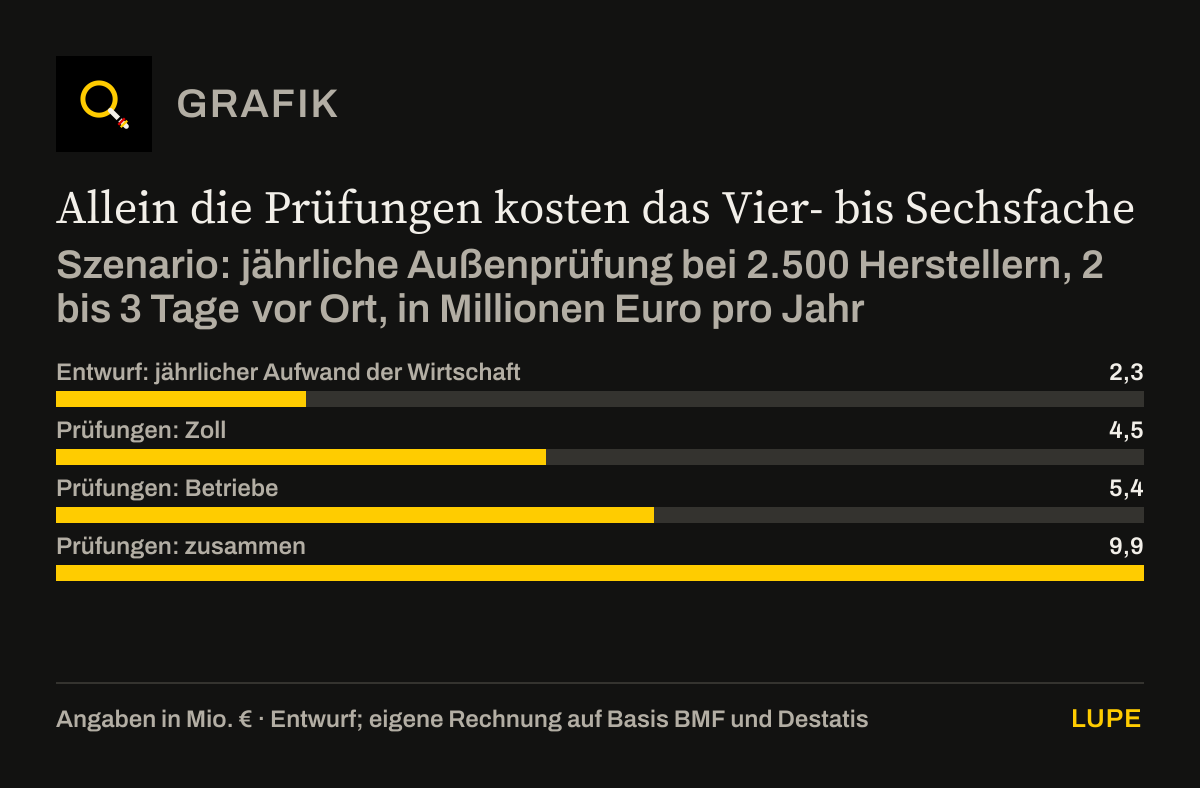
That is more than twice what the draft concedes to the entire industry as annual burden: 2.3 million euros.[1]
State and industry together
For inspections alone, per year
up to €14m
Customs 4.5 to 6.8 million euros, companies 5.4 to 7.2 million euros: together 9.9 to 14.0 million euros a year. Over ten years, up to 140 million euros.
Not counting registrations, permits, IT and software.
The inspections alone cost four to six times as much
Scenario: annual on-site inspection at 2,500 manufacturers, 2 to 3 days on site, in millions of euros per year
- Value or lower bound
- Upper bound
Draft[1]; own calculation based on BMF[5] and Destatis[6]. Chart redrawn from the figures in the text.
Download the chart as an image (PNG)
Show data table4 rows
| Value or lower bound (€m) | Upper bound (€m) | |
|---|---|---|
| Draft: annual burden on industry | 2.3 | – |
| Inspections: customs | 4.5 | 6.8 |
| Inspections: companies | 5.4 | 7.2 |
| Inspections: together | 9.9 | 14 |
The promise
On 14 May 2025 Federal Chancellor Friedrich Merz said in his government statement:
„Wir werden die unzähligen Dokumentations-, Berichts- und Meldepflichten schnell und spürbar reduzieren.“
Translation: We will reduce the countless documentation, reporting and notification obligations quickly and noticeably.
The balance sheet
| Item | Content |
|---|---|
| Goal | Minus 16 billion euros in bureaucracy costs for industry. That is what the coalition set out to do.[8] |
| Reality | New permits, tax warehouses, filings, inspections and 223 new posts.[2] |
| Question | Whatever happened to “one in, one out”?[8] |
Less sugar? We are on it. A new customs monster? No.
Andreas W. HerbCEO MBG Group, Paderborn
METHOD
Method
All amounts from “What Berlin overlooks” onwards are a scenario of the MBG Group: customs inspects each of the roughly 2,500 drinks manufacturers once a year, two to three days on site; preparation and follow-up double the inspector days. At the company, two employees accompany the inspection, plus two person-days of preparation, eight hours per day. The draft does not fix how often inspections actually take place.
The statements about the draft legislation come from media reports on the ministerial draft; the full original text was not available. In the comparison of state and industry the amounts come from different cost categories and are not fully equivalent. Legal status: draft in interdepartmental consultation, procedure halted for now; details may change.
CHECK
What was checked before publication
- Every step of the arithmetic has been recalculated and follows from the stated starting figures.
- The eight sources are the same as in the essay „Die Steuer, die sich selbst widerlegt“ and were accessed there on 4 October 2026 and checked against the text. Two limitations apply here as well: the figure of around 2,500 drinks manufacturers comes from a commercial address-list provider using Destatis data, not from official statistics (source 3). The 194 working days and 87,200 euros per post do not appear verbatim in the linked document of the Federal Ministry of Finance and are derived from it (source 5).
- The basis is a set of charts by the MBG Group on the sugar tax (as of 1 October 2026). Departing from them, this report gives the range 5,000 to 7,500 for inspector days on site, because two to three days per company produce that range.
- The statements about the draft legislation come from media reports on the ministerial draft, whose full text was not available (see Method).
SOURCES
Sources
Every number in the text leads to its source. The origin is given at each entry: official, media report, trade association, institute or data portal. Titles stay in the original language, so that each document can still be found.
[1] Getränke News, 30.09.2026
Zuckersteuer – Verbände kritisieren PläneMedia report↑ back to the text
[2] news.de, 01.10.2026
Finanzministerium plant Zuckersteuer mit Milliarden-Einnahmen (nach BILD)Media report↑ back to the text
[3] Listflix auf Basis Destatis
Getränkehersteller in DeutschlandData portal↑ back to the text
[4] Zoll online
Zulässigkeit der PrüfungOfficial source↑ back to the text
[5] Bundesministerium der Finanzen
Personal- und Sachkosten 2025 für WirtschaftlichkeitsuntersuchungenOfficial source↑ back to the text
[6] Statistisches Bundesamt
Eine Arbeitsstunde kostete 2025 durchschnittlich 45,00 EuroOfficial source↑ back to the text
[7] Bundesregierung, 14.05.2025
Regierungserklärung von Bundeskanzler Friedrich MerzOfficial source↑ back to the text
[8] Bundesministerium für Digitales und Staatsmodernisierung
BürokratierückbauOfficial source↑ back to the text
CORRECTIONS
Corrections
No corrections since publication on 06/10/2026. Every substantive change appears here with its date, reason and previous wording.
This page is opinion. Our fact checks are not.