BACKGROUNDOVERVIEWPUBLIC FINANCES
Where do the billions go?
The federal budget, the social budget, development assistance and payments to the United Nations: the large blocks of spending in checked figures, with the year and the basis of each.
Basis: research by the editorial team in official statistics and budget documents
4 minutes read19 sources0 corrections
Share
Contents
Anyone wanting to talk about potential savings first needs the orders of magnitude. This overview shows the state’s large spending blocks: the federal budget, the social budget across all providers, public development assistance and payments to the United Nations. Every figure appears with its year, its basis and its source. Where two figures sound similar but measure different things, that is stated expressly.
The federal budget
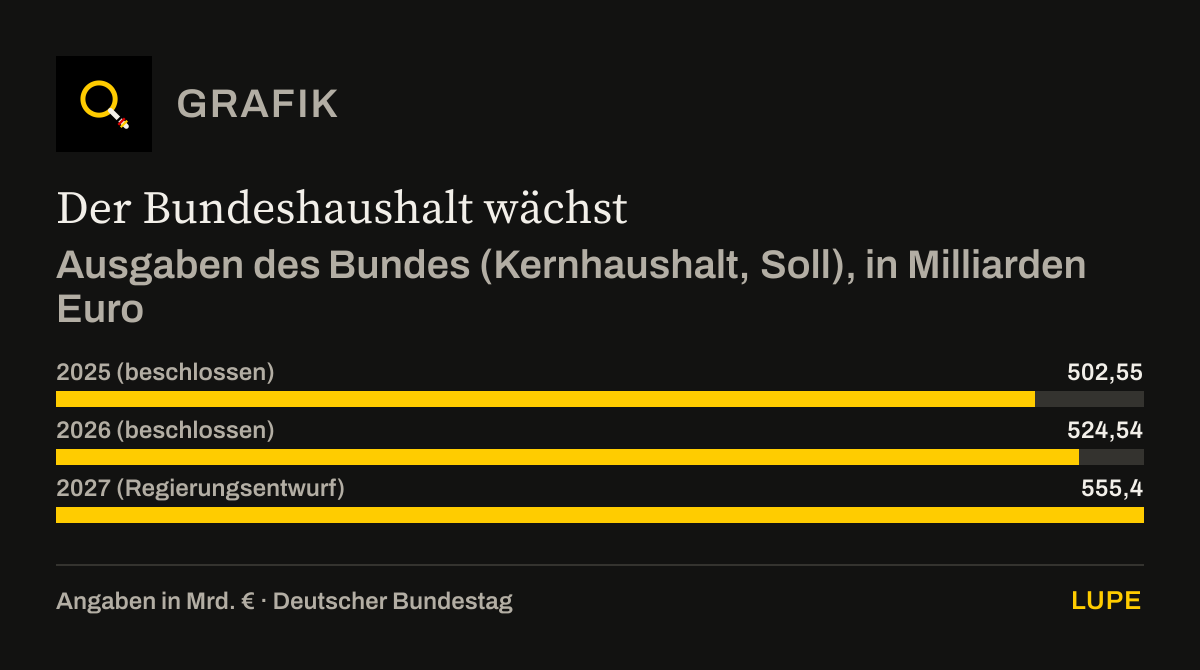
For 2026 the Bundestag adopted spending of 524.54 billion euros.[1][2] In the core budget the federal government takes on 97.96 billion euros of new borrowing for this; in addition come 83.58 billion euros of borrowing by the special funds for the armed forces, infrastructure and climate neutrality. Together that is around 181.5 billion euros of new debt in one year.[1][2]
The federal budget is growing
Federal spending (core budget, planned), in billions of euros
German Bundestag[1][3][7]. Chart redrawn from the figures in the text.
Limits of the data: The 2027 budget is still going through parliament.
Download the chart as an image (PNG)
Show data table3 rows
| Spending (€bn) | |
|---|---|
| 2025 (adopted) | 502.55 |
| 2026 (adopted) | 524.54 |
| 2027 (government draft) | 555.4 |
Labour and social affairs 2026 (departmental budget 11)
€197.34bn
More than every third euro of the federal budget: 37.6 per cent. The largest item is the payments to the pension insurance at 127.42 billion euros.[4][5][6]
Government draft for 2027: 201.46 billion euros.
For basic income support for jobseekers the 2026 budget provides 51.02 billion euros in total. Of that, 28.05 billion euros goes to the cash benefit itself, the former Bürgergeld, which after the reform adopted in March 2026 is called Grundsicherungsgeld, 13 billion euros to the federal government’s share of accommodation and heating and 4.7 billion euros to integration into work.[4][5][8]
The social budget across all providers
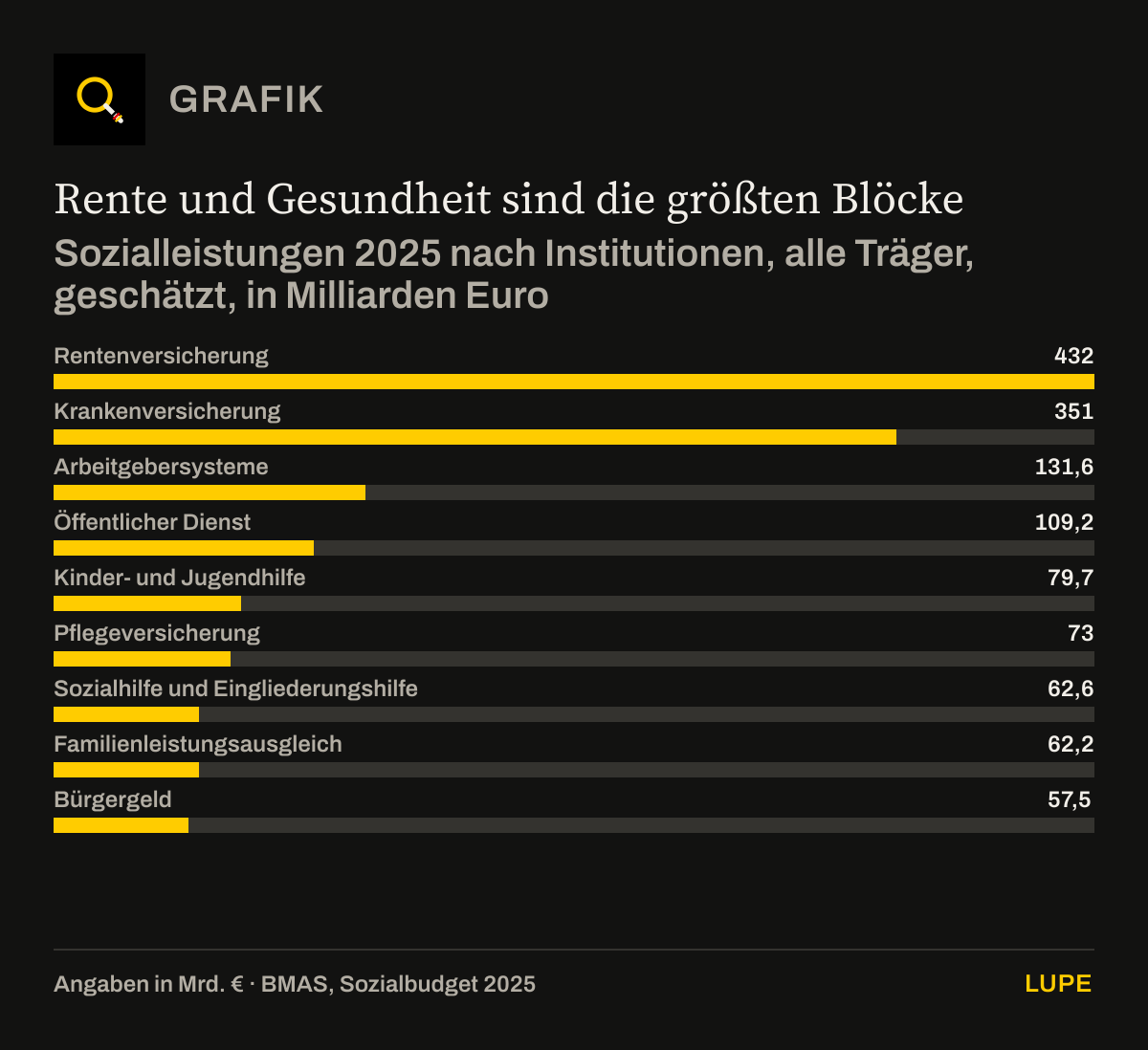
The federal budget is only one part. The social budget of the federal ministry of labour and social affairs adds up the social benefits of all providers: social insurance funds, the federal government, the Länder, the municipalities, employers. For 2025 it estimates them at 1,431.0 billion euros, that is 32.0 per cent of economic output. For 2024 it reports 1,354.1 billion euros, 31.3 per cent.[9]
Pensions and health are the largest blocks
Social benefits in 2025 by institution, all providers, estimated, in billions of euros
BMAS, social budget 2025[9]. Chart redrawn from the figures in the text.
Limits of the data: A selection of the largest institutions. Employer schemes include, among other things, continued pay during sickness (75.7 billion euros); the public service covers pensions, family allowances and medical assistance.
Download the chart as an image (PNG)
Show data table9 rows
| Benefits 2025 (€bn) | |
|---|---|
| Pension insurance | 432 |
| Health insurance | 351 |
| Employer schemes | 131.6 |
| Public service | 109.2 |
| Child and youth welfare | 79.7 |
| Long-term care insurance | 73 |
| Social assistance and integration assistance | 62.6 |
| Family benefit equalisation | 62.2 |
| Bürgergeld | 57.5 |
The social insurance systems account for 863.2 billion euros, around three fifths of the benefits. The social budget is financed to around two thirds from social contributions: 973.9 of 1,488.2 billion euros of revenue.[9]
| Measure | Amount | What it covers |
|---|---|---|
| Federal budget 2026 | €28.05bn | The federal government only, the cash benefit only (after the 2026 reform Grundsicherungsgeld).[4][5][8] |
| Social budget 2025 | €57.5bn | The federal government and municipalities together, including accommodation, heating and administration; 3.8 per cent of all social benefits.[9] |
Both figures are correct. They measure different things and must not be set against each other.
Public development assistance
Germany’s public development assistance (ODA) stood at 35.1 billion euros in 2023, 0.82 per cent of gross national income. Of that, 25.2 billion euros ran through bilateral and 9.9 billion euros through multilateral channels. The largest provider was the development ministry with 13.0 billion euros (37.2 per cent), while the foreign office came to 4.8 billion euros (13.8 per cent). 6.7 billion euros (19.2 per cent) were eligible costs for refugees from developing countries in Germany, and 1.98 billion euros the Länder’s costs for university places.[10]
A matter of definition: the 62.5 billion euros that the Federal Statistical Office also gives for 2023 are the total flows to developing countries. Besides ODA these include private flows, for instance 18.4 billion euros of direct investment by companies and 1.5 billion euros from aid organisations. They are not state spending.[10]
Since then the flows have fallen markedly. In 2024 they stood at 32.83 billion US dollars, 0.68 per cent of gross national income, for the first time since 2020 below the United Nations target of 0.7 per cent.[11] For 2025 the OECD provisionally reports around 26 billion euros, 0.56 per cent; the eligible costs for refugees within Germany fell to around 4.3 billion euros.[12][13]
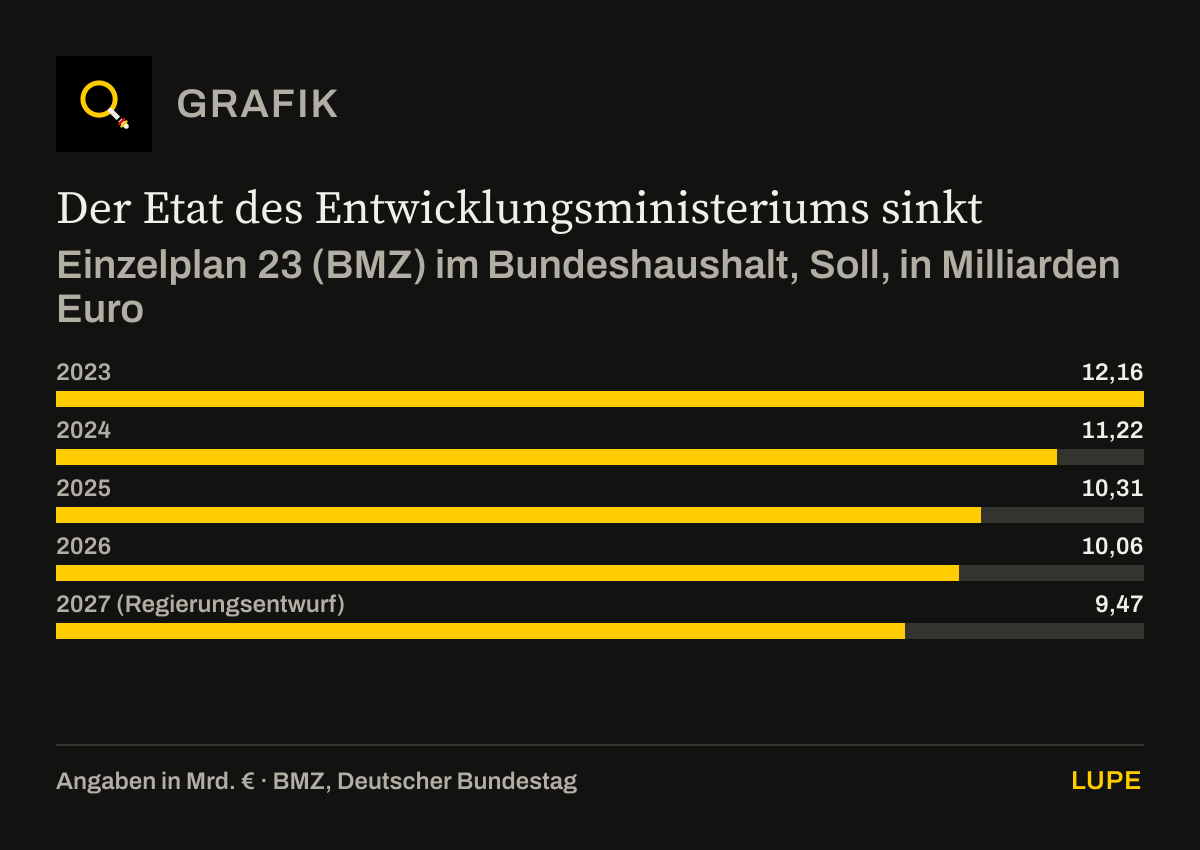
The development ministry’s budget is falling
Departmental budget 23 (BMZ) in the federal budget, planned, in billions of euros
BMZ[14], German Bundestag[15]. Chart redrawn from the figures in the text.
Limits of the data: The ministry’s budget is not the same as ODA: not every item of spending is eligible, and ODA also comes from other ministries and from the Länder.
Download the chart as an image (PNG)
Show data table5 rows
| Departmental budget 23 (€bn) | |
|---|---|
| 2023 | 12.16 |
| 2024 | 11.22 |
| 2025 | 10.31 |
| 2026 | 10.06 |
| 2027 (government draft) | 9.47 |
Payments to the United Nations
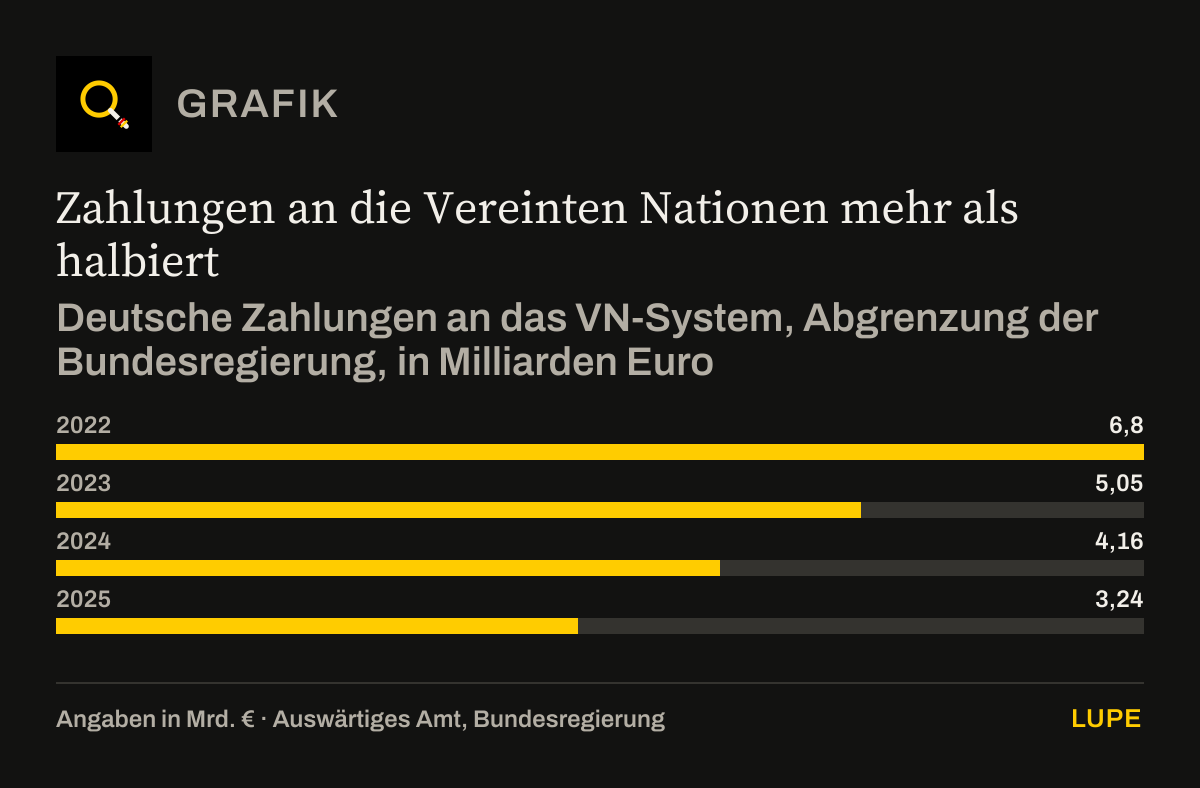
According to the federal government’s reports, Germany paid 6.80 billion euros to the United Nations system in 2022, 5.05 billion in 2023, 4.16 billion in 2024 and 3.24 billion euros in 2025.[16][17] Assessed contributions, for instance to the regular budget and to the peacekeeping missions, whose level the General Assembly sets bindingly, made up only a smaller part of that: 695.8 million euros in 2023 (13.8 per cent) and 807.4 million euros in 2025 (24.9 per cent). The rest are voluntary payments.[16][17]
Payments to the United Nations more than halved
German payments to the UN system, as defined by the federal government, in billions of euros
- Total
- of which assessed contributions
Federal Foreign Office[16], federal government[17]. Chart redrawn from the figures in the text.
Limits of the data: Payments to the United Nations can count as development assistance (ODA) at the same time. The two measures overlap and cannot be added together.
Download the chart as an image (PNG)
Show data table4 rows
| Total (€bn) | of which assessed contributions (€bn) | |
|---|---|---|
| 2022 | 6.8 | 0.86 |
| 2023 | 5.05 | 0.7 |
| 2024 | 4.16 | 0.59 |
| 2025 | 3.24 | 0.81 |
The level of debt
At the end of 2025 general government debt under the rules of the Maastricht Treaty stood at 2.84 trillion euros, 63.5 per cent of economic output.[18] At the end of the first quarter of 2026 it was 2.90 trillion euros, 64.4 per cent.[19]
The orders of magnitude at a glance
| Block | Year | Amount | Basis |
|---|---|---|---|
| Social benefits | 2025 | €1,431.0bn | all providers, estimated[9] |
| Federal budget | 2026 | €524.54bn | federal spending, core budget[1] |
| Labour and social affairs | 2026 | €197.34bn | departmental budget 11 of the federal government[4][5] |
| Payments to the pension insurance | 2026 | €127.42bn | federal government[6] |
| Basic income support for jobseekers | 2026 | €51.02bn | federal government, including accommodation and integration[4][5] |
| Development assistance (ODA) | 2025 | around €26bn | all public providers, provisional[12] |
| Development ministry’s budget | 2026 | €10.06bn | departmental budget 23 of the federal government[14] |
| Payments to the United Nations | 2025 | €3.24bn | federal government, as defined by the federal government[17] |
The rows partly overlap and do not add up to a total.
METHOD
Method
Federal budget: planned figures from the adopted budgets for 2025 and 2026 and from the 2027 government draft, in each case the core budget without the special funds, unless stated otherwise. Social budget: benefits by institution from the BMAS social budget 2025 (as at June 2026); the values for 2025 there are estimates, those for 2024 provisional. The percentages are the BMAS table values, not calculated by us.
Development assistance: ODA in grant equivalent under the OECD’s rules; 2023 final according to Destatis, 2024 final according to the OECD in US dollars, 2025 provisional. Payments to the United Nations: assessed contributions and voluntary payments as defined in the federal government’s reports, excluding the World Bank. Debt level: Maastricht definition for general government.
CHECK
What was checked before publication
- Every figure was checked against the primary source named on 6 October 2026.
- Provisional and estimated values are marked as such: the 2025 social budget is an estimate, the 2025 development assistance figures are provisional, and the 2027 federal budget is a government draft.
- The federal government’s payments to the pension insurance for 2026 come from the previous-year comparison in a Bundestag report on the 2027 draft budget (source 6), not from the departmental budget itself.
- The figures come from different definitions (the federal government or all providers, development assistance or payments to the United Nations) and cannot be added up into a single total.
SOURCES
Sources
Every number in the text leads to its source. The origin is given at each entry: official, media report, trade association, institute or data portal. Titles stay in the original language, so that each document can still be found.
[1] Deutscher Bundestag, 28.11.2025
Bundestag beschließt Ausgaben von 524,54 Milliarden Euro für 2026Official source↑ back to the text
[2] Bundesregierung, 19.12.2025
Bundeshaushalt 2026: Investitionen für die ZukunftOfficial source↑ back to the text
[3] Deutscher Bundestag, 18.09.2025
Bundestag beschließt Ausgaben von 502,55 Milliarden Euro im Haushalt 2025Official source↑ back to the text
[4] Deutscher Bundestag, 28.11.2025
Arbeits- und Sozialetat macht mehr als ein Drittel des gesamten Haushalts ausOfficial source↑ back to the text
[5] Deutscher Bundestag, hib, 14.11.2025
Haushaltsausschuss beschließt Haushalt 2026Official source↑ back to the text
[6] Deutscher Bundestag, hib, 19.08.2026
201 Milliarden Euro für den Sozialetat 2027Official source↑ back to the text
[7] Deutscher Bundestag, hib, 14.08.2026
Haushaltsentwurf 2027 zugeleitetOfficial source↑ back to the text
[8] Deutscher Bundestag, 05.03.2026
Textarchiv 2026, Kalenderwoche 10: GrundsicherungOfficial source↑ back to the text
[9] Bundesministerium für Arbeit und Soziales, Juni 2026
Sozialbudget 2025Official source↑ back to the text
[10] Statistisches Bundesamt, Datenstand 09.05.2025
Öffentliche EntwicklungsleistungenOfficial source↑ back to the text
[11] Statistisches Bundesamt, 11.02.2026
Öffentliche Entwicklungsleistungen 2024 (Ländervergleich)Official source↑ back to the text
[12] Bundesministerium für wirtschaftliche Zusammenarbeit und Entwicklung, 09.04.2026
OECD-Bilanz: Deutschland verfehlt 2025 erneut UN-FinanzierungszielOfficial source↑ back to the text
[13] Bundesministerium für wirtschaftliche Zusammenarbeit und Entwicklung
Öffentliche Entwicklungsleistungen (ODA)Official source↑ back to the text
[14] Bundesministerium für wirtschaftliche Zusammenarbeit und Entwicklung, Stand 16.02.2026
BMZ-HaushaltOfficial source↑ back to the text
[15] Deutscher Bundestag, 2026
Entwicklungsetat soll 2027 auf 9,47 Milliarden Euro sinkenOfficial source↑ back to the text
[16] Auswärtiges Amt, August 2024
Bericht der Bundesregierung zur Zusammenarbeit mit den Vereinten Nationen 2022 und 2023Official source↑ back to the text
[17] Deutscher Bundestag, 12.08.2026
Drucksache 21/7580: Bericht der Bundesregierung zur Zusammenarbeit mit den Vereinten Nationen 2024 und 2025Official source↑ back to the text
[18] Deutsche Bundesbank, 31.03.2026
Deutsche Staatsschulden wachsen 2025 um 144 Milliarden EuroOfficial source↑ back to the text
[19] Eurostat, 21.07.2026
Government debt at 88.9% of GDP in euro area (1. Quartal 2026)Official source↑ back to the text
CORRECTIONS
Corrections
No corrections since publication on 06/10/2026. Every substantive change appears here with its date, reason and previous wording.