OPINIONOPEN PROPOSALBUDGET AND BUSINESS LOCATION
Chancellor, do not burden citizens with underhand indirect taxes – implement a savings plan in full
CO₂ levy, road toll, sugar tax, alcohol duty: the state reaches into the till instead of saving on itself. Yet parts of our 150-billion catalogue are already enough. 102 billion euros a year can be found without raising a single tax. That includes reversing the growth in staff in the public service. And four questions about Germany as a business location now need an answer.
By Andreas W. Herb, Founder and CEO MBG Group, Paderborn
16 minutes read76 sources0 correctionsDisclosure
Share
Contents and Documents
€102bn
savings a year without any tax increase
Own estimates, full effect around 2030
€48bn
open gap in the federal financial plan for 2030
For 2028 it is 22, for 2029 already €39bn[1]
+507,100
employees in the public service since 2020
Since 2008 it is 970,000 more[2]
€1.4bn
is what sugar tax and alcohol duty are to bring in together in 2028
The key points in brief
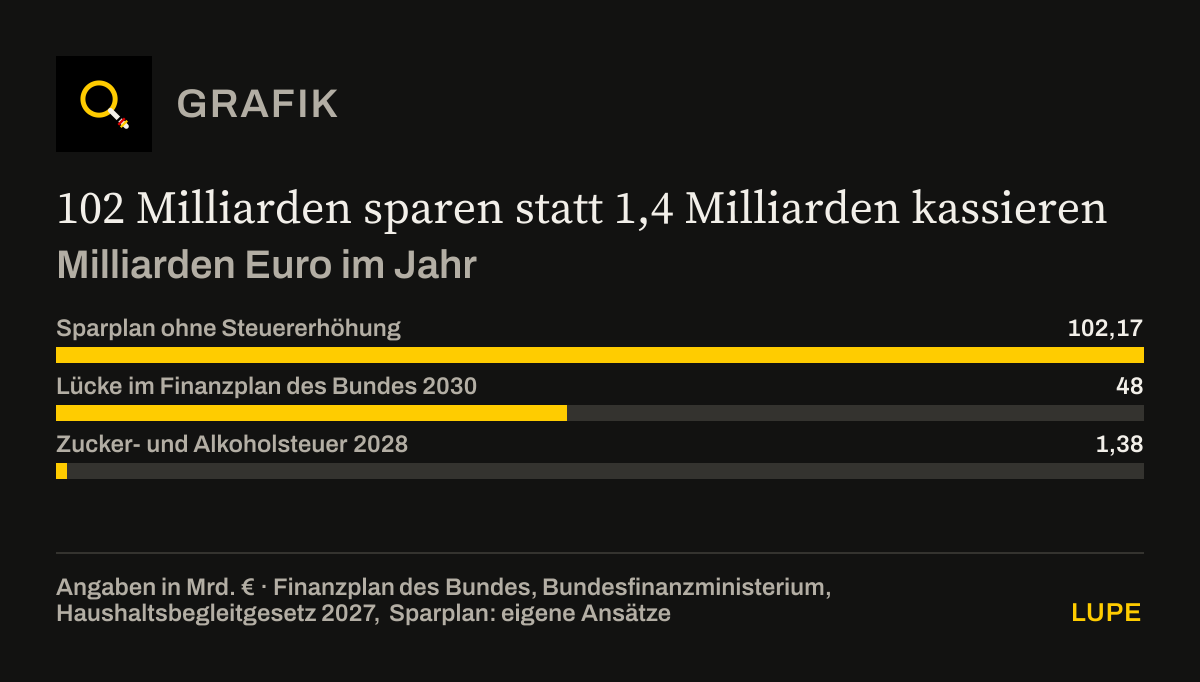
Save instead of collect. Sugar tax and alcohol duty are together to bring the federal government 1.38 billion euros in 2028.[3][4] The savings plan brings in more than 70 times as much.
Parts are enough. Of the 150-billion catalogue, only the parts that save within the state itself are needed: 85 billion euros of fixed cuts and 17 billion euros under conditions. The 45 billion euros from abolished tax concessions stay on the shelf. They would be tax increases.
But these parts in full. The federal financial plan is still 48 billion euros short for 2030.[1] Anyone who saves only by half ends up at the next levy again.
Reduce staff. The public service has grown by 507,100 employees since 2020 and by 970,000 since 2008.[2] The reduction can be achieved through retirements, without redundancies.
Secure the business location. Stop the combustion engine ban, make electricity cheaper, examine nuclear power without taboos, suspend the PPWR.
Save 102 billion instead of collecting 1.4 billion
Billions of euros a year
Federal financial plan[1], Bundesfinanzministerium (Federal Ministry of Finance)[3], Haushaltsbegleitgesetz 2027 (budget accompanying act)[4], savings plan: own estimates. Chart redrawn from the figures in the text.
Limits of the data: The savings plan is an estimate by the author at full effect around 2030, not an official estimate. Sugar tax and alcohol duty: 925 and 455 million euros in 2028.
Download the chart as an image (PNG)
Show data table3 rows
| Billions of euros a year (€bn) | |
|---|---|
| Savings plan without tax increases | 102.17 |
| Gap in the federal financial plan 2030 | 48 |
| Sugar tax and alcohol duty 2028 | 1.38 |
Seven demands
1. No new excise duties. Scrap the sugar tax and the higher alcohol duty, bury the plastic tax for good.
2. Cap the CO₂ price, rule out a toll. No price jump when EU emissions trading starts in 2028. No car toll.
3. Implement the savings plan in full. 102 billion euros a year, item by item.
4. Reverse the growth in staff. Back to the 2020 level, only through retirements.
5. Stop the combustion engine ban. Vote in the EU Council for genuine technology openness, not for 95 instead of 100 per cent.
6. Make electricity cheaper. Electricity tax for everyone at the EU minimum. Have nuclear power examined with an open mind.
7. Suspend the PPWR. First improve and simplify, then apply.
The grab at the till
Indirect taxes appear on no payslip. They are hidden in the price: at the pump, in the supermarket, at the counter. Anyone who earns little spends most of their money on consumption and therefore pays the most in relative terms. That is exactly what I mean by underhand. A good year and a half after the chancellor’s promise, a sugar tax and an alcohol duty raised by 20 per cent are before the Bundestag.[5][3]
„Wir haben einen Koalitionsvertrag, und da steht keine Steuererhöhung drin, es wird auch keine geben.“
Translation: We have a coalition agreement, and there is no tax increase in it, and there will not be one either.
| Levy | Status on 10 November 2026 | What it costs | My demand |
|---|---|---|---|
| CO₂ levy | National emissions trading with a price corridor of €55 to €65 per tonne, 2026 and 2027. From 2028 EU emissions trading for buildings and transport is to start.[7] | Around €16bn of revenue in 2025.[8] Surcharge in 2026: 15.7 to 18.6 cents per litre of petrol, 17.3 to 20.5 cents per litre of diesel.[9] | No further increases. Push through a price cap before 2028. |
| Car toll | No government plan. Transport minister Bilger: “A mandate to introduce a car toll – I don’t have one.”[10] Experts are campaigning for it, the construction industry is calling for it.[11][12] | Model calculation by Agora Verkehrswende: around €33bn a year.[11] | Rule it out with binding effect. |
| Sugar tax | On 14 October 2026 the cabinet adopted drafting assistance: 26 cents per litre from 5 g of sugar per 100 ml, 32 cents from 8 g, start 1 July 2027.[3] The Union wants to postpone it to 2028.[13] | €690m in 2027, €925m in 2028.[3] | Scrap it. |
| Alcohol duty | 20 % more on alcohol, sparkling wine, intermediate products and alcopop duty from 1 January 2027. Part of the Haushaltsbegleitgesetz 2027 (budget accompanying act), which the Bundestag is debating.[5] | €380m in 2027, €455m in 2028.[4] | Scrap it. |
| Plastic tax | Union parliamentary group chairman Frei: “We are not doing the plastic tax.” As a result, more than €1bn a year is missing from 2028. By Thursday, 12 November 2026, the Union is to put forward proposals for the gap.[13] | More than €1bn a year from 2028.[13] | Stick to that. Close the gap by saving, not with the next levy. |
The arithmetic: sugar tax and alcohol duty are together to bring in 1.38 billion euros in 2028. For the sugar and plastic taxes, early finance ministry papers envisaged 1,046 new posts, most of them in customs.[14] Anyone who saves 102 billion euros within the state needs none of these levies. More on this in Die Aufrechte Lupe.[15]
Almost a million more employees since 2008, half a million since 2020
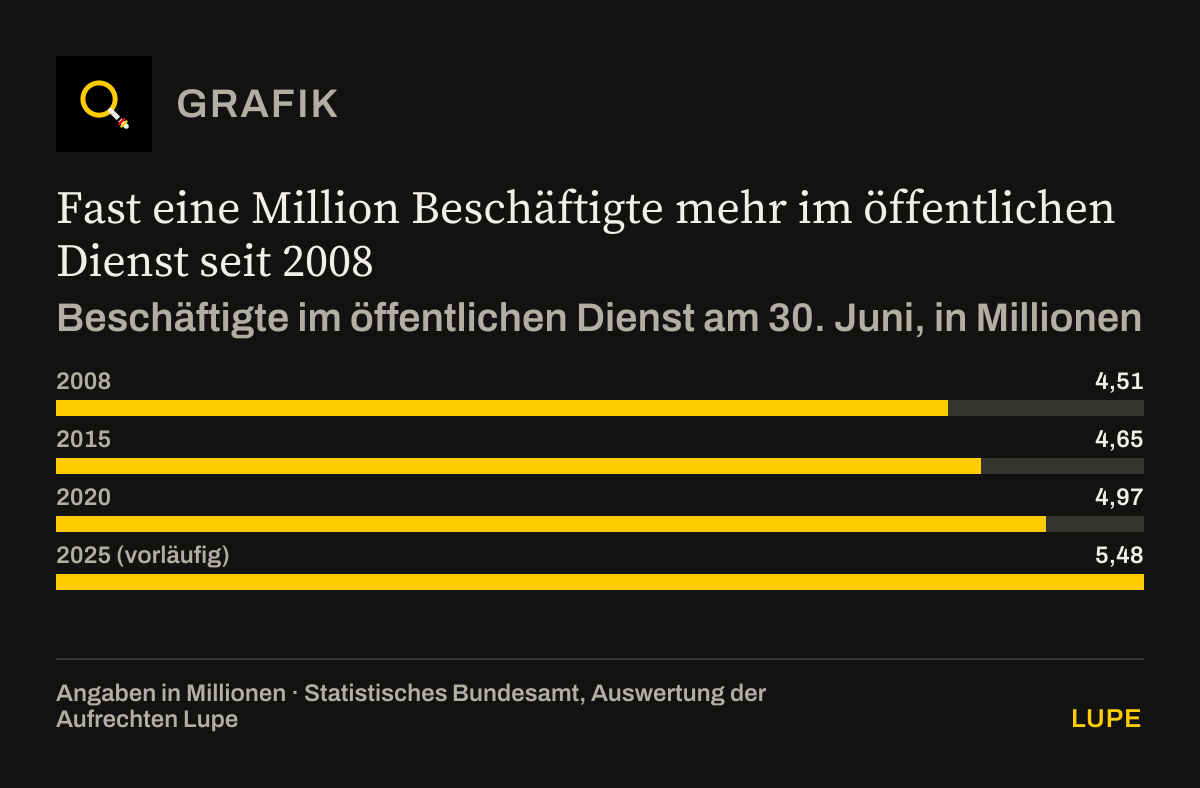
On 30 June 2025, 5,475,100 people were working in the public service. That is around 12 per cent of all people in employment and 95,100 more than a year earlier.[16] Compared with 2020 it is 507,100 more, compared with 2008 as many as 970,000.[2][17] Less than half of the increase since 2020 is accounted for by schools, universities, day-care centres and police. 266,400 were added in all other areas.
Almost a million more employees in the public service since 2008
Employees in the public service on 30 June, in millions
Statistisches Bundesamt (Federal Statistical Office)[2], analysis by Die Aufrechte Lupe[17]. Chart redrawn from the figures in the text.
Download the chart as an image (PNG)
Show data table4 rows
| Employees in millions (millions) | |
|---|---|
| 2008 | 4.51 |
| 2015 | 4.65 |
| 2020 | 4.97 |
| 2025 (provisional) | 5.48 |
| Area | 2008 | 2020 | 2025 | since 2020 | since 2008 |
|---|---|---|---|---|---|
| Schools | 932,200 | 966,100 | 1,069,600 | +103,500 | +137,400 |
| Universities including university hospitals | 432,700 | 585,900 | 651,300 | +65,400 | +218,600 |
| Municipal day-care centres | 136,600 | 243,600 | 298,000 | +54,400 | +161,400 |
| Police | 307,000 | 341,400 | 358,800 | +17,400 | +51,800 |
| All other areas | 2,696,600 | 2,831,000 | 3,097,400 | +266,400 (+9.4 %) | +400,800 (+14.9 %) |
| Public service in total | 4,505,100 | 4,968,000 | 5,475,100 | +507,100 (+10.2 %) | +970,000 (+21.5 %) |
Without redundancies: according to the dbb (German civil service federation), at least 1.42 million employees will retire in the next ten years, that is 26.3 per cent.[18] Anyone who does not refill a good one in three of these posts is back at the 2020 level. For the full million since 2008 it would be two in three. The dbb sees it the other way round: it reports 631,000 missing employees.
The federal government is building up: the 2027 budget plans 310,487 posts in the federal administration, 4,752 more than in 2026. Staff costs rise by 7.5 per cent to 51.62 billion euros.[19] The coalition’s target is at least 8 per cent fewer staff by 2029. The draft for 2027 contains a savings requirement of 2 per cent.[20]
What it brings: in 2025 the state paid around 383.8 billion euros in compensation of employees.[21] That is about 70,000 euros per head. 507,100 employees correspond roughly to 35 billion euros a year. That is a rough estimate, not a budget figure. Of this, only the federal level appears in the savings list, with 5 billion euros.
My demand: reverse the growth since 2020 by 2035 – at federal level immediately, with the Länder and municipalities through a staffing pact. The way to do it is to drop tasks, digitalise and not refill posts that fall vacant. The million since 2008 remains the long-term goal.
Four questions that need an answer now
Saving alone does not rescue a business location. From 2018 to 2025 the German economy grew by 2.0 per cent in real terms, that is 0.3 per cent a year and last place among 20 economies compared. Industry is producing 15.2 per cent less than in 2018; for motor vehicles it is 23.2 per cent less.[22]
Question 1: How will you rescue our automotive industry? Stop the combustion engine ban.
At the end of June 2026 only 691,500 people were still working in the car industry, 5.8 per cent fewer than a year earlier and fewer than at any time since 2005.[23] The VDA (German Association of the Automotive Industry) expects 225,000 jobs to be lost by 2035 compared with 2019. Around 100,000 of them are already gone. By its calculation, technology openness could preserve about 50,000.[24] The law in force remains: a 100 per cent CO₂ reduction for new cars from 2035. The Commission has proposed 90 per cent; you and President Macron want a further ten points.[25] The European Parliament’s committees voted for 95 per cent on 4 November; the plenary and the Council are to follow in December.[26][27] You yourself have lobbied Ursula von der Leyen for “highly efficient combustion engines”.[28]
My demand: stop the ban entirely, not 95 per cent of it. In the Council, agree only to rules that permanently allow combustion engines running on climate-friendly fuels, hybrids and range extenders after 2035 as well.
Question 2: How do you intend to lower energy costs?
In the first half of 2026 households paid an average of 36.18 cents per kilowatt hour. Only Ireland was more expensive; the EU average was 28.32 cents.[29] Businesses paid 21.8 cents, in France 17.4 cents.[30] A third of the household price is taxes, levies and surcharges: 12.6 cents.[31] Cutting the electricity tax for everyone to the EU minimum, from 2.05 to 0.1 cents, costs around 5 billion euros a year. You said on this: “But we should do it.” Your finance minister sees “no new room for manoeuvre”.[32]
My demand: cut the electricity tax for everyone. The 5 billion euros are covered around 20 times over by the savings list. The subsidies on the electricity price may only fall once electricity is permanently cheaper. That is why they appear in the list only as “conditional”.
Question 3: When will you discuss and examine nuclear power constructively?
Question 3
Early 2030s
is when the EU Commission expects the first small modular reactors in Europe.[34]
In mid-March 2026 you said that a return to nuclear power was not an option for the near future. Your economy minister Katherina Reiche told the Financial Times: “We can say that we are interested in this technology again.”[33] On 10 March 2026 the EU Commission presented a strategy for small modular reactors.[34] The Bundesumweltministerium (Federal Environment Ministry), by contrast, explains why in its view such reactors “are not better”.[35]
My demand: by mid-2027, have an independent examination of what nuclear power in Germany would cost, how long it would take and what it would do for the electricity price: new reactors, small modular reactors, European stakes. Publish the result. I am not asking for a decision in advance, but for an honest examination.
Question 4: When will you stop the PPWR madness?
The EU packaging regulation has applied since 12 August 2026.[36] On 7 September the federal government proposed relief: traders with less than 10 tonnes of packaging a year are not to have to name an authorised representative, and registration is to be suspended until mid-2028.[37] The European Parliament and the Council adopted their positions on this in October; the negotiations are still to come.[38] The Mittelstandsunion (the CDU/CSU small business wing) demands more: “suspend, improve, simplify – and only then apply with legal certainty”.[39] Until then the obligations apply, with fines of up to 200,000 euros.[40][41]
My demand: push through the suspension until the central EU register is in place, and for all businesses, not just for micro-traders. No national add-ons, no fines in the transition period.
150 billion are on the table, I recommend 102 billion
Each row gives the proposal as a percentage of the base and the amount per year at full effect around 2030. The base is the documented starting value in billions of euros, mostly from the 2027 draft budget. The amounts are my estimates, not official estimates. For comparison: the government itself shows a gap of 48 billion euros for 2030.[1]
Each item has a status. Core means: a fixed spending cut that the federal government can decide on itself. Conditional means: achievable only under a condition, for instance through an EU negotiation, the labour market or permanently cheaper electricity. Not recommended means: the item is in the catalogue but is not recommended, because it works like a tax increase or weakens defence.
| Item | Proposal | Base in €bn | €bn a year | Status |
|---|---|---|---|---|
| Adjust existing pensions only in line with inflation for some years[42] | −70 % of the adjustment | 18.0 | 12.5 | Core |
| Do not extend the floor on the pension level[43] | −100 % | 9.3 | 9.0 | Core |
| Reverse Mütterrente III (mothers’ pension)[43] | −100 % | 5.0 | 5.0 | Core |
| End early retirement without deductions for new entrants | new entrants only | own estimate | 1.5 | Core |
| Reverse the Aktivrente and the Frühstartrente[44][45] | −100 % | 1.1 | 1.1 | Core |
| Curb civil service pensions in line with statutory pensions[46] | −3 % | 16.8 | 0.5 | Core |
| Total | 29.6 | Core 29.6 |
| Item | Proposal | Base in €bn | €bn a year | Status |
|---|---|---|---|---|
| Cut building subsidies back to a good third[47] | −64 % | 12.56 | 8.0 | Core |
| Cut electricity price aid: grid fee subsidy, electricity price compensation, industrial electricity price[47] | −58 % | 12.98 | 7.5 | conditional |
| Hydrogen, charging infrastructure, electric car subsidies[48] | Partial cut | own estimate | 4.0 | Core |
| Other support programmes of the fund[48] | Partial cut | own estimate | 4.0 | Core |
| No EEG (renewable energy act) support for new installations | −100 % for new ones | own estimate | 2.5 | Core |
| Total | 26.0 | Core 18.5 · conditional 7.5 |
| Item | Proposal | Base in €bn | €bn a year | Status |
|---|---|---|---|---|
| Reach the 3.5 per cent target only in 2032 instead of 2029[1] | −5.4 % | 183.7 | 10.0 | Core |
| Further stretching to the NATO deadline of 2035[49] | −1.6 % | 183.7 | 3.0 | not recommended |
| Total | 13.0 | Core 10.0 · not recommended 3.0 |
| Item | Proposal | Base in €bn | €bn a year | Status |
|---|---|---|---|---|
| Social housing: €2bn instead of €5bn[50] | −60 % | 5.0 | 3.0 | Core |
| Supplementary grants to the Länder[51] | −18 % | 11.3 | 2.0 | Core |
| Refugees and migration: lump sums, reception, integration[52] | −8 % | 24.8 | 2.0 | Core |
| Subsidy for the Deutschlandticket[53] | −100 % | 1.5 | 1.5 | Core |
| Regionalisation funds for local public transport[54] | −10 % | 13.7 | 1.4 | Core |
| Total | 9.9 | Core 9.9 |
| Item | Proposal | Base in €bn | €bn a year | Status |
|---|---|---|---|---|
| Get an additional 200,000 people into work[55][56] | −4 % of those entitled | 4.95 million entitled | 6.0 | conditional |
| Cap housing costs[57] | −10 % | 13.15 | 1.3 | Core |
| Slim down job centre administration[58] | −15 % | 7.97 | 1.2 | Core |
| Lower the standard rate to the calculated need[59] | −1.3 % | 27.7 | 0.35 | Core |
| Total | 8.85 | Core 2.85 · conditional 6.0 |
| Item | Proposal | Base in €bn | €bn a year | Status |
|---|---|---|---|---|
| Federal staff costs[60] | −10 % | 51.62 | 5.0 | Core |
| Culture budget including Deutsche Welle[61] | −15 % | 2.1 | 0.3 | Core |
| Budget lines for civil society and for family, equality and senior citizens policy[62] | −50 % | 0.50 | 0.25 | Core |
| Consultants, campaigns, press office[63] | −50 % | own estimate | 0.2 | Core |
| Party-affiliated foundations, excluding the share in the development budget[64] | −29 % | 0.69 | 0.2 | Core |
| “Demokratie leben!” programme (Live Democracy!)[62] | −100 % | 0.17 | 0.17 | Core |
| Bundestag and state funding of political parties[65][66] | −10 % | 1.51 | 0.15 | Core |
| Total | 6.27 | Core 6.27 |
| Item | Proposal | Base in €bn | €bn a year | Status |
|---|---|---|---|---|
| Halve the development budget and voluntary UN contributions[67] | −50 % | 9.47 | 5.0 | Core |
| Halve humanitarian aid and crisis prevention, remainder in the row above[68] | −50 % | 1.43 | 0.25 | Core |
| Foreign cultural policy[68] | −25 % | 0.96 | 0.25 | Core |
| Total | 5.5 | Core 5.5 |
| Item | Proposal | Base in €bn | €bn a year | Status |
|---|---|---|---|---|
| Freeze the contribution at the 2027 level: €42.1bn instead of €45.8bn in 2030[69] | −8 % | 45.8 | 3.5 | conditional |
| Item | Proposal | Base in €bn | €bn a year | Status |
|---|---|---|---|---|
| Agricultural social policy[70] | −25 % | 4.30 | 1.1 | Core |
| Elterngeld (parental allowance): lower income limit[62] | −14 % | 7.07 | 1.0 | Core |
| Space[71] | −20 % | 2.24 | 0.45 | Core |
| Total | 2.55 | Core 2.55 |
| Item | Proposal | Base in €bn | €bn a year | Status |
|---|---|---|---|---|
| Replace Ehegattensplitting (income splitting for married couples) with Realsplitting[72] | Restructuring | own estimate | 8.0 | not recommended |
| Diesel tax privilege[48] | −100 % | 7.0 | 7.0 | not recommended |
| Inheritance tax: relief for business assets[73] | −50 % | 8.8 | 4.4 | not recommended |
| Reduced VAT for culture and entertainment[73] | −100 % | 4.32 | 4.3 | not recommended |
| Company car tax privilege[48] | −100 % | 4.0 | 4.0 | not recommended |
| VAT on restaurant food back to 19 %[74] | −100 % | 3.6 | 3.6 | not recommended |
| Tax-free supplements for Sunday, public holiday and night work[73] | −100 % | 3.25 | 3.25 | not recommended |
| Reverse the electricity tax cut for businesses[75] | −100 % | 3.0 | 3.0 | not recommended |
| Tax bonus for tradespeople’s services[73] | −100 % | 2.5 | 2.5 | not recommended |
| Commuter allowance: halve the remaining amount[76] | −50 % | 5.0 | 2.5 | not recommended |
| Commuter allowance: reverse the 2026 increase[74] | −100 % | 1.9 | 1.9 | not recommended |
| Agricultural diesel relief[48] | −100 % | 0.4 | 0.4 | not recommended |
| Total | 44.85 | not recommended 44.85 |
| Status | What it includes | €bn a year |
|---|---|---|
| Core | Fixed spending cuts from eight blocks | 85.17 |
| Conditional | EU contribution 3.5 · 200,000 people into work 6.0 · electricity price aid 7.5 | 17.00 |
| Recommended | Without any tax increase | 102.17 |
| Not recommended | Tax concessions 44.85 · further stretching of defence 3.0 | 47.85 |
| Catalogue in total | 150.02 |
Where the 102 billion come from and what this proposal does not achieve
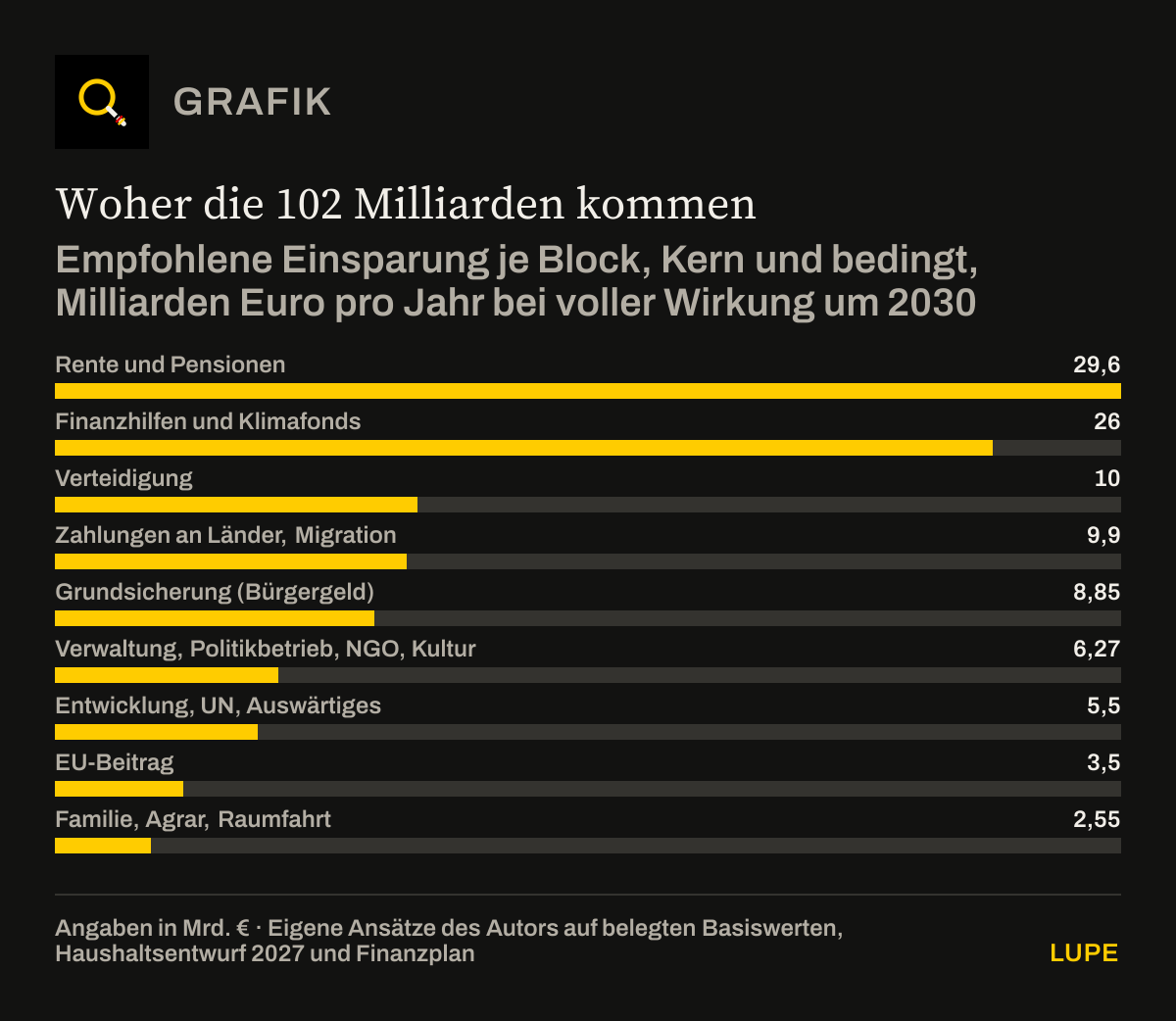
Almost a third of the recommended plan lies in pensions, a quarter in financial aid and the climate fund. The largest bar remains untouched: the 44.85 billion euros from abolished tax concessions would be tax increases.
Where the 102 billion come from
Recommended savings per block, core and conditional, billions of euros a year at full effect around 2030
The author’s own estimates on documented base values, 2027 draft budget and financial plan[1][69]. Chart redrawn from the figures in the text.
Limits of the data: Of which conditional: financial aid and climate fund 7.5, basic income support 6.0, EU contribution 3.5. Not included because not recommended: tax concessions 44.85 and a further stretching of defence 3.0.
Download the chart as an image (PNG)
Show data table9 rows
| Recommended (€bn) | |
|---|---|
| Statutory and civil service pensions | 29.6 |
| Financial aid and climate fund | 26 |
| Defence | 10 |
| Payments to the Länder, migration | 9.9 |
| Basic income support (Bürgergeld) | 8.85 |
| Administration, political apparatus, NGOs, culture | 6.27 |
| Development, UN, foreign affairs | 5.5 |
| EU contribution | 3.5 |
| Family, agriculture, space | 2.55 |
What I expressly do not claim
Not a million in five years. The public service has grown by 507,100 employees since 2020. The 970,000 apply to the period since 2008.[2]
No planned car toll. The federal government is not planning one; the transport minister denies having a mandate. It is being called for by experts and the construction industry.[10][12]
Not a tax in the legal sense. The CO₂ levy is an emissions trading scheme with a price corridor. At the pump it works like a tax.[7]
No money from tomorrow. The list takes full effect around 2030. In the first year I consider around a third achievable.
No cut without people affected. The proposals hit pensioners, the Länder, recipients of subsidies and aid organisations. The difference: this is decided openly, not hidden in the price.
No direct control by the chancellor over staffing. The federal government can only cut its own posts. For the Länder and municipalities an agreement is needed.
Andreas W. HerbFounder and CEO MBG Group, Paderborn
METHOD
Method
Amounts: all savings are the author’s own estimates per year at full effect, calculated on the base values stated. They are not official estimates.
Status: core 85.17 billion euros, conditional 17.00 billion euros, not recommended 47.85 billion euros. Core and conditional are recommended, together 102.17 billion euros. Including the items not recommended, the catalogue comprises 150.02 billion euros.
Scope: the 10 billion euros in defence reduce new borrowing, not the gap in the core budget. The pensions item relieves the federal budget only if the federal subsidy falls accordingly. The 6 billion euros in basic income support are calculated for general government as a whole.
Staff: 383.77 billion euros of government compensation of employees divided by 5.475 million employees gives around 70,000 euros per head; times 507,100 that is around 35 billion euros. The definitions of the two statistics differ, and heads are not full-time posts. The value is an order of magnitude.
Public service: 5,475,100 − 4,968,000 = 507,100, that is 10.2 per cent. 5,475,100 − 4,505,100 = 970,000, that is 21.5 per cent. Schools, universities, day-care centres and police together +240,700 since 2020, that is 47.5 per cent of the increase. 507,100 ÷ 1.42 million retirements = 36 per cent, a good one post in three; 970,000 ÷ 1.42 million = 68 per cent, two in three.
Comparison with the excise duties: sugar tax and alcohol duty 2028: 925 + 455 = 1,380 million euros. That is 1.35 per cent, rounded 1.4 per cent, of 102.17 billion euros. 102.17 ÷ 1.38 = 74, so more than 70 times as much. Electricity tax: 102.17 ÷ 5 = 20.4, covered around 20 times over.
Business location: car industry 691,500 + 42,300 = 733,800 a year earlier, 42,300 ÷ 733,800 = 5.8 per cent. Growth of 2.0 per cent in seven years: 1.020 to the power of 1/7 = 1.0028, i.e. 0.3 per cent a year.
Not touched: interest, investment, aid to Ukraine and the subsidy to the health insurance funds.
As at: data and status of procedures on 10 November 2026. The 2027 budget has not yet been adopted.
CHECK
What was checked before publication
- The basis is the author’s open proposal as a PDF, 7 pages, as at 10 November 2026. According to the author, the factual statements have been checked several times. Many of them already appear in checked reports by Die Aufrechte Lupe, for instance on the public service, on growth since 2018, on consumption taxes and on the packaging regulation.
- For this version the editorial team recalculated every calculation on 10 November 2026: every block total of the savings list, every percentage, the totals of 102.17 and 150.02 billion euros, the table on the public service, shares and multiples. All values are correct. The sources were not individually accessed again for this version.
- The savings amounts in the list are the author’s estimates, not official estimates. The base values they refer to are documented.
- Changed compared with the PDF: the Union’s deadline for proposals on the plastic tax is given as a date, not as a day of the week. The legal notice has been dropped because it has its own page on this website. The source list therefore has 76 rather than 77 entries.
- The federal government and the Bundesfinanzministerium (Federal Ministry of Finance) were not asked for comment.
SOURCES
Sources
Every number in the text leads to its source. The origin is given at each entry: official, media report, trade association, institute or data portal. Titles stay in the original language, so that each document can still be found.
[1] Deutscher Bundestag, heute im bundestag, 14.08.2026
Finanzplan bis 2030Official source↑ back to the text
[2] Statistisches Bundesamt, Stand 22.06.2026
Beschäftigte im öffentlichen Dienst nach ausgewählten AufgabenbereichenOfficial source↑ back to the text
[3] Bundesministerium der Finanzen, 14.10.2026
Pressemitteilung: Gesetzentwurf zur ZuckergetränkesteuerOfficial source↑ back to the text
[4] Deutscher Bundestag, abgerufen 10.11.2026
Haushaltsbegleitgesetz 2027Official source↑ back to the text
[5] Deutscher Bundestag, 07.09.2026
Drucksache 21/7860: Entwurf eines Haushaltsbegleitgesetzes 2027Official source↑ back to the text
[6] tagesschau, 19.04.2025
Merz bei Caren Miosga zu SteuererhöhungenMedia report↑ back to the text
[7] Deutscher Bundestag, heute im bundestag, abgerufen 10.11.2026
CO2-Preis 2027Official source↑ back to the text
[8] Umweltbundesamt, abgerufen 10.11.2026
Emissionshandel 2025: EinnahmenOfficial source↑ back to the text
[9] ADAC, abgerufen 10.11.2026
CO2-Preis: Aufschlag je Liter Benzin und DieselTrade association↑ back to the text
[10] Der Spiegel, 20.08.2026
Verkehrsminister Steffen Bilger arbeitet nicht an Pkw-MautMedia report↑ back to the text
[11] Die Zeit, 08.10.2026
Autobahnmaut für Pkw-FahrerMedia report↑ back to the text
[12] Verkehrsrundschau, abgerufen 10.11.2026
Pkw-Maut soll Verkehrsinfrastruktur finanzierenMedia report↑ back to the text
[13] tagesschau, 09.11.2026
Baustellen im Haushalt: Steuerpläne der BundesregierungMedia report↑ back to the text
[14] t-online, 06.10.2026
Zuckersteuer und Plastiksteuer: 1.046 neue Beamte benötigtMedia report↑ back to the text
[15] Die Aufrechte Lupe, 14.10.2026
Klingbeils indirekte Steuern – Milliarden mehr Belastung für die BürgerMedia report↑ back to the text
[16] Statistisches Bundesamt, Juni 2026
Pressemitteilung Nr. 215: Beschäftigte im öffentlichen DienstOfficial source↑ back to the text
[17] Die Aufrechte Lupe, 24.10.2026
970.000 mehr im öffentlichen Dienst seit 2008 – digitaler wird der Staat, schlanker nichtMedia report↑ back to the text
[18] dbb beamtenbund und tarifunion, 27.08.2026
Personalbedarfe im öffentlichen DienstTrade association↑ back to the text
[19] Initiative Neue Soziale Marktwirtschaft, 2026
Neue Studie zur Stellenmehrung in der BundesverwaltungTrade association↑ back to the text
[20] Deutscher Bundestag, heute im bundestag, 21.08.2026
Stelleneinsparung in der BundesverwaltungOfficial source↑ back to the text
[21] Statistisches Bundesamt, GENESIS, abgerufen 10.11.2026
Volkswirtschaftliche Gesamtrechnungen, Tabelle 81000-0031: Arbeitnehmerentgelt des StaatesData portal↑ back to the text
[22] Die Aufrechte Lupe, 26.10.2026
Sieben Jahre, zwei Prozent (Auswertung aus Daten von IWF und Eurostat)Media report↑ back to the text
[23] Statistisches Bundesamt, August 2026
Pressemitteilung: Beschäftigte in der AutomobilindustrieOfficial source↑ back to the text
[24] Verband der Automobilindustrie, 13.05.2026
Pressemeldung: Beschäftigungsentwicklung bis 2035Trade association↑ back to the text
[25] heise online, abgerufen 10.11.2026
Verbrenner-Aus: Merz und Macron wollen CO2-Ziel für 2035 weiter lockernMedia report↑ back to the text
[26] Zentralverband des Deutschen Handwerks, abgerufen 10.11.2026
Verbrennerverbot: EP-Ausschüsse stimmen für AuflockerungTrade association↑ back to the text
[27] elektroauto-news.net, abgerufen 10.11.2026
Verbrenner-Aus: EU-Umweltausschuss für LockerungMedia report↑ back to the text
[28] Der Spiegel, abgerufen 10.11.2026
Autoindustrie: Friedrich Merz wirbt in Brief an Ursula von der Leyen für flexiblere KlimazieleMedia report↑ back to the text
[29] Eurostat, abgerufen 10.11.2026
Electricity price statistics, erstes Halbjahr 2026Official source↑ back to the text
[30] Statista nach Eurostat, abgerufen 10.11.2026
Strompreise für Nicht-Haushaltskunden in der EUData portal↑ back to the text
[31] Bundesverband der Energie- und Wasserwirtschaft, Oktober 2026
BDEW-Strompreisanalyse Oktober 2026Trade association↑ back to the text
[32] tagesschau, 04.11.2026
Stromsteuer: Bundesregierung und EntlastungMedia report↑ back to the text
[33] Frankfurter Rundschau, abgerufen 10.11.2026
Wirtschaftsministerin Reiche fordert Neubewertung der AtomkraftMedia report↑ back to the text
[34] Europäische Kommission, Vertretung in Deutschland, 11.03.2026
Hohe Energiepreise: EU-Kommission prüft verschiedene OptionenOfficial source↑ back to the text
[35] Bundesministerium für Umwelt, Klimaschutz, Naturschutz und nukleare Sicherheit, abgerufen 10.11.2026
Kleine Atomkraftwerke vs. erneuerbare EnergienOfficial source↑ back to the text
[36] Amtsblatt der Europäischen Union, abgerufen 10.11.2026
Verordnung (EU) 2025/40 über Verpackungen und Verpackungsabfälle (PPWR)Official source↑ back to the text
[37] Bundesministerium für Umwelt, Klimaschutz, Naturschutz und nukleare Sicherheit, 07.09.2026
Kritik an der EU-Verpackungsverordnung PPWR: Bundesregierung setzt sich für Entlastungen einOfficial source↑ back to the text
[38] IHK Karlsruhe, abgerufen 10.11.2026
PPWR: EU-Umweltrat setzt sich für Aussetzungen einTrade association↑ back to the text
[39] n-tv, 15.10.2026
Wirtschaftsunion fordert Stopp der EU-VerpackungsregelnMedia report↑ back to the text
[40] Bundesministerium der Justiz, abgerufen 10.11.2026
Verpackungsrecht-Durchführungsgesetz (VerpackDG)Official source↑ back to the text
[41] Die Aufrechte Lupe, 15.10.2026
Offener Brief an Bundeskanzler Merz zur EU-VerpackungsverordnungMedia report↑ back to the text
[42] Berliner Zeitung, abgerufen 10.11.2026
Rente wie in Österreich: Was der Vorschlag für Ihr Geld im Alter wirklich bedeuten würdeMedia report↑ back to the text
[43] Nordwest-Zeitung, abgerufen 10.11.2026
Rentenpaket in Berlin: Mütterrente, Haltelinie und Aktivrente beschlossenMedia report↑ back to the text
[44] Der Spiegel, abgerufen 10.11.2026
Aktivrente: Kabinett beschließt Anreize für Arbeit im RentenalterMedia report↑ back to the text
[45] Deutscher Bundestag, abgerufen 10.11.2026
FrühstartrenteOfficial source↑ back to the text
[46] Bundesministerium des Innern, abgerufen 10.11.2026
BeamtenversorgungOfficial source↑ back to the text
[47] Deutscher Bundestag, heute im bundestag, abgerufen 10.11.2026
Klima- und TransformationsfondsOfficial source↑ back to the text
[48] Bundesrechnungshof, abgerufen 10.11.2026
Subventionen verdreifacht: enormes Einsparpotenzial noch nicht genutztOfficial source↑ back to the text
[49] Der Tagesspiegel, abgerufen 10.11.2026
Fast 125 Milliarden Euro: Deutschland meldet NATO Verteidigungsausgaben in RekordhöheMedia report↑ back to the text
[50] Bundesregierung, abgerufen 10.11.2026
Haushaltsgesetz 2027: Etat des BauministeriumsOfficial source↑ back to the text
[51] Bundesministerium der Finanzen, April 2026
Monatsbericht April 2026: Bundesstaatlicher Finanzausgleich 2025Official source↑ back to the text
[52] Deutscher Bundestag, heute im bundestag, abgerufen 10.11.2026
Flüchtlings- und IntegrationskostenOfficial source↑ back to the text
[53] Deutscher Bundestag, abgerufen 10.11.2026
RegionalisierungsgesetzOfficial source↑ back to the text
[54] Reutlinger General-Anzeiger, abgerufen 10.11.2026
Finanzstreit zu Regionalverkehr: Einschnitte in FahrplänenMedia report↑ back to the text
[55] tagesschau, abgerufen 10.11.2026
Bürgergeld: Merz und BasMedia report↑ back to the text
[56] Südkurier, abgerufen 10.11.2026
Wie viele Empfänger der neuen Grundsicherung gibt es in Deutschland?Media report↑ back to the text
[57] Deutscher Bundestag, heute im bundestag, abgerufen 10.11.2026
Etat Arbeit und SozialesOfficial source↑ back to the text
[58] HNA, abgerufen 10.11.2026
Bürgergeld-Kosten 2025 auf RekordhochMedia report↑ back to the text
[59] Kreisbote, abgerufen 10.11.2026
Bürgergeld zu hoch: bislang geheime Zahlen zu Regelsatz und BedarfMedia report↑ back to the text
[60] Initiative Neue Soziale Marktwirtschaft, 04.09.2026
Studie: Stellenmehrung in der BundesverwaltungTrade association↑ back to the text
[61] Deutscher Kulturrat, abgerufen 10.11.2026
Kulturpolitischer Wochenreport: Bundeskulturhaushalt 2027Trade association↑ back to the text
[62] Deutscher Bundestag, heute im bundestag, abgerufen 10.11.2026
Etat Bildung und FamilieOfficial source↑ back to the text
[63] Der Spiegel, abgerufen 10.11.2026
Bundesrechnungshof kritisiert teure Berater für RegierungMedia report↑ back to the text
[64] Wikipedia, abgerufen 10.11.2026
Parteinahe Stiftung (Deutschland)Media report↑ back to the text
[65] Deutscher Bundestag, heute im bundestag, abgerufen 10.11.2026
Etat des BundestagesOfficial source↑ back to the text
[66] Deutscher Bundestag, heute im bundestag, abgerufen 10.11.2026
Staatliche ParteienfinanzierungOfficial source↑ back to the text
[67] Deutscher Bundestag, heute im bundestag, abgerufen 10.11.2026
EntwicklungsetatOfficial source↑ back to the text
[68] Deutscher Bundestag, heute im bundestag, abgerufen 10.11.2026
Etat des Auswärtigen AmtsOfficial source↑ back to the text
[69] Deutscher Bundestag, abgerufen 10.11.2026
Drucksache 21/7301: Finanzplan des BundesOfficial source↑ back to the text
[70] Deutscher Bundestag, heute im bundestag, abgerufen 10.11.2026
AgraretatOfficial source↑ back to the text
[71] Deutscher Bundestag, heute im bundestag, abgerufen 10.11.2026
ForschungsetatOfficial source↑ back to the text
[72] iwd, Institut der deutschen Wirtschaft, abgerufen 10.11.2026
Was bringt eine Reform des Ehegattensplittings?Institute or public body↑ back to the text
[73] RedaktionsNetzwerk Deutschland, abgerufen 10.11.2026
Top 10 der Subventionen: die größten Steuervergünstigungen und Finanzhilfen 2025Media report↑ back to the text
[74] tagesschau, abgerufen 10.11.2026
Bundeskabinett beschließt SteuerentlastungenMedia report↑ back to the text
[75] Joyn Newstime, abgerufen 10.11.2026
Merz will Stromsteuer für alle senken, Klingbeil bremstMedia report↑ back to the text
[76] HNA, abgerufen 10.11.2026
Ab 2026 neue Pendlerpauschale: Was Millionen Autofahrer erwartetMedia report↑ back to the text
CORRECTIONS
Corrections
No corrections since publication on 10/11/2026. Every substantive change appears here with its date, reason and previous wording.
This page is opinion. Our fact checks are not.