OPINIONCOMMENTARYPLASTIC TAX
Promised: no tax increases. Planned: a plastic tax with 819 new posts
On the day of the bureaucracy report, the draft of a new excise duty is on the table. In the end it is the customers at the till who are to pay it.
By Andreas W. Herb, CEO MBG Group, Paderborn
7 minutes read25 sources0 correctionsDisclosure
Share
Contents
Today the federal cabinet adopted its interim report on modernising the state.[2] On the bureaucracy costs of business it so far shows net relief of around 232 million euros a year; the report itself speaks of “merely” this sum.[1] At the same time there is a draft act from the coalition parliamentary groups for a new excise duty on plastic packaging: 550 euros per tonne from July 2027, 819 additional posts in customs and administration, and new reporting obligations for companies.[4][9]
Politically the cabinet decided on the plastic tax on 6 July 2026 with the draft federal budget for 2027.[4] It has not discussed the text of the act. According to a letter from seven business associations and the customs and finance union BDZ to the Chancellery, it is to reach the ongoing budget procedure as drafting assistance, without the involvement of the departments responsible.[5] According to dpa the draft from the finance and environment ministries is still to be agreed within the government.[13]
Additional posts for a single tax
819
The draft reckons with 788 full-time posts at customs, 28 at the federal IT service provider and 3 at the federal finance ministry.[4] For the sugar tax, also planned, around 227 posts would be added according to reports.[3]
| Indicator | Value according to the draft |
|---|---|
| Tax rate | €550 per tonne, that is 55 cents per kilogram of plastic[9] |
| Start of collection | 1 July 2027[4] |
| Revenue | €805m in the half-year 2027, €1.485bn in the first full year 2028, falling slightly thereafter[4] |
| Federal spending on implementation | €283.5m from 2026 to 2029, around €103.6m a year from 2029[4] |
| Bureaucracy costs for business | €44.1m a year, plus €8.8m one-off[4] |
| Burden per household | around €36 a year if passed on in full (our own calculation)[4][18] |
What was promised, what is now planned
| Promised | Planned |
|---|---|
| “I rule out tax increases. They would be poison for our economy.” Friedrich Merz on ZDF-Morgenmagazin, 21 February 2025[6] | A new excise duty with revenue of just under 1.5 billion euros a year[4] |
| Coalition agreement: cut the bureaucracy costs of business by 25 per cent, around 16 billion euros[7] | New reporting obligations of 44.1 million euros a year according to the draft; the associations estimate the total compliance cost at at least 600 million euros a year[4][5] |
| Coalition agreement: cut posts in the federal administration by eight per cent by 2029, security agencies excepted[7] | 819 additional posts for one tax[4] |
An express “no tax increases” does not appear in the coalition agreement; the agreement raises, for instance, the minimum rate of trade tax.[7] The promise comes from today’s chancellor himself. According to a Handelsblatt report, the retail association nevertheless speaks of a breach of the coalition agreement.[8]
And the plastic tax is not the only new tax. For the sugar tax the federal government reckons on around 1.2 billion euros a year from 2028; together the two would come to more than 2.5 billion.[25][3] On 1 October the Chancellery halted the draft on the sugar tax for the time being.[10]
More bureaucracy rather than less
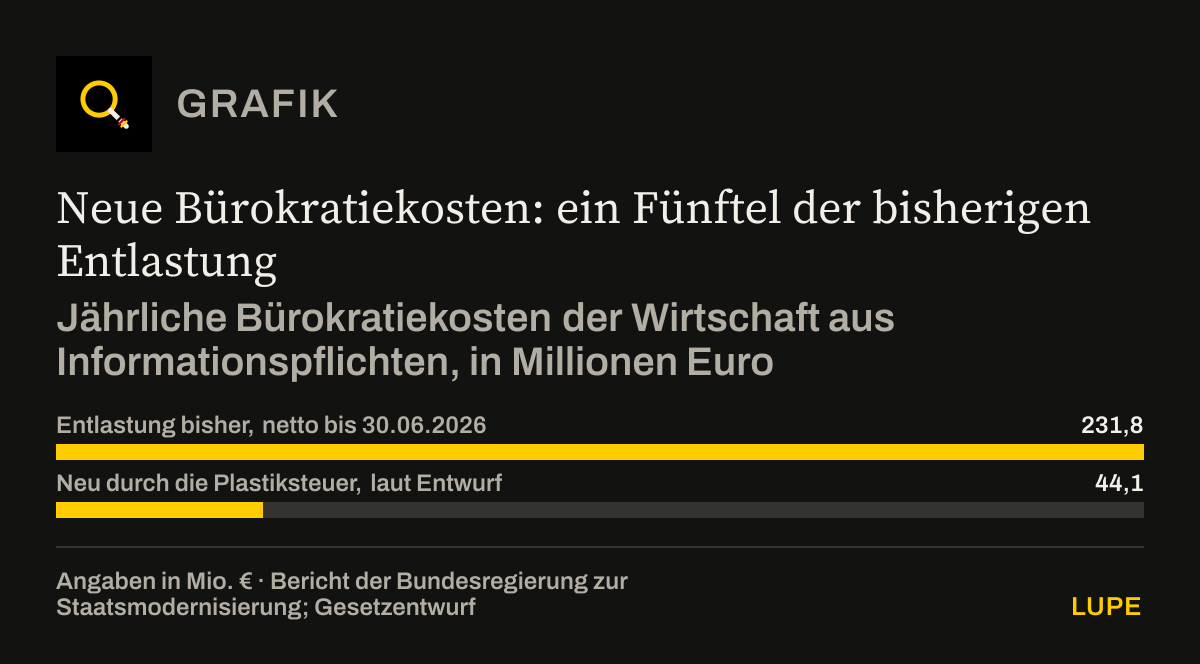
The draft puts the new bureaucracy costs for business at 44.1 million euros a year, plus 8.8 million one-off.[4] That is around a fifth of what the federal government had cut from bureaucracy costs, net, by the end of June.[1] For customs, IT and the ministry the federal government plans spending of 283.5 million euros up to 2029.[4]
New bureaucracy costs: a fifth of the relief achieved so far
Annual bureaucracy costs for business arising from reporting obligations, in millions of euros
Federal government report on modernising the state[1]; draft act[4]. Chart redrawn from the figures in the text.
Limits of the data: Both values measure the same thing: annual costs arising from reporting obligations on business. The associations’ estimate of 600 million euros relates to the total compliance cost and therefore does not appear in this chart.
Download the chart as an image (PNG)
Show data table2 rows
| Bureaucracy costs a year (€m) | |
|---|---|
| Relief so far, net to 30/06/2026 | 231.8 |
| New from the plastic tax, according to the draft | 44.1 |
The associations consider the official value far too low. They estimate the compliance cost at at least 600 million euros a year and themselves call for an independent examination.[5] That would be a good third of what the government has so far saved on the compliance cost of business: 1.7 billion euros.[1]
It is even unclear who owes the tax. The draft attaches to the “extraction” of packaging; in the assessment of Plastics Europe, packaging law does not know this term.[4][11] Relief for packaging made from recycled plastic is something the federal government intends to introduce only by statutory instrument, and a system of proof for it is still missing.[4] Even the customs and finance union, whose members would have to collect the tax, warns together with the associations against an “unprecedented fast-track procedure”.[5]
What it means for industry
According to its own association, German plastics production in 2025 was 26 per cent below the 2021 level.[12] But it is not only the makers of plastic who are affected; it is everyone who packages: food and drinks manufacturers, retail and logistics. Films, closures, lids, capsules and transport packaging are covered too.[13] According to a report in packaging journal, the draft does not distinguish between single-use and reusable.[14]
Ecologically, a tax on plastic alone is contested. A report commissioned by the Federal Environment Agency warned in 2023 of mis-steering in favour of other materials, some of them ecologically worse.[15] The final report of 2025 nevertheless considers an entry point via plastic packaging possible, combined with incentives for recycling-friendly design.[16] In April 2026 Austria dropped a planned levy on non-recyclable plastic packaging after resistance from business and retail, which warned of the effort involved and of more expensive food.[17]
In the end the customer pays
The draft says so itself: the tax is “designed so that those liable pass the burden on to the end customer”. As its aim it names in first place “additional revenue for the federal budget”; the tax “can at the same time” contribute to less plastic packaging.[4]
Per item it sounds small: 1.93 cents per large PET bottle, 0.28 cents per yoghurt pot.[3] But it hits almost every packaged product in the shopping trolley. At just under 1.5 billion euros a year and around 41 million households, if passed on in full that is around 36 euros per household per year.[4][18] On top would come the sugar tax, if it comes after all, and possible mark-ups along the supply chain.
What belongs to a fair assessment
The tax has a background. Since 2021 Germany has paid the EU a levy of 0.80 euros per kilogram of non-recycled plastic packaging waste, around 1.25 billion euros in 2026.[19][20] According to the draft the new tax is to bring in an amount of this order for the federal budget on a permanent basis.[4] The previous coalition already wanted to pass the EU levy on to producers and those placing goods on the market in 2024.[22]
What also belongs here is what the federal government itself stated in 2023: because Germany’s share of the EU plastics levy is smaller than its share of contributions based on economic strength, no additional costs arise for taxpayers.[21] For me that means: the new tax does not offset an additional burden, it creates a new source of revenue. Its planned yield is also above the EU contribution.[4][19]
There are supporters too. Deutsche Umwelthilfe calls it “important and right” that single-use plastic packaging should have a price, and demands that reusable packaging be exempted and that paper and metal be included.[13][23]
What I demand
First: no new tax by fast-track procedure. An act that creates hundreds of posts and makes almost every purchase more expensive belongs in a regular procedure with a cabinet decision, agreement between the ministries and a hearing.
Second: keep your word. A promise against tax increases applies to excise duties too.
Third: honest costs. Before parliament debates it, the national regulatory control council should examine the costs independently. Between 44 million euros according to the draft and 600 million according to the associations lies too much latitude.
Fourth: circularity rather than the till. Packaging law already provides for licence fees to be graded by recyclability and recycled content; the environment ministry has to issue the necessary regulation.[24] The coalition agreement announced a reform of this rule.[7]
Fifth, to the members of parliament from the Union: do not vote for a new tax that breaks your chancellor’s promise.
Less plastic? Gladly, through recycling, reusables and intelligent incentives. More forms and higher prices at the till? No.
Andreas W. HerbCEO MBG Group, Paderborn
CHECK
What was checked before publication
- Every step of the arithmetic has been recalculated and follows from the starting values named. The 36 euros per household are our own calculation assuming full pass-through to customers.
- The draft act (as at 30 September 2026) was available only as an extract: cover sheet and general explanatory memorandum up to the compliance cost. The tax rate, the person liable and the exemptions are documented through Tagesschau, dpa and packaging journal.
- That the text of the act is to be introduced as drafting assistance without going through cabinet is the account given by the associations (source 5). No government source confirms this route so far.
- The 600 million euros are an estimate by the associations, which themselves call for an independent examination. The figure on plastics production comes from Plastics Europe, an association that opposes the tax.
- Handelsblatt and BILD were behind a paywall. From Handelsblatt only the freely readable introduction has been used, from BILD nothing at all.
SOURCES
Sources
Every number in the text leads to its source. The origin is given at each entry: official, media report, trade association, institute or data portal. Titles stay in the original language, so that each document can still be found.
[1] Bundesministerium für Digitales und Staatsmodernisierung, Stand September 2026
Bericht der Bundesregierung zum Stand der Staatsmodernisierung 2026 (S. 42 und 79)Official source↑ back to the text
[2] Bundesministerium für Digitales und Staatsmodernisierung, 07.10.2026
Deutschland einfach machen: Bundesregierung zieht Zwischenbilanz zur Staatsmodernisierung (Pressemitteilung 61/2026)Official source↑ back to the text
[3] t-online, 06.10.2026
Zuckersteuer und Plastiksteuer: 1046 neue Beamte benötigtMedia report↑ back to the text
[4] Fraktionen der CDU/CSU und SPD, Stand 30.09.2026
Entwurf eines Kunststoffverpackungsteuergesetzes, Auszug (veröffentlicht von Plastics Europe)Official source↑ back to the text
[5] BDZ, BDE, BVE, HDE, IK, Markenverband, Plastics Europe Deutschland, VDMA, 02.10.2026
Schreiben an die Chefin des Bundeskanzleramts zur Plastiksteuer, mit AnlageTrade association↑ back to the text
[6] WELT, 21.02.2025
Bundestagswahl 2025: „Ich schließe Steuererhöhungen aus“, verspricht Merz (Liveticker, Eintrag zum ZDF-Morgenmagazin)Media report↑ back to the text
[7] CDU, CSU und SPD, 2025
Verantwortung für Deutschland. Koalitionsvertrag, 21. Legislaturperiode (Z. 1220, 1456, 1684 f., 1814 ff., 1943 ff.)Institute or public body↑ back to the text
[8] Handelsblatt, 05.10.2026
Steuern: Plastiksteuer bringt 1,4 Milliarden Euro – und mehr Bürokratie (frei lesbarer Vorspann)Media report↑ back to the text
[9] tagesschau.de, 05.10.2026
Koalitionsfraktionen planen neue PlastiksteuerMedia report↑ back to the text
[10] Lebensmittel Praxis, 01.10.2026
Umstrittenes Vorhaben: Kanzleramt legt Zuckersteuer auf EisMedia report↑ back to the text
[11] Plastics Europe Deutschland, 05.10.2026
Plastiksteuer: Ersteinschätzung zum neuen Referentenentwurf eines KunststoffverpackungsteuergesetzesTrade association↑ back to the text
[12] Plastics Europe Deutschland, 17.03.2026
Kunststofferzeugung sinkt 2025 um 4,5 Prozent – Branche warnt vor DominoeffektTrade association↑ back to the text
[13] ZEIT ONLINE (dpa), 05.10.2026
Koalitionsfraktionen planen neue PlastiksteuerMedia report↑ back to the text
[14] packaging journal, 06.10.2026
Bunderegierung plant Plastiksteuer: 550 Euro je Tonne Kunststoff?Media report↑ back to the text
[15] Umweltbundesamt (Gutachten von Öko-Institut, Klinski, cyclos, GVM, RWI), 2023
Texte 124/2023: Untersuchung ökonomischer Instrumente, Zwischenbericht (S. 40, 67, 81)Official source↑ back to the text
[16] Umweltbundesamt (Gutachten), Juli 2025
Texte 87/2025: Abschlussbericht (S. 21 f.)Official source↑ back to the text
[17] ORF, 22.04.2026
Mehrwertsteuersenkung: Geplante Plastikabgabe kommt nichtMedia report↑ back to the text
[18] Statistisches Bundesamt, Stand 13.04.2026
Privathaushalte und Haushaltsmitglieder, Mikrozensus 2025 (Erstergebnis): 41,1 Millionen HaushalteOfficial source↑ back to the text
[19] Rat der Europäischen Union, 16.06.2026
ST 9919/26 ADD 1: Draft amending budget No 1 to the general budget for 2026, Council position (Anhang mit den Eigenmitteln der Mitgliedstaaten)Official source↑ back to the text
[20] Europäische Kommission
Plastics own resourceOfficial source↑ back to the text
[21] Deutscher Bundestag, 09.06.2023
Drucksache 20/7148: Schriftliche Fragen mit den in der Woche vom 5. Juni 2023 eingegangenen Antworten der Bundesregierung (Frage 195)Official source↑ back to the text
[22] Deutscher Bundestag, 29.01.2024
Drucksache 20/10201: Geplante Umlegung der Plastikabgabe auf die Verursacher (Antwort der Bundesregierung)Official source↑ back to the text
[23] Deutsche Umwelthilfe, 30.04.2026
Deutsche Umwelthilfe begrüßt geplante Plastikabgabe: „Wichtiger finanzieller Anreiz für weniger Verpackungsmüll und mehr Recycling“Trade association↑ back to the text
[24] Bundesministerium der Justiz
Verpackungsrecht-Durchführungsgesetz (VerpackDG), § 26aOfficial source↑ back to the text
[25] Deutsches Ärzteblatt, 30.09.2026
Bundesregierung rechnet mit Einnahmen aus Steuer auf Zuckergetränke ab Sommer 2027Media report↑ back to the text
CORRECTIONS
Corrections
No corrections since publication on 07/10/2026. Every substantive change appears here with its date, reason and previous wording.
This page is opinion. Our fact checks are not.