OPINIONCOMMENTARYPUBLIC SERVICE BROADCASTING
Public service does not mean lecturing the public
The public service idea is too important to be left to its functionaries. Germany needs journalism that holds power to account and informs citizens. It does not need broadcasters who mistake their own view of the world for the minimum standard of democracy.
By Andreas W. Herb, Publisher of Die Aufrechte Lupe, Paderborn
10 minutes read14 sources0 correctionsDisclosure
Share
Contents
61%
trust in public service broadcasting
2024, the lowest value since the series began; in 2019 it was 67 per cent[3]
20%
believe the public is systematically lied to
two years earlier it was 14 per cent[3]
€1.5m
planned maximum fine for media supervision
every fifth
recommendation, as a minimum quota in the discussion draft
consultation runs until 13 November 2026[9]
The public service idea is too important to be left to its functionaries. Germany needs journalism that holds power to account and informs citizens. It does not need broadcasters who mistake their own view of the world for the minimum standard of democracy. It becomes dangerous when media regulation no longer protects open debate above all, but secures institutional power and privileged visibility.
A good idea is no blank cheque
After the National Socialist appropriation of broadcasting, a counter-model independent of the state was to be created. The British ordinance that established Nordwestdeutscher Rundfunk as the first public service broadcasting corporation on 1 January 1948 required programmes “in complete independence of influence by the state and by party political movements”.[1] The lesson from this is not to supply citizens with the supposedly correct attitude. It is: make independent judgement possible.
Today too the Medienstaatsvertrag binds the broadcasters to journalistic standards, “in particular to guarantee independent, factual, truthful and comprehensive information and reporting”. Objectivity and impartiality sit one step below: the broadcasters “should” observe these principles and present the broadest possible range of topics and opinions in a balanced way.[2] Impartiality does not mean indifference towards human dignity and democracy. But it does mean not mistaking democratic dissent for moral inferiority.
Trust is not a possession
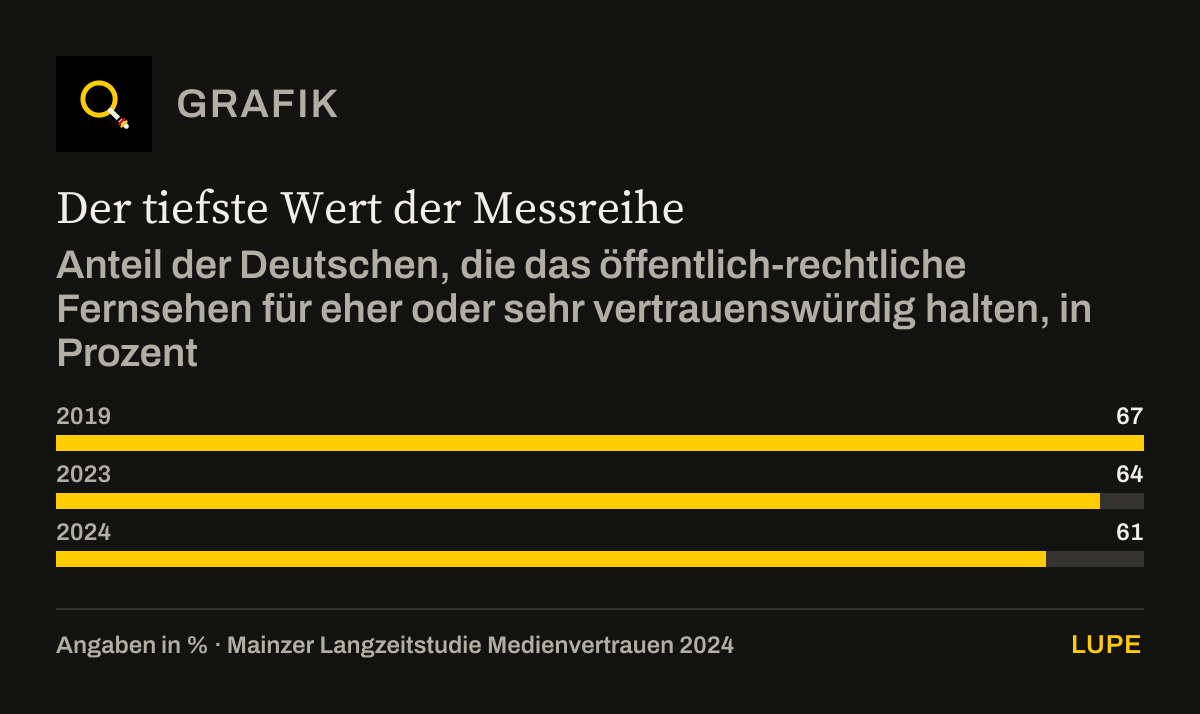
The criticism is measurable. In the Mainz long-term study, trust in public service broadcasting fell from 67 per cent in the pre-pandemic year of 2019 to 61 per cent in 2024. That is the lowest value since the survey began; during the pandemic the figures stood at 70 per cent.[3]
The lowest value of the series
Share of Germans who consider public service television rather or very trustworthy, in per cent
Mainz long-term study Medienvertrauen 2024[3]. Chart redrawn from the figures in the text.
Limits of the data: Only the years for which this publication gives a separate value. For the pandemic years it gives 70 per cent without breaking down the individual years; those years therefore do not appear in the chart. In November and December 2024, 1,203 people aged 18 and over were surveyed by telephone.
Download the chart as an image (PNG)
Show data table3 rows
| Trust (%) | |
|---|---|
| 2019 | 67 |
| 2023 | 64 |
| 2024 | 61 |
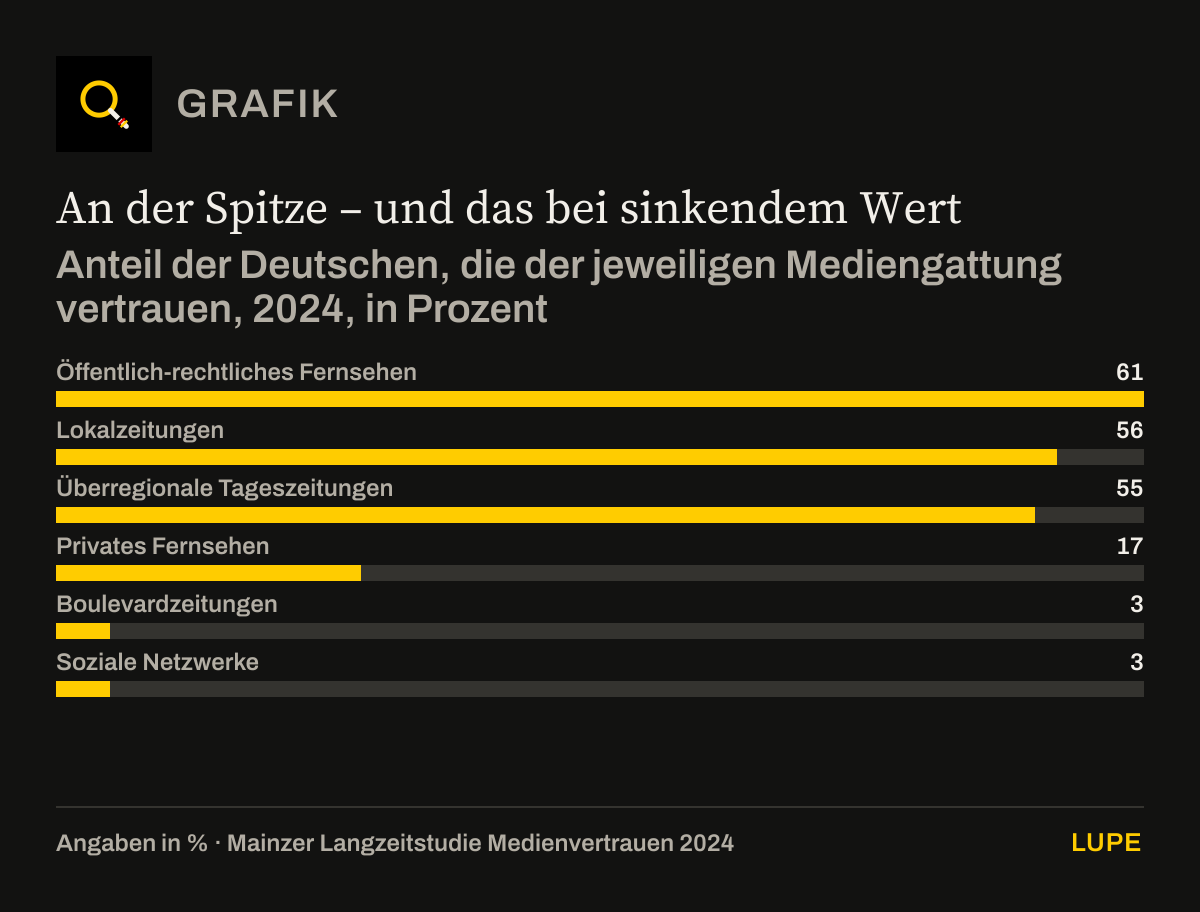
Even so, public service broadcasting remained the type of medium that is trusted most, ahead of the national and the regional press. The researchers expressly do not find a general collapse of trust in the media; they speak of continuity rather than change, and the share of those who trust the media little or not at all has also remained stable.[3]
At the top – and that with a falling value
Share of Germans who trust the respective type of medium, 2024, in per cent
Mainz long-term study Medienvertrauen 2024[3]. Chart redrawn from the figures in the text.
Limits of the data: Commercial broadcasting is the only category with a noticeable change compared with 2023: from 22 to 17 per cent. The values for local newspapers and national daily newspapers each changed by three points, which lies within the margin of error.
Download the chart as an image (PNG)
Show data table6 rows
| Trust (%) | |
|---|---|
| Public service television | 61 |
| Local newspapers | 56 |
| National daily newspapers | 55 |
| Commercial television | 17 |
| Tabloids | 3 |
| Social networks | 3 |
At the same time, fundamental rejection is growing. In 2024 one in five Germans agreed with the statement that the public is systematically lied to by the media; two years earlier that figure stood at 14 per cent. The statement that the media undermine freedom of opinion also reached a record high at 20 per cent.[3] That does not prove the accusation. It shows how urgently trust has to be won back.
In a survey by the INSA institute for the news agency IDEA in September 2025, 38 per cent of the 2,002 respondents found public service reporting left-leaning, 36 per cent disagreed and 20 per cent answered “don’t know”.[4] That is not a majority, not even a narrow one. But it is not a negligible fringe either.
A content analysis by the University of Mainz examined nine public service news formats and 38 commercial comparison media with large reach for the period from April to June 2023, almost 10,000 contributions in total. The diversity of topics and actors was high, in both groups. All nine public service formats took a welfare-state rather than a market-liberal perspective, and in seven out of nine liberal-progressive positions outweighed conservative ones. That said, this did not make them particularly one-sided compared with the commercial media.[5] This does not justify a blanket accusation of bias. It justifies the question of whether a jointly financed broadcaster really takes the whole of society seriously.
A case that shows where the line runs
The presentation of “heute journal” on 11 September 2025 about the assassination of the American activist Charlie Kirk shows how sensitive this line is. Dunja Hayali explicitly stated at the outset that it could be “justified by nothing” when people celebrated Kirk’s death, and then described his political work.[6]
On 23 October 2025 ZDF replied to the complainants: the account had not been “factually incorrect”, but could have “created a relativising impression at the start of the sentence” and had been felt by some viewers to be inappropriate. The editorial team had reflected on this critically and discussed it afterwards with the presenter. The broadcaster and the presenter regretted that the pointed presentation had created a misleading impression.[6]
On 12 December 2025 the television council dealt with the broadcast, selected one lead complaint because of the large number of submissions and rejected it as unfounded. It found no breach of the legal provisions applying to ZDF.[7] That is part of the truth. But it does not end the journalistic debate: “no legal breach” is no seal of quality for a successful piece of presentation.
Positions may be assessed critically, but not in a way that makes the condemnation of the act appear verbally softened. Anyone presenting on public service broadcasting owes the audience precision rather than moral sharpening, particularly here. That the editorial team discussed exactly this internally speaks in its favour. That it was said publicly only after thousands of complaints does not.
Pressure to control and privileged reach
In parallel, the federal states are expanding supervision. The government draft of the Digitale Medien-Staatsvertrag, agreed by the heads of government in June 2026, allows the state media authorities to use technical means that automatically screen text, image, audio and moving-image content from broadcasting and telemedia for possible breaches, including content behind access restrictions. At the same time the general maximum fine rises from 500,000 to 1.5 million euros, and the limitation period grows from six to 24 months.[2][8]
The draft contains safeguards, and they are not incidental: if the technology reports a possible breach, a natural person must check without delay whether it can be confirmed; otherwise the data is to be deleted immediately, and at the latest after 30 days. Automated screening aimed at particular individuals is expressly prohibited. It must afterwards be possible to trace who entered, changed or removed which data.[8] This supervision applies to commercial broadcasting and to telemedia, not to the public service corporations.
The second part of the project goes further. The broadcasting commission put it forward for discussion on 16 September 2026, and the consultation runs until 13 November 2026. For algorithmic recommendation systems it proposes a minimum quota: every fifth recommendation is to come from labelled public value content. The draft justifies the order of magnitude with the share of advertising that is customary in feeds today, and expressly names commercial offerings as examples too, from a news item through a podcast to a press article.[9] So it is neither adopted nor a quota for ARD and ZDF. Even so, the question remains: why should a status that has been granted secure attention? Trust has to be earned, not replaced by privileged placement.
This is where the democratic risk lies. Where automated control, high pressure of sanctions and institutional privileges of reach come together, the space for an independent counter-public can narrow. It does not take a ban to endanger the freedom of debate. The mere fear of expensive proceedings can tempt smaller providers into self-censorship. Faulty automated assessments can hit legitimate contributions. Privileged recommendations can strengthen established offerings and push new voices relatively further back.
This is not a finding that censorship has been decided. It is a warning against a concentration of power that could be harmful even without any such intention. That is why error rates, selection criteria, routes of complaint and actual diversity must be open to scrutiny. The protection of democracy must not become a label that replaces critical examination.
The supervisors are not beyond doubt either
The state media authorities are not to be equated with the supervisory bodies of ARD and ZDF. They are bodies of the federal states, independent of government, and they supervise commercial broadcasting and parts of telemedia.[13] Broadcasting councils and television councils are something else: bodies of the respective corporation, staffed from social groups, supervising their own house.[14] Both have to put up with uncomfortable questions.
For the particular duties of the state media authorities the Medienstaatsvertrag provides a share of the broadcasting fee which can finance licensing and supervision, open channels, technical infrastructure, non-commercial local broadcasting and media literacy.[2] For 2025 the licence fee service reports around 164.5 million euros for this, out of a total fee income of 8.72 billion euros.[10] These are not purely administrative costs.
Whether this money is well spent everywhere is open to doubt. In November 2024 the Bavarian Supreme Audit Office called the Bayerische Landeszentrale für neue Medien “structurally overfunded for many years”: it is the only state media authority to receive the full 1.89 per cent share of the fee, around 26 million euros a year, with an equity ratio of almost 70 per cent. Salaries, it said, were well above those in the Bavarian public service.[11] The BLM counters that the salary comparison is factually wrong because it equates employee salaries with civil service pay and leaves pension liabilities out of account; and that it is not the only authority to receive the full share.[12] That is precisely why need and costs belong under independent scrutiny before this supervision is given new powers.
Back to the remit
The answer is neither abolition nor a change of political colour. It is: keep news and commentary cleanly apart, take democratic counter-positions seriously, correct errors visibly, have quality examined independently and dismantle duplicate structures. New supervisory power needs independent control and effective legal protection before it is extended.
Conservative arguments do not have to be agreeable in order to be presented fairly. Progressive arguments deserve no discount in the fact check. The same standard applies to both.
The public service idea deserves protection. The apparatus deserves no blank cheque. Public service means: bound to the public. Not to a party, not to a government and not to the favourite milieu of an editorial team.
Andreas W. HerbPublisher of Die Aufrechte Lupe, Paderborn
What I expressly do not claim
I do not claim that public service broadcasting lies to the population, that its reporting is steered, or that the content analyses examined prove a one-sidedness going beyond that of the commercial comparison media. The data do not support that. Nor do I claim that censorship has been decided: the automated screening appears in the government draft with human review and deletion periods, and the recommendation quota is a discussion proposal out for consultation. That 20 per cent of Germans impute systematic lying to the media is a finding about the respondents, not a finding about the media. The political demands in this text are my position, not the statement of the sources.
CHECK
What was checked before publication
- All figures were checked against the primary sources on 30 October 2026: the trust figures against the Mainz long-term study Medienvertrauen 2024, the survey figures against the report by the news agency IDEA, the content analysis against the press release of the University of Mainz, the statements on the broadcast of 11 September 2025 against the published response of ZDF and against the decision of its television council, the planned powers against the government draft of the Digitale Medien-Staatsvertrag and against the discussion draft for its second part, the amounts against the Medienstaatsvertrag in force, against the licence fee service and against the Bavarian Supreme Audit Office.
- One passage of the draft did not pass the check: it attributed to the media council of the BLM a position opposing the audit office, and gave as its arguments statutory duties and necessary reserves. What is documented is a position taken by the BLM itself, put forward by its president, and with different arguments: that the salary comparison is factually wrong, and that it is not the only authority receiving the full share of the fee. The paragraph now says what the sources support. No statement by the media council itself could be found.
- Stated more precisely than in the draft: the Medienstaatsvertrag obliges the broadcasters to provide independent, factual, truthful and comprehensive information. Objectivity and impartiality, by contrast, appear in the law as a “should” provision. That is a distinction which often disappears in the debate.
- On the headline of source 4: the news agency IDEA calls 38 per cent a “narrow majority”. It is not. 36 per cent disagree, 20 per cent answer “don’t know”, 5 per cent give no answer. This commentary therefore does not describe the 38 per cent as a majority.
- On the presentation of 11 September 2025: this commentary states that the presenter described the political positions of the man who was killed. ZDF and the television council describe the same passage more sharply, namely as an account of demonstrable racist, far-right, sexist and antisemitic convictions. That assessment is the broadcaster’s and its supervisory body’s, not this editorial team’s; we did not examine the broadcast ourselves, and it is not available to us.
- Not checked and therefore not claimed: whether the powers described lead to wrong decisions in practice, how high the error rate of the technology used is, and how many contributions by small providers would be affected. The second part of the state treaty is a discussion draft out for consultation; it has not been adopted. ZDF, the broadcasting commission of the federal states and the BLM were not asked for comment.
SOURCES
Sources
Every number in the text leads to its source. The origin is given at each entry: official, media report, trade association, institute or data portal. Titles stay in the original language, so that each document can still be found.
[1] Bundeszentrale für politische Bildung, 19.06.2023
Konrad Dussel: Vom Monopol zu komplizierter Konkurrenz. Aus Politik und Zeitgeschichte 25/2023 (mit dem Wortlaut der britischen Verordnung zur Errichtung des NWDR vom 1. Januar 1948)Institute or public body↑ back to the text
[2] die medienanstalten, Stand 30.10.2026
Medienstaatsvertrag, geltende Fassung (§ 26 Abs. 2 Auftrag, § 112 Finanzierung besonderer Aufgaben, § 115 Abs. 2 Ordnungswidrigkeiten mit 500.000 Euro)Official source↑ back to the text
[3] Johannes Gutenberg-Universität Mainz, Mai 2025
Fawzi u. a.: Stabiles Medienvertrauen auch in Zeiten politischer Umbrüche. Mainzer Langzeitstudie Medienvertrauen 2024, Media Perspektiven 13/2025Institute or public body↑ back to the text
[4] IDEA, 24.09.2025
Knappe Mehrheit findet öffentlich-rechtlichen Rundfunk linkslastig (INSA-Umfrage, 2.002 Befragte, 19. bis 22. September 2025)Media report↑ back to the text
[5] Johannes Gutenberg-Universität Mainz / Stiftung Mercator, 26.01.2024
Maurer, Kruschinski, Jost: „Fehlt da was? Perspektivenvielfalt in den öffentlich-rechtlichen Nachrichtenformaten“, Pressemitteilung zur StudieInstitute or public body↑ back to the text
[6] ZDF, 23.10.2025
Programmkritik zur Sendung „heute journal“ vom 11.09.2025, Stellungnahme in Vertretung des IntendantenOfficial source↑ back to the text
[7] ZDF-Fernsehrat, 12.12.2025
Mitteilung über den Ausgang des Beschwerdeverfahrens zur Programmbeschwerde vom 14.09.2025 (Beschluss der Sitzung vom 12.12.2025)Official source↑ back to the text
[8] Schleswig-Holsteinischer Landtag, 02.10.2026
Entwurf eines Gesetzes zum Neunten Staatsvertrag zur Änderung medienrechtlicher Staatsverträge – Digitale Medien-Staatsvertrag, Regierungsentwurf (Unterrichtung 20/379, § 109a neu, § 115 Abs. 2 neu)Official source↑ back to the text
[9] Rundfunkkommission der Länder, 28.09.2026
Digitale Medien-Staatsvertrag Teil 2, Diskussionsentwurf in der Anhörungsfassung (Mindestquote „jede fünfte Empfehlung“ für Public-Value-Inhalte), Anhörung bis 13.11.2026Official source↑ back to the text
[10] ARD ZDF Deutschlandradio Beitragsservice, 30.06.2026
Beitragsservice stellt Jahresbericht 2025 vor (Erträge 8,72 Milliarden Euro, davon 164,5 Millionen Euro für die Landesmedienanstalten)Official source↑ back to the text
[11] Bayerischer Oberster Rechnungshof, 12.11.2024
Finanzierung überprüfen und Einsparmöglichkeiten nutzen. Beratende Äußerung zur Bayerischen Landeszentrale für neue Medien (BLM)Official source↑ back to the text
[12] DWDL.de, 13.11.2024
Rechnungshof kritisiert BLM als „seit Jahren überfinanziert“ (mit der Gegenposition von BLM-Präsident Thorsten Schmiege)Media report↑ back to the text
[13] die medienanstalten, Stand 30.10.2026
Über uns: Aufgaben und Zuständigkeit der LandesmedienanstaltenInstitute or public body↑ back to the text
[14] Westdeutscher Rundfunk, Stand 30.10.2026
Der WDR-Rundfunkrat: Zusammensetzung und AufgabenOfficial source↑ back to the text
CORRECTIONS
Corrections
No corrections since publication on 30/10/2026. Every substantive change appears here with its date, reason and previous wording.
This page is opinion. Our fact checks are not.