OPINIONANALYSISEU BUDGET
EU chief von der Leyen and the loss of contact with reality
EU spending has more than doubled since 2000 – cutting the cost of all those translations is apparently no longer in the EU’s vocabulary
By Andreas W. Herb, CEO MBG Group, Paderborn
7 minutes read31 sources0 correctionsDisclosure
Share
Contents
The European Union today spends more than two and a half times as much as in 2000: 216.4 billion euros in 2025 instead of 83.5 billion. The administration of all the EU institutions now costs 13.8 billion euros a year.[1] For translation and interpretation into 24 official languages the EU has for years given the same estimate of around one billion euros, a figure from 2013.[2]
Ursula von der Leyen has led the EU Commission since December 2019. Since then total spending has risen by 36 per cent up to 2025, and administrative spending by 33 per cent.[1] For the overall budget the largest part goes back to the coronavirus recovery fund NextGenerationEU; without it, it is just under 10 per cent. Administration, by contrast, grows without any special fund, with practically the same number of established posts: 39,130 in 2019, 39,309 in 2026.[1][3][4]
Anyone who lets their own administration keep growing with figures like these, and who does not put forward even a quantified savings requirement for translation into 24 languages, has lost contact with the people and businesses who pay for all of it. What lies behind it is shown by the figures since 1980.
€216.4bn
EU spending in 2025; in 2000 it was €83.5bn
Commission[1]
€13.8bn
administrative spending in 2025, 7.9% of the regular budget
Commission[1]
around 96
EU regulations a month, 2025
EUR-Lex[5]
≈ €1bn
for translation and interpretation a year
estimate from 2013[2]
The EU budget since 2000
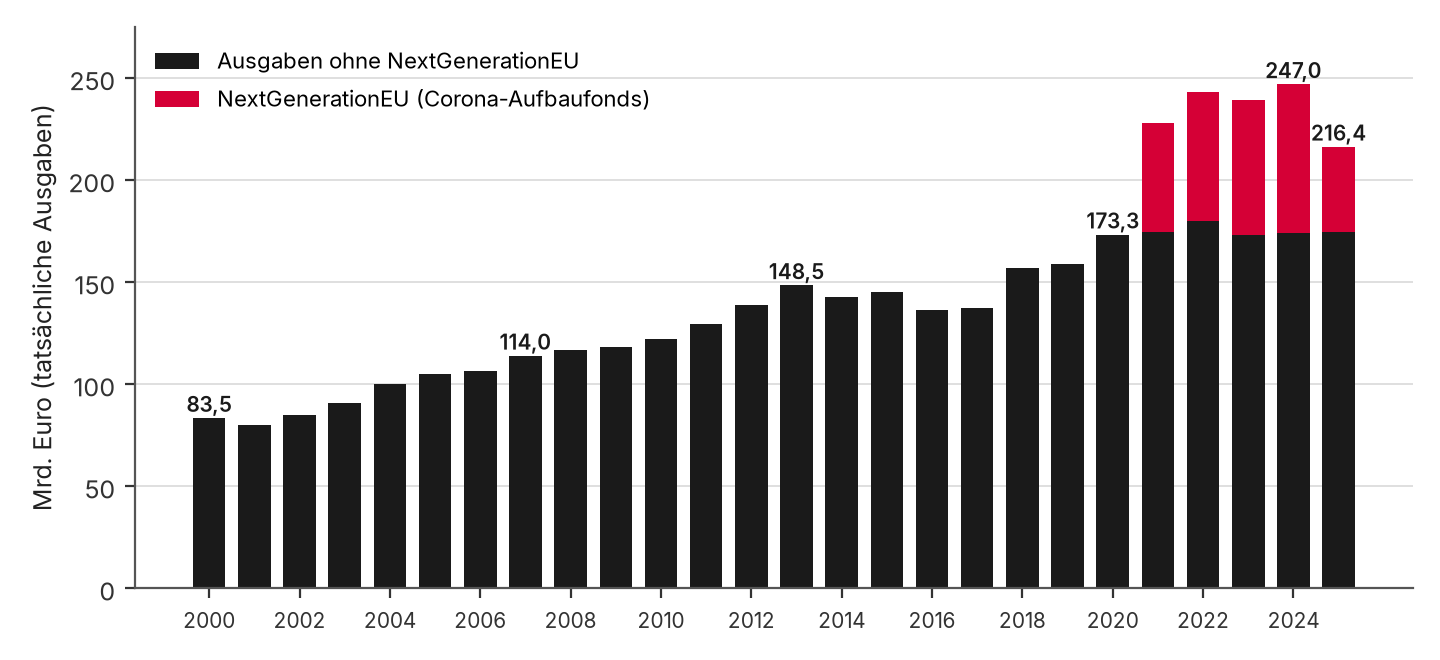
The development came in steps: the 2004 enlargement to the east lifted spending above 100 billion euros. In the 2014 to 2020 financial framework it fell back at first, then rose markedly again from 2018. The jump from 2021 goes predominantly back to NextGenerationEU; in 2024 alone 73.1 billion euros flowed from it, and spending reached its peak at 247.0 billion euros. Without NextGenerationEU the budget from 2021 to 2025 lay relatively stable between 173 and 180 billion euros.[1]
How many EU regulations come each month?
The figure depends heavily on what is counted. The table shows the most robust counts, converted to months.
| Count | Period | Number | per month |
|---|---|---|---|
| Regulations including amending regulations[5] | 2025 | 1,150 | ≈ 96 |
| All legal acts[5] | 2025 | 2,567 | ≈ 214 |
| Regulations including amending regulations[6] | 2023 | 1,146 | ≈ 96 |
| The same count, average[6] | 2019–2023 | 1,023 a year | ≈ 85 |
| Regulations by Parliament and Council (289), Council (539) and Commission (4,401)[7] | 07/2019–07/2024 | 5,229 | ≈ 87 |
| All binding legal acts: regulations, directives, decisions[7] | 07/2019–07/2024 | 11,219 | ≈ 186 |
| Regulations including amending regulations[8] | 2015 | 1,269 | ≈ 106 |
By far the largest part are implementing and delegated regulations of the Commission: technical detail, authorisations, customs tariffs, food additives. Legislative acts of Parliament and Council make up only around five regulations a month. EUR-Lex also leaves out short-lived agricultural administrative acts; with them the figure would be higher.[5][7]
The administrative budget since 1980
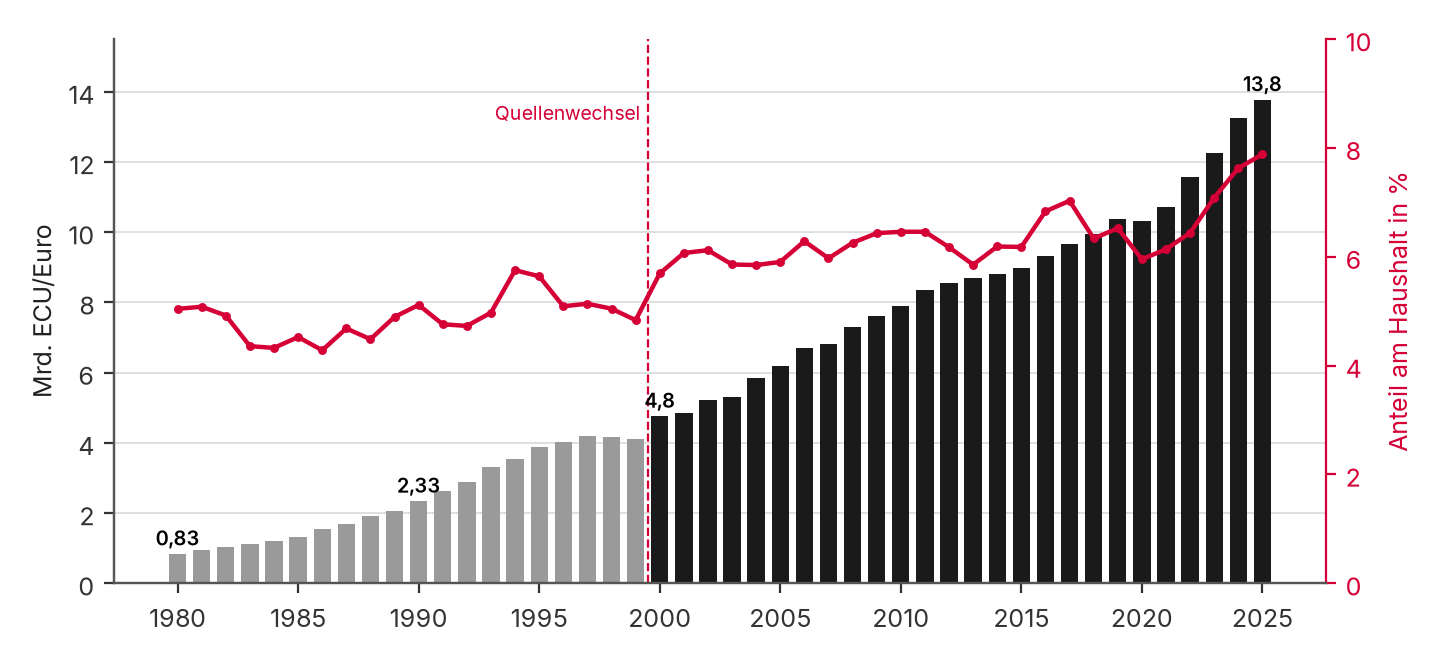
Into the nineties the share of administration in the budget lay stable between 4 and 6 per cent. Since 2021 it has been rising noticeably, in 2025 to 7.9 per cent of the regular budget.[1][9] Since 2019 administrative spending has risen by 33 per cent, from 10.4 to 13.8 billion euros.[1] Since established posts have barely grown since 2009, it is likely to be above all salaries, pensions, buildings and external staff that drive the costs. That is an inference of our own; the Commission provides no breakdown of it.
EU staff since 1979
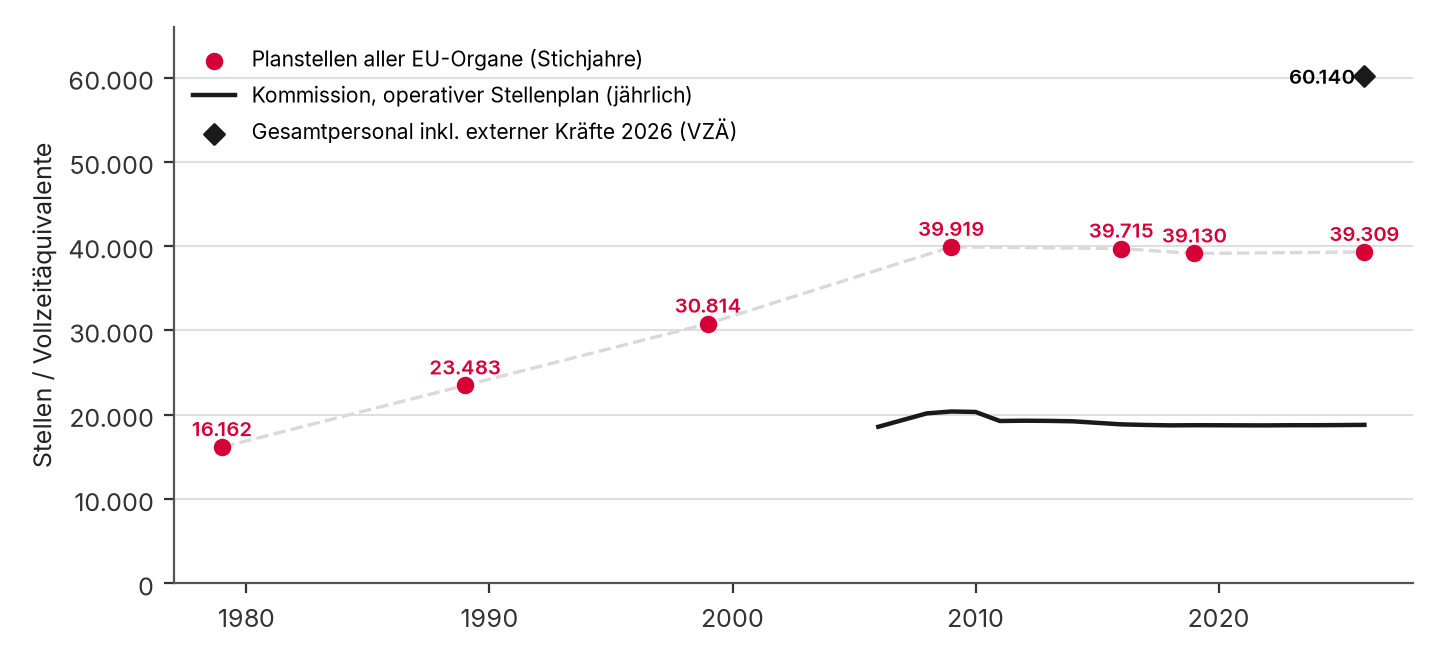
The established posts of all the EU institutions rose from 16,162 in 1979 to 39,309 in 2026, 2.4 times as many.[10][4] Since 2009 they have stood at around 39,000 to 40,000; between 2013 and 2017 all the institutions and agencies were to reduce their staff by 5 per cent.[3] On top come around 20,000 full-time posts of external personnel in 2026. Including the executive agencies, around 60,100 full-time staff thus work for the institutions.[4] The decentralised agencies are not counted in this; in 2026 they have a further 16,100 posts or so.[11]
The Commission itself had 18,797 established posts in its operational establishment plan in 2026, fewer than in 2009 with 20,384. Including external personnel it is 32,552 full-time equivalents.[4]
Ten curious EU rules
A selection by public perception, with the legal basis and the position today. Claims without a legal basis, such as the supposed condom size regulation, are deliberately not included.
| Rule | Content | Position |
|---|---|---|
| Curvature of cucumbers, Reg. (EEC) 1677/88 | Cucumbers of class Extra and class I were allowed a curvature of at most 10 mm over 10 cm of length.[12] | repealed since 1 July 2009[13] |
| Curvature of bananas, today Delegated Reg. (EU) 2023/2429 | Green bananas must be “free from malformation or abnormal curvature of the fingers”.[14] | in force, since 1994 in changing regulations[14] |
| Water against thirst, Reg. (EU) 1170/2011 | The advertising claim that regular drinking of water can reduce the risk of dehydration was refused after a procedure of more than three years. The reason was its legal classification as a claim on reducing a disease risk, not the effect of water.[15][16] | in force |
| The carrot as a fruit, Dir. 2001/113/EC | For jam, tomatoes, carrots, sweet potatoes, cucumbers, pumpkins, melons and rhubarb stalks count as fruit.[17] | in force |
| Vacuum cleaner limit, Reg. (EU) 666/2013 | Rated power below 1,600 watts from 2014, below 900 watts from 1 September 2017.[18] | in force |
| Tethered cap, Dir. (EU) 2019/904 | Plastic caps of single-use drinks containers up to 3 litres have to remain firmly attached to the container.[19] | obligatory since 3 July 2024 |
| Hotel shampoo and ketchup sachets, Reg. (EU) 2025/40 | Ban on single-use toiletries in hotels, single-use plastic portion packs in hospitality and single-use plastic packaging for fresh fruit and vegetables under 1.5 kg.[20] | from 1 January 2030 |
| No “veggie steak”, Reg. (EU) 2026/1739 | 31 meat designations, for instance steak, bacon and chicken, are banned for plant-based products; “burger” and “sausage” remain permitted.[21] | from 19 August 2029 |
| Chip colour chart, Reg. (EU) 2017/2158 | The frying temperature has to stay below 175 °C; a colour chart clearly visible in the kitchen is recommended.[22] | since 11 April 2018 |
| Olive oil jugs, proposed amendment 2013 | Restaurants were to offer olive oil only in sealed, non-refillable bottles.[23] | withdrawn after protests |
Several of these rules have a substantive background: trading standards, consumer protection, acrylamide in food, plastic waste in the sea. They still look curious, and they show how deep into the detail Brussels goes.
Translation costs: 24 languages, no list of savings
| Indicator | Value |
|---|---|
| Translation and interpretation, all EU institutions | around €1bn a year, under 1% of the budget, a good €2 per citizen; Commission estimate from 2013[2] |
| Of that translation and interpretation | around €800m and around €200m, with no reference year[24] |
| The Commission’s translation service | around 2.2 million pages for around €325m (2019 figures)[25] |
| Translation costs of the Commission, Parliament and Council | €414m (2003), €511m (2005)[26] |
| Cost per page translated in 2005 | €119 (Parliament), €194 (Commission), €276 (Council)[26] |
| The Commission’s translation service in 2025 | around 2.5 million pages, 1,895 employees, 36% outsourced[27] |
As long ago as 2006 the European Court of Auditors objected that the institutions do not calculate their total costs for translation or the cost per page; only the Commission had done so, for 2002.[26] To this day only the lump sum of around one billion euros is publicly named.[2] The Commission is reducing staff in its translation service and outsourcing more: the share of outsourced translation rose in 2025 from 30.2 to 35.7 per cent.[28] But no quantified savings requirement for the language services has been published. That would be a concrete starting point for saving on administration.
What belongs to a fair assessment
The budget is not decided by the Commission alone. The multiannual financial framework is adopted by the Council unanimously with the consent of the European Parliament; the annual budget is adopted by the Council and Parliament together on a proposal from the Commission.[29]
NextGenerationEU was agreed by all the member states in 2020 and ratified by May 2021, Germany included.[30] In 2022 the Federal Constitutional Court dismissed the constitutional complaints against it.[31]
Measured against economic output the regular budget has barely grown: without NextGenerationEU it corresponded in 2025 to 0.93 per cent of the EU’s gross national income, and in 2000 it was 0.92 per cent. That is a calculation of our own from the Commission’s file.[1] All amounts are at current prices; since 2000 the EU has grown from 15 to 27 member states.
Andreas W. HerbCEO MBG Group, Paderborn
METHOD
Method
Total spending: 216.37 instead of 83.45 billion euros is an increase of 159 per cent, 2.6 times as much. Without NextGenerationEU (41.74 billion euros) it is 174.63 billion euros, plus 109 per cent.
Since 2019: 159.10 to 216.37 billion euros is plus 36 per cent; without NextGenerationEU 159.10 to 174.63 billion euros, plus 9.8 per cent. Administration 10.38 to 13.77 billion euros, plus 33 per cent.
Administration 1980 to 2025: 13.77 billion euros divided by 0.83 billion ECU gives 16.6 times. Share in 2025: 13.77 divided by 174.63 billion euros, 7.9 per cent.
Per month: annual values divided by 12. The parliamentary term from 2 July 2019 to 15 July 2024 lasted 60.45 months; 5,229 and 11,219 legal acts give 87 and 186 a month.
Staff: 39,309 divided by 16,162 gives 2.4 times. 60,140 full-time equivalents in the 2026 budget including 3,202 at the executive agencies.
EU gross national income according to the Commission’s file: 2000 9,085 billion euros, 2025 18,733 billion euros. 83.45 divided by 9,085 gives 0.92 per cent, 174.63 divided by 18,733 gives 0.93 per cent.
CHECK
What was checked before publication
- All the figures were checked against the original sources on 16 October 2026, the budget series directly in the Commission’s file (source 1). The arithmetic is set out under Method.
- Corrected against the version submitted: the subheading spoke of spending rising “year after year”; in 2025 it was below 2024. The 36 per cent since 2019 holds only with the recovery fund; without it, it is just under 10 per cent. The around 60,100 full-time staff include the executive agencies. The around 5,000 agency employees for 2015 came from an older secondary source and have been removed; the 10.4 billion euros for 2019 appear in the Commission’s file, not in the EPRS paper.
- Removed is the figure of 1,456 Commission legal acts in 2025 (Gesamtmetall, Welt am Sonntag), because it adds proposals and adopted legal acts together. In its place come the EUR-Lex statistics for 2025 (source 5, read via an archive copy of 10 June 2026, because EUR-Lex blocks automated access).
- Curious rules: the banana standard today appears in Delegated Regulation (EU) 2023/2429; the old Regulation 2257/94 has been repealed. The advertising claim about water failed not because of what water does but because of its legal classification; the EFSA opinion was negative. The carrot appears in Annex III of the jam directive. For chips only the temperature below 175 °C is obligatory, while the colour chart is a recommendation. The packaging regulation’s ban covers not only nets but all single-use plastic packaging for fruit and vegetables under 1.5 kg.
- Translation: the billion comes from a Commission estimate of 2013 (source 2, version of April 2022). The 414 million euros applies to 2003. No current full-cost calculation for all the institutions was found, nor any quantified savings requirement specifically for the language services. The Commission is, however, reducing staff in its translation service (source 28).
- Administrative spending before and after 2000 comes from two sources with different definitions; the older series lies about 4 to 6 per cent lower. The “16.6 times” joins the two series and is not adjusted for inflation.
SOURCES
Sources
Every number in the text leads to its source. The origin is given at each entry: official, media report, trade association, institute or data portal. Titles stay in the original language, so that each document can still be found.
[1] Europäische Kommission, Stand 29.09.2026
EU spending and revenue – Data 2000–2025 (Excel-Datei, Blätter 2000 bis 2025)Official source↑ back to the text
[2] Wissenschaftlicher Dienst des Europäischen Parlaments (EPRS), April 2022
Multilingualism: The language of the European Union (PE 642.207)Official source↑ back to the text
[3] Wissenschaftlicher Dienst des Europäischen Parlaments (EPRS), Februar 2020
Financing the EU's administration: Heading 7 of the 2021-2027 MFF (S. 4–6, Tabelle 3)Official source↑ back to the text
[4] Europäische Kommission, Juni 2026
Draft General Budget 2027 – Working Document Part II: Human Resources of the EU institutions and Executive Agencies (S. 2–4, 8, 12, 69)Official source↑ back to the text
[5] EUR-Lex, Amt für Veröffentlichungen der EU, Stand 10.06.2026
Statistiken zu Rechtsakten, Jahr 2025Data portal↑ back to the text
[6] Demagog, 28.05.2024
Akty prawne przyjmowane przez UE. Ile ich jest rocznie?Media report↑ back to the text
[7] Camera dei deputati, 10.04.2025
La legislazione dell'Unione europea, in: La legislazione tra Stato, regioni e Unione europea – Rapporto 2024-2025 (Tabelle 1)Official source↑ back to the text
[8] BBC News, 17.05.2016
Reality Check: Are there 2,500 new regulations every year from the EU?Media report↑ back to the text
[9] Europäische Kommission, 2009
EU budget 2008 – Financial Report, Anhang 2: Ausgaben der Gemeinschaft 1958–2008Official source↑ back to the text
[10] Andreja Pegan, 2017
The Bureaucratic Growth of the European Union, Journal of Contemporary European Research 13(2), Tabelle 1Institute or public body↑ back to the text
[11] Europäische Kommission, Juni 2026
Draft General Budget 2027 – Working Document Part III: Bodies set up by the EU having legal personality (Tabelle 1.5.8)Official source↑ back to the text
[12] Europäische Kommission, 15.06.1988
Verordnung (EWG) Nr. 1677/88 zur Festsetzung von Qualitätsnormen für Gurken, Anhang IIOfficial source↑ back to the text
[13] Europäische Kommission, 05.12.2008
Verordnung (EG) Nr. 1221/2008 zur Änderung der Verordnung (EG) Nr. 1580/2007 hinsichtlich der Vermarktungsnormen, Art. 2 und 3Official source↑ back to the text
[14] Europäische Kommission, 17.08.2023
Delegierte Verordnung (EU) 2023/2429, Anhang I Teil B Teil 11 (Bananen)Official source↑ back to the text
[15] Europäische Kommission, 16.11.2011
Verordnung (EU) Nr. 1170/2011 über die Verweigerung der Zulassung bestimmter gesundheitsbezogener AngabenOfficial source↑ back to the text
[16] idw – Informationsdienst Wissenschaft (Leibniz Universität Hannover), 22.11.2011
EU-Verordnung: Wasseraufnahme verringert Dehydration nichtInstitute or public body↑ back to the text
[17] Rat der EU, 20.12.2001
Richtlinie 2001/113/EG über Konfitüren, Gelees, Marmeladen und Maronenkrem, Anhang III Teil AOfficial source↑ back to the text
[18] Europäische Kommission, 08.07.2013
Verordnung (EU) Nr. 666/2013, Ökodesign-Anforderungen an Staubsauger, Anhang IOfficial source↑ back to the text
[19] Europäisches Parlament und Rat, 05.06.2019
Richtlinie (EU) 2019/904 über die Verringerung der Auswirkungen bestimmter Kunststoffprodukte auf die Umwelt, Art. 6 und 17Official source↑ back to the text
[20] Europäisches Parlament und Rat, 19.12.2024
Verordnung (EU) 2025/40 über Verpackungen und Verpackungsabfälle, Art. 25 und Anhang VOfficial source↑ back to the text
[21] Europäisches Parlament und Rat, 08.07.2026
Verordnung (EU) 2026/1739 zur Änderung der Verordnungen (EU) Nr. 1308/2013, (EU) 2021/2115 und (EU) 2021/2116 (Stärkung der Position der Landwirte), Art. 1 Nr. 13Official source↑ back to the text
[22] Europäische Kommission, 20.11.2017
Verordnung (EU) 2017/2158 zur Senkung des Acrylamidgehalts in Lebensmitteln, Anhang II Teil AOfficial source↑ back to the text
[23] DER SPIEGEL, 23.05.2013
EU-Kommission zieht Verbot von Olivenöl-Karaffen nach Protesten zurückMedia report↑ back to the text
[24] Bundeszentrale für politische Bildung, 2020
Dolmetscher- und Übersetzerdienst, in: Das Europalexikon, 3. AuflageInstitute or public body↑ back to the text
[25] Victor Ginsburgh, Juan D. Moreno-Ternero, 2022
Brexit and multilingualism in the European Union, Metroeconomica 73(2)Institute or public body↑ back to the text
[26] Europäischer Rechnungshof, 21.11.2006
Sonderbericht Nr. 9/2006 über Ausgaben für Übersetzungsleistungen bei der Kommission, beim Parlament und beim RatOfficial source↑ back to the text
[27] Europäische Kommission, GD Übersetzung, Stand 12.08.2026
DG Translation in figuresOfficial source↑ back to the text
[28] Europäische Kommission, GD Übersetzung, 16.06.2026
Annual activity report 2025 – TranslationOfficial source↑ back to the text
[29] Europäische Kommission
How is the EU budget prepared?Official source↑ back to the text
[30] Wissenschaftlicher Dienst des Europäischen Parlaments (EPRS), 02.06.2021
National ratification of the Own Resources Decision: Procedure completed on 31 May 2021Official source↑ back to the text
[31] Bundesverfassungsgericht, 06.12.2022
Pressemitteilung Nr. 103/2022 zum Urteil vom 6. Dezember 2022 (2 BvR 547/21, 2 BvR 798/21)Official source↑ back to the text
CORRECTIONS
Corrections
No corrections since publication on 16/10/2026. Every substantive change appears here with its date, reason and previous wording.
This page is opinion. Our fact checks are not.