OPINIONCOMMENTARYCO₂ PRICE
CO₂ levies: a price driver announced in advance
Climate protection needs solutions. An ever higher bill alone is not yet a solution.
By Andreas W. Herb, CEO MBG Group, Paderborn
3 minutes read11 sources0 correctionsDisclosure
Share
Contents
Climate protection needs solutions. An ever higher bill alone is not yet a solution. Higher CO₂ prices make fossil energy more expensive and, through higher production costs, can also push consumer prices up.[1][2]
The curve is steep. The burden is real.
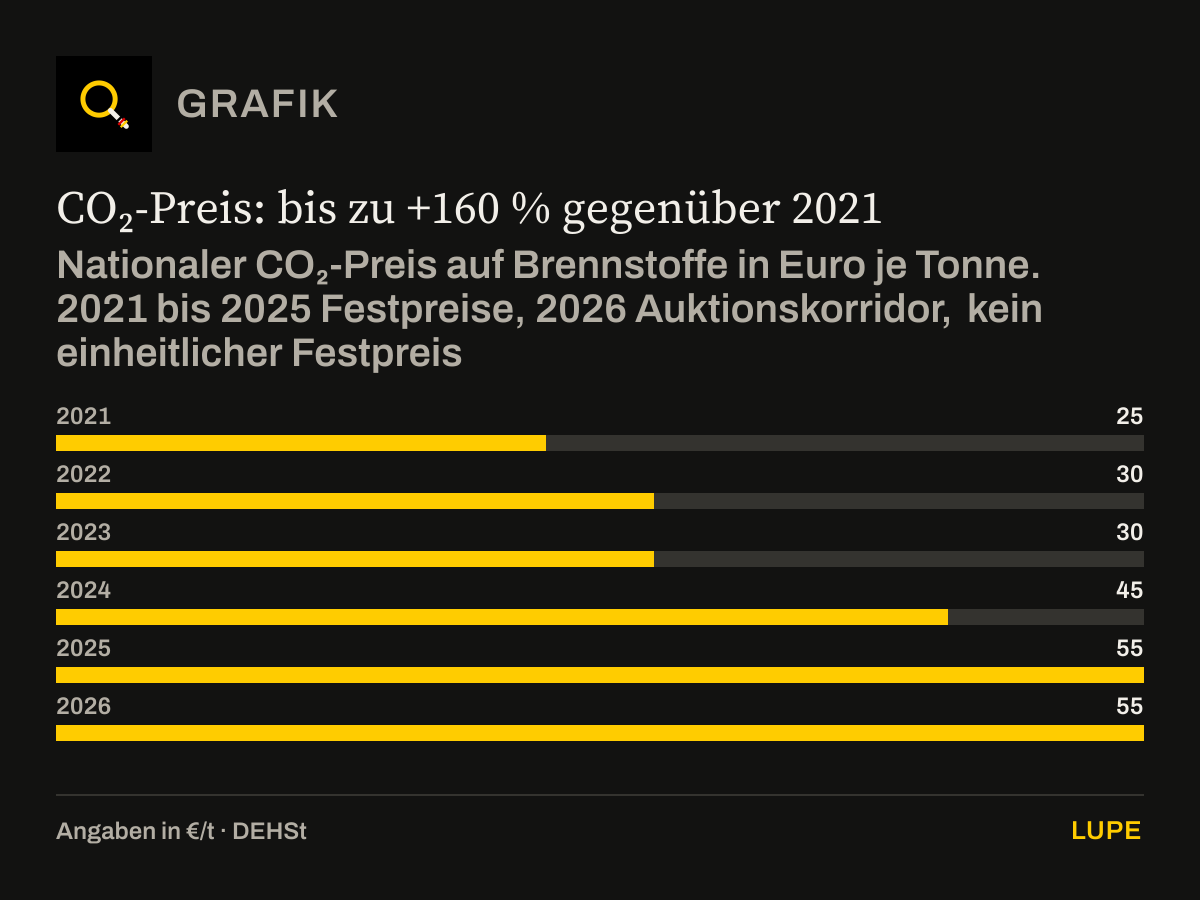
In 2021 the national CO₂ price stood at 25 euros per tonne; in 2026 the auction corridor runs from 55 to 65 euros: 120 to 160 per cent more in five years.[3] Behind that lie costs for filling up and heating which hit citizens and companies, not merely an abstract figure in a statute.[1][2]
CO₂ price: up to +160% against 2021
National CO₂ price on fuels in euros per tonne. 2021 to 2025 fixed prices, 2026 auction corridor, no single fixed price
- Fixed price or lower limit
- Upper limit of the corridor
DEHSt[3]. Chart redrawn from the figures in the text.
Limits of the data: No statement about general inflation.
Download the chart as an image (PNG)
Show data table6 rows
| Fixed price or lower limit (€/t) | Upper limit of the corridor (€/t) | |
|---|---|---|
| 2021 | 25 | – |
| 2022 | 30 | – |
| 2023 | 30 | – |
| 2024 | 45 | – |
| 2025 | 55 | – |
| 2026 | 55 | 65 |
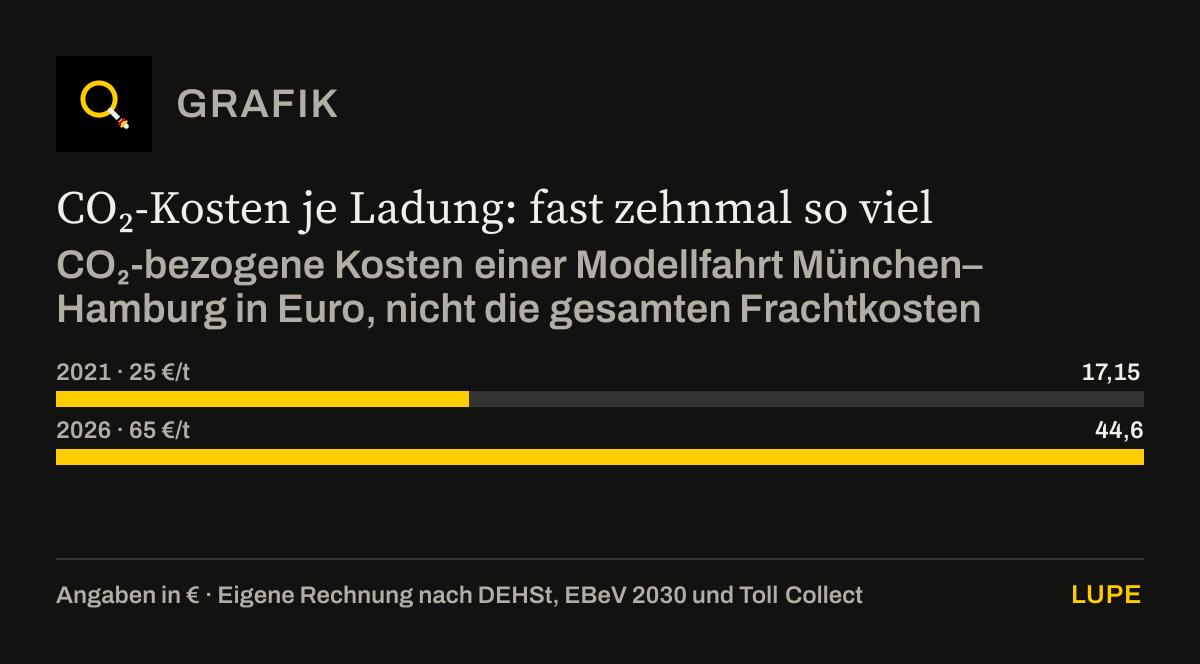
Same route. Same load. Almost ten times the CO₂ costs.
A lorry load from Munich to Hamburg makes the burden tangible: in our 800 km model calculation the CO₂-related costs rise from 17.15 euros in 2021 to 171.00 euros at an assumed price of 65 euros per tonne in 2026; besides the more expensive CO₂ share in the diesel, what matters is the CO₂ toll introduced on top.[3][4][5] That is around 154 euros more per load, and not a tenfold increase in total transport costs.[4][5]
CO₂ costs per load: almost ten times as much
CO₂-related costs of a model journey from Munich to Hamburg in euros, not total freight costs
- CO₂ in the diesel
- CO₂ toll
- Together
Own calculation based on DEHSt[3], EBeV 2030[4] and Toll Collect[5]. Chart redrawn from the figures in the text.
Limits of the data: 800 km, fully subject to toll, 256 litres of diesel, 2.68 kg of CO₂ per litre, Euro VI, at least five axles, CO₂ class 1, excluding deductible VAT. The CO₂ toll has existed since December 2023. At €55/t: 164.13 euros.
Download the chart as an image (PNG)
Show data table2 rows
| CO₂ in the diesel (€) | CO₂ toll (€) | Together (€) | |
|---|---|---|---|
| 2021 · €25/t | 17.15 | 0 | 17.15 |
| 2026 · €65/t | 44.6 | 126.4 | 171 |
The pressure on prices does not stop at the factory gate.
When energy and inputs become more expensive, companies can pass the higher costs on through their selling prices; the burden from production and transport can thus reach consumers too.[6] How much is passed on depends on competition, on alternatives and on demand;[6][7] higher CO₂ costs can also weigh on company profits and on real purchasing power.[8]
That is why the burden on citizens, on small and medium-sized businesses and on industry belongs openly on the table. Anyone promising affordability also has to explain how companies are to invest and how households are to finance the transition.
Up to 2031: a cost risk rather than planning certainty.
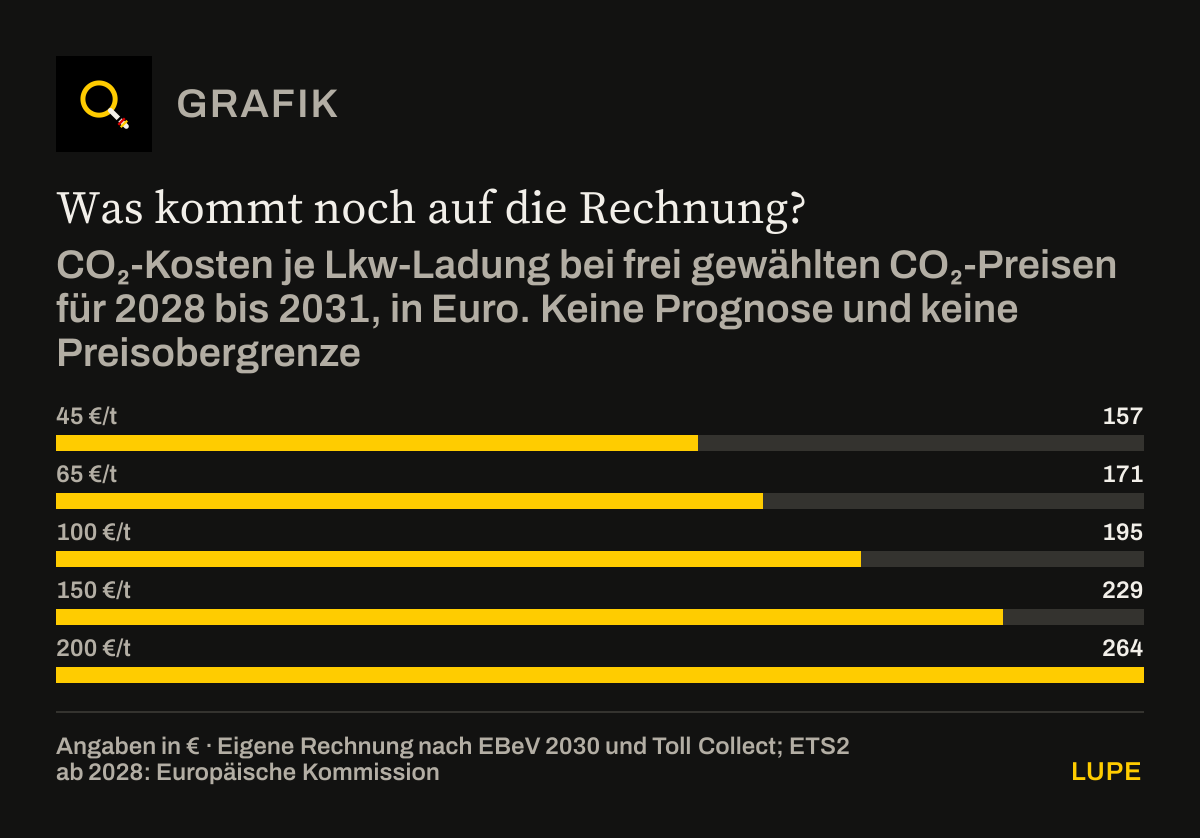
For 2027 the auction corridor of 55 to 65 euros per tonne is to be continued, but was still going through parliament at the cut-off date; from 2028 ETS2 is to form the price for the road transport emissions it covers on the market.[9][10][11] At an assumed 150 euros per tonne the same model load, including an unchanged assumed CO₂ toll, would cost around 229 euros, and at 200 euros per tonne around 264 euros; these are scenarios, not prices that have been decided.[4][5]
What else is coming onto the bill?
CO₂ costs per lorry load at freely chosen CO₂ prices for 2028 to 2031, in euros. Not a forecast and not a price ceiling
Own calculation based on EBeV 2030[4] and Toll Collect[5]; ETS2 from 2028: European Commission[10]. Chart redrawn from the figures in the text.
Limits of the data: Identical 800 km model journey, CO₂ toll set unchanged at 126.40 euros, excluding deductible VAT. Lower prices are possible too. A curve that keeps rising is not written into law.
Download the chart as an image (PNG)
Show data table5 rows
| CO₂ costs per load (€) | |
|---|---|
| €45/t | 157 |
| €65/t | 171 |
| €100/t | 195 |
| €150/t | 229 |
| €200/t | 264 |
Climate protection has to work. Not just collect money.
My demand is clear: affordable alternatives, reliable conditions and comprehensible relief. Anyone demanding change has to make it economically possible. A rising bill is no substitute either for working infrastructure or for an investment that can be financed.
Reading the figures correctly
The model journey assumes 800 kilometres fully subject to toll, 256 litres of diesel, a rounded 2.68 kg of CO₂ per litre, Euro VI, at least five axles and CO₂ class 1; all journey costs are calculated excluding deductible VAT.[4][5] At 55 rather than 65 euros per tonne the total is 164.13 rather than 171.00 euros; separate certificate purchases at 68 and 70 euros per tonne respectively are not included in the €55–65 auction model.[3]
CO₂ pricing is a price impulse, not the explanation for inflation as a whole: in its forecast of December 2025 the Bundesbank put the direct contribution to inflation of a rise from 55 to 65 euros per tonne in 2026 at around 0.1 percentage points; an unchanged CO₂ price produces no renewed direct price impulse in the following year, and falling prices are possible too.[2] The charts therefore show cost components and scenarios, not a curve of inflation across the economy; relief measures, subsidies and adjustments in consumption are not taken into account in the example calculation.
Andreas W. HerbCEO MBG Group, Paderborn
CHECK
What was checked before publication
- Every step of the arithmetic has been recalculated and follows from the stated assumptions (800 km, 256 litres of diesel, 2.68 kg of CO₂ per litre, 15.8 cents of CO₂ toll per kilometre).
- The eleven sources were accessed on 6 October 2026 and checked against the text.
- Bundesbank (sources 1 and 2): it describes the path through production costs into consumer prices, but assesses it as small. It supports the sentence on filling up and heating in substance, not verbatim. The inflation contribution of around 0.1 percentage points applies under its assumption of 65 euros per tonne for 2026.
- The calculation uses the standard value for fossil diesel (2.676 kg of CO₂ per litre, source 4); a share of biofuel in commercially available diesel lowers the CO₂ cost per litre somewhat. The CO₂ component of the toll of 15.8 cents per kilometre appears in the toll table applying from December 2023 (source 5).
- The certificate purchases at 68 and 70 euros per tonne follow the auction in time: sale in November and December 2026, limited subsequent purchase until 31 August 2027 (source 3).
- The price in ETS2 is formed on the market, but is dampened in the first years: if it rises above 45 euros (at 2020 prices), additional certificates are released from a reserve (source 10).
SOURCES
Sources
Every number in the text leads to its source. The origin is given at each entry: official, media report, trade association, institute or data portal. Titles stay in the original language, so that each document can still be found.
[1] Deutsche Bundesbank, Dezember 2019
Monatsbericht Dezember 2019, Kasten: Zu den Auswirkungen des Klimapakets auf Wirtschaftswachstum und InflationsrateOfficial source↑ back to the text
[2] Deutsche Bundesbank, 19.12.2025
Deutschland-Prognose: Wirtschaft geht allmählich wieder auf Erholungskurs (Monatsbericht Dezember 2025, Kasten zum ETS2)Official source↑ back to the text
[3] Deutsche Emissionshandelsstelle (DEHSt)
nEHS: Verkauf und VersteigerungOfficial source↑ back to the text
[4] Bundesrecht (gesetze-im-internet.de)
Emissionsberichterstattungsverordnung 2030 (EBeV 2030), Anlage 2: Standardwerte zur Berechnung von BrennstoffemissionenOfficial source↑ back to the text
[5] Toll Collect, 01.12.2023
Mautsätze pro Kilometer ab 1. Dezember 2023Institute or public body↑ back to the text
[6] KfW Research, 18.02.2022
Fokus Volkswirtschaft Nr. 368: Grüne Inflation? Zwischen Klimaschutz und PreisniveaustabilitätInstitute or public body↑ back to the text
[7] KfW Research, 20.07.2022
Fokus Volkswirtschaft Nr. 396: Erzeugerpreise und Inflation: Kommt das dicke Ende erst noch?Institute or public body↑ back to the text
[8] Europäische Zentralbank, 2023
Wirtschaftsbericht 5/2023, Aufsatz: Die makroökonomischen Implikationen des Übergangs zu einer kohlenstoffarmen WirtschaftOfficial source↑ back to the text
[9] Deutscher Bundestag, 07.09.2026
Drucksache 21/7869: Entwurf eines Dritten Gesetzes zur Änderung des BrennstoffemissionshandelsgesetzesOfficial source↑ back to the text
[10] Europäische Kommission, Stand 02.09.2026
ETS2: buildings, road transport and additional sectorsOfficial source↑ back to the text
[11] Amtsblatt der Europäischen Union, 11.03.2026
Verordnung (EU) 2026/667 (Verschiebung des ETS2 auf 2028)Official source↑ back to the text
CORRECTIONS
Corrections
No corrections since publication on 06/10/2026. Every substantive change appears here with its date, reason and previous wording.
This page is opinion. Our fact checks are not.