OPINIONDISCUSSION PAPERCAR INDUSTRY
Up to 500,000 jobs at risk
How the crisis in the car industry drags suppliers, regions and local purchasing power with it, and why the official figures on job cuts show only the tip of the iceberg.
By Andreas W. Herb, CEO MBG Group, Paderborn
12 minutes read36 sources0 correctionsDisclosure
Share
Contents and Documents
| Figure | Meaning |
|---|---|
| 691,500 | employees in mid-2026, the lowest level since 2005[1] |
| −142,400 | jobs since 2019, one in six[3] |
| up to 200,000 | further direct jobs within around five years[6] |
| up to 500,000 | including knock-on jobs in retail, the trades and hospitality |
The essentials in five sentences
Since 2019 one in six jobs in the German car industry has disappeared, and the pace has lately more than tripled.[3][26]
Depending on the study, a further 125,000 to 200,000 direct posts at manufacturers and suppliers will go by the early 2030s.[5][6]
On German data, every industrial post cut costs its region around one to two further posts in the long run. With those knock-on jobs, 250,000 to 500,000 jobs are in the firing line.[16][35]
The regions affected are thereby short of up to around 21 billion euros of net purchasing power every year, at the baker’s, at the car dealership, in the restaurant and in the trades.
It does not hit the whole of Germany equally, but 116 car districts with full force, and with them their municipal budgets.[12]
1. What has already been lost
At the end of June 2026 the German car industry still employed 691,500 people, the fewest since comparable statistics began in 2005.[1] Within a single year 42,300 posts disappeared, a fall of 5.8 per cent. No other large industrial sector with more than 200,000 employees is losing jobs so fast.[1] Since 2019 the loss adds up to around 142,400 jobs. One job in six has gone.[3]
It hits the suppliers hardest. Among makers of parts and accessories, employment fell by 7.6 per cent within a year.[1] Since 2019 almost one post in four there has disappeared.[2] And the pace is picking up: between 2019 and 2024 around 12,000 jobs a year were lost on average, and since 2024 it has been around 41,000 a year.[26][1]
| Area | Employees mid-2026 | Change on the previous year |
|---|---|---|
| Car manufacturers (vehicles and engines) | 429,200 | −6.1% |
| Suppliers of parts and accessories | 219,500 | −7.6% |
| Bodies, superstructures, trailers | 42,800 | +10.0% |
| Car industry in total | 691,500 | −5.8% (−42,300) |
Source: Federal Statistical Office.[1]
Employees in the car industry: actuals and two forecast paths
In thousands
Actuals: EY[26][2] and Destatis[1]. Roland Berger path: fall to around 490,000[6]. VDA path: a further 125,000 posts by 2035[5], carried forward from the Destatis level. Own presentation. Chart redrawn from the figures in the text.
Limits of the data: The last two values are forecast paths, not actuals.
Download the chart as an image (PNG)
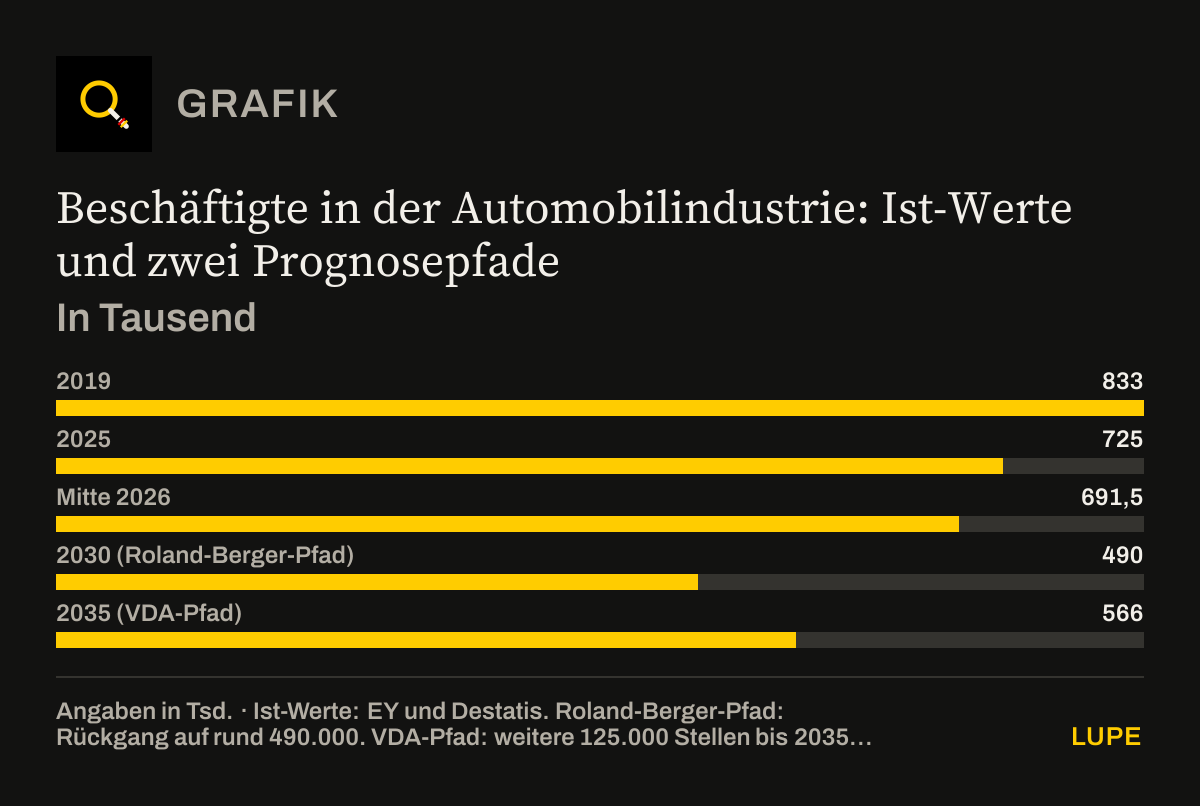
Show data table5 rows
| Employees (k) | |
|---|---|
| 2019 | 833 |
| 2025 | 725 |
| mid-2026 | 691.5 |
| 2030 (Roland Berger path) | 490 |
| 2035 (VDA path) | 566 |
2. Why this is not a dip
Anyone hoping for the next recovery is misreading the situation. The causes are structural, and they reinforce one another:
China is falling away. In the second quarter of 2026 sales of BMW and Mercedes-Benz in China slumped by around 30 per cent each, and at the VW group by more than a third.[10][27][28] The three groups’ combined operating profit fell by 19 per cent in the first half of 2026 to 13 billion euros.[11] EY does not expect exports to China to come back; markets such as India or South America cannot come close to closing the gap.[2]
Production is moving away. In 2014, 5.6 million cars came off the line in Germany; in 2024 it was just under 4.1 million.[12]
The drivetrain is changing. An electric car needs fewer parts and less work than a combustion car. That hits the suppliers above all.[5] Around 235,000 people still work in activities around the combustion engine.[12]
The location is too expensive. According to the VDA, new jobs from the transformation are increasingly arising abroad, because conditions in Germany are no longer good enough.[5]
The suppliers are buckling. From the beginning of 2024 to the middle of 2026, 333 insolvency proceedings were opened at car suppliers. Between 2023 and 2025 around 35,800 jobs were lost at suppliers, about 13 per cent.[9]
3. What is still to come: the forecasts
All the serious analyses point in the same direction. They differ only in how fast and how deep the cut will be.
| Study | Expected further cuts | Period | Assessment |
|---|---|---|---|
| VDA (industry association) | around 125,000 further posts, 225,000 since 2019[5] | by 2035 | rather cautious |
| Roland Berger | at least 200,000 posts, down to around 490,000 employees; arithmetically at least five plants too many[6] | by 2030 (according to manager magazin by 2031[7]) | rather harsh |
| Structural study Baden-Württemberg (e-mobil BW) | up to 66,000 in the Baden-Württemberg car cluster; by 2040 up to 154,500 (progressive scenario)[23][33] | by 2030 / 2040 | one Land only |
| Fraunhofer IAO | up to 726,000 of 1.6 million jobs in the European drivetrain (−45%)[8] | by 2040 | Europe, strictest scenario |
The VDA calculates using data of the Federal Employment Agency for all businesses in the sector (around 958,000 employees in 2019 and around 911,000 in 2023); its figures for job cuts are therefore not directly comparable with the Destatis values, which count only businesses with 50 or more employees.[25]
Notably, the VDA has already revised its own 2024 forecast upwards by 35,000 posts. The cuts are running faster than even the industry expected.[5] Roland Berger breaks the cuts down by function: around 90,000 direct posts, 95,000 in indirect functions and 15,000 in management; the plants are only around 60 per cent utilised.[6]
4. Who is cutting right now
| Company | Announced cuts in Germany |
|---|---|
| Volkswagen | over 35,000 posts at the German sites by 2030, on socially acceptable terms, agreed in December 2024[4] |
| Bosch | around 22,000 posts in the Mobility division in Germany, announced in 2024 and 2025, running to between 2029 and 2032[13][29] |
| ZF Friedrichshafen | up to 14,000 posts by the end of 2028, about a quarter of the German workforce, announced in 2024[22][32] |
| Continental | around 3,000 posts in research and development worldwide, around 1,450 of them in Germany; the Nuremberg site is being given up, announced in February 2025[14][30] |
The announcements span several years and cannot be added together. What has already actually been lost is shown by the statistics: across the whole of industry around 124,000 posts were lost in 2025, around 50,000 of them in the car industry.[15] These figures are the visible tip. What they do not show are the people whose work depends on those posts.
5. The second and third waves
When a plant shrinks, the damage does not stop at the factory gate. Research distinguishes three waves:[19]
| Wave | Who is affected | Examples | Visibility |
|---|---|---|---|
| 1 Direct | Workforce at manufacturers and suppliers | Assembly, logistics, development, administration | high, appears in every report |
| 2 Indirect | Suppliers and service providers outside the sector | Toolmaking, haulage, cleaning, engineering offices, chemicals, plastics | medium, often only at second glance |
| 3 Induced | everyone who lives from the employees’ spending | Bakers, hairdressers, hospitality, retail, car dealerships, the trades, clubs | low, appears in no corporate balance sheet |
Even the official figure of 691,500 employees is pitched too low: it covers only businesses with 50 or more employees within the sector. Tyre manufacturers and other suppliers outside the car industry are missing.[1] Counting the whole value chain, around 3.2 million people in employment in Germany depend on the automotive economy.[12]
How many knock-on jobs depend on an industrial job is well researched:
| Study | Finding |
|---|---|
| Gathmann, Helm, Schönberg (Heidelberg, Stockholm, London), West German administrative data 1975 to 2008 | After mass redundancies at large employers, regions lose markedly more jobs than the original cuts, and permanently.[16] With 1,700 posts cut on average, employment in the district was around 3,000 posts below the comparison region after four years and almost 5,200 below after ten years. That is around 0.8 and, in the long run, around 2 further posts per post cut.[35] |
| Moretti (University of California, Berkeley), US cities 1980 to 2000 | Every additional industrial job brought 1.6 jobs in local services in the long run, and every skilled one 2.5. For durable goods such as cars the value was 0.7 and was not statistically significant. What was measured were increases, not losses.[18] |
6. The calculation: up to 500,000
Combining the forecasts for direct cuts with the multipliers from the research gives three scenarios. This is a calculation of our own based on the studies cited, not an official forecast. The factors are assumptions by the author within the range that German research shows in the long run.[5][6][16][35]
| Scenario | Direct | Factor | Knock-on jobs | Total | Purchasing power a year |
|---|---|---|---|---|---|
| A Cautious (VDA) | 125,000 | 1.0 | 125,000 | 250,000 | €7.5–10.5bn |
| B Medium | 160,000 | 1.4 | 224,000 | 384,000 | €11.5–16.1bn |
| C Harsh (Roland Berger) | 200,000 | 1.5 | 300,000 | 500,000 | €15.0–21.0bn |
Purchasing power: net income lost at 2,500 to 3,500 euros net per month per post, before unemployment benefit and other transfers.
Up to 500,000 jobs
Direct jobs in the car industry and knock-on jobs in the supply chain, retail, hospitality and the trades, in thousands
- Direct jobs
- Knock-on jobs
- Together
Own calculation based on the sources[5][6][16][35]. Chart redrawn from the figures in the text.
Download the chart as an image (PNG)
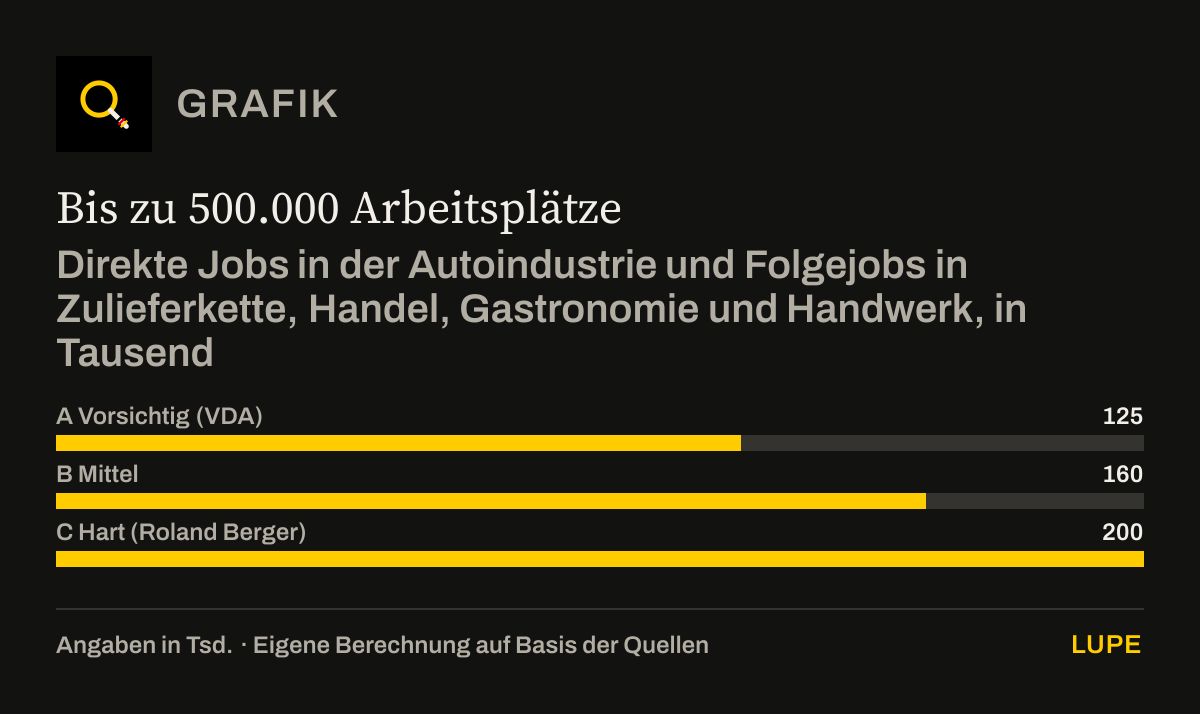
Show data table3 rows
| Direct jobs (k) | Knock-on jobs (k) | Together (k) | |
|---|---|---|---|
| A Cautious (VDA) | 125 | 125 | 250 |
| B Medium | 160 | 224 | 384 |
| C Harsh (Roland Berger) | 200 | 300 | 500 |
7. The money is missing locally
A skilled car worker who loses their job does not necessarily become unemployed. But they almost always earn less, and permanently so. A large study using German administrative data shows that income losses after job loss are large, lasting and almost twice as high in downturns, above all because those affected move to worse-paying employers.[20]
The DIW shows the range: anyone who changes both occupation and sector after a mass redundancy from production earns around 30 per cent less in daily wages in their first new job. Anyone staying in a production occupation in industry loses around 2 per cent, and anyone moving in a production occupation into the service sector around 6 per cent.[21]
This is exactly where the explosive force lies. Industrial wages are among the highest in the country. Every euro missing there is missing at the car dealer, in the restaurant, at the sports club and for the builder who no longer builds the family home. Bochum shows it: new jobs arose on the former Opel site, but many cannot match the pay of a skilled car worker.[17]
8. Where it strikes
The crisis does not hit Germany evenly. According to IW Consult, 116 of 400 districts and district-free cities are particularly shaped by the automotive economy. Almost 859,000 production-related employees of the automotive economy work there, almost three quarters of all those nationwide. Their share of all employees there is 8.4 per cent, against only 3.4 per cent nationwide.[12] In 36 of these districts particularly many jobs depend on the combustion engine; Salzgitter, the Saarpfalz district, Bamberg and the district of Kassel are at the top.[12]
Baden-Württemberg: the complete car cluster counted around 480,000 employees in 2022. In the progressive scenario of the Land study, with a rapid ramp-up of electric mobility, up to 66,000 posts go by 2030 and up to 154,500 by 2040. The Land government stresses that these are scenarios and not forecasts.[23][33]
Eastern Germany: one industrial job in four, a quarter of a million, depends directly or indirectly on the vehicle and supplier industry, according to a study commissioned by IG Metall.[24] Around the VW plant in Zwickau, around 20,000 posts at suppliers are at stake, according to an estimate by the Saxon automotive suppliers’ network.[36]
Other Länder: in 2025 employment in the car industry fell by 8 per cent in North Rhine-Westphalia, by 11 per cent in Saarland and by 20 per cent in Schleswig-Holstein.[2]
Worked example: a typical car district
around 6,700 jobs
A district with 100,000 employees has, at a sector share of 8.4 per cent, around 8,400 jobs in the automotive economy.[12] If a third of them go (2,800) and 1.4 knock-on jobs per post are added, the district loses around 6,700 jobs, almost 7 per cent of all its jobs. At 30,000 to 42,000 euros of net income per post, the district is short of around 200 to 280 million euros of purchasing power every year.
Our own model calculation with assumptions from the studies cited.
On top of this come municipal finances. In Stuttgart trade tax revenue fell from 1.3 billion euros in 2024 to around 730 million euros in 2025; taz attributes this to the crisis at Mercedes and Porsche, while the city speaks of a drastic economic downturn.[22][31] In Rastatt, the site of a Mercedes plant, revenue was still above 100 million euros in 2024; for 2026 the city has most recently reckoned on only around 300,000 euros.[22][34] When the largest taxpayer falls away, it hits day-care centres, swimming pools, roads and clubs, that is all citizens, not only car workers.
9. What cushions the situation and why that is not enough
Mobility: according to the study by Gathmann and colleagues, those under 50 in the regions affected lose no employment, because they are mobile; those over 50 are hit permanently.[16] For the region that is cold comfort: anyone who moves away takes their purchasing power with them.
Structural change: from 1975 to 2019, 1.53 million lost production jobs in industry were matched by 1.03 million new production-related jobs in the service sector, around 68 per cent.[21]
Social systems: unemployment benefit, severance payments and partial retirement delay the collapse in purchasing power by a few years. They do not prevent it.
Demography: many posts disappear through retirements. That spares the individual, but not the region: the post does not come back, and the next generation lacks the well-paid industrial job.
10. What follows from this
The figures allow only one conclusion: the crisis in the car industry is not a sectoral question. It is a question of regions, of municipal finances and of small and medium-sized business. Anyone deciding today about the budget, energy prices or CO₂ rules is deciding about these jobs too.
Count honestly: the federal government and the Länder should report, alongside the direct posts, the knock-on jobs and the losses of purchasing power by region, not just corporate figures.
Make the location competitive: energy, levies and bureaucracy decide whether the new jobs of the transformation arise in Germany or abroad.[5]
Recalculate the 2035 regulation: on the VDA’s calculation, around 50,000 jobs depend on how the CO₂ fleet rules are designed.[5]
Focus on the 116 car districts: an early warning system, help for medium-sized suppliers, retraining and targeted investment attraction, before the second and third waves reach the regions.
Outlook: part 2 of this series quantifies the tax shortfalls for the federal government, the Länder and the municipalities and the pressure to save that follows from them. Part 3 shows the 116 car districts on the map, with populations and catchment areas.
Andreas W. HerbCEO MBG Group, Paderborn
METHOD
Method
The official employment figures come from the monthly report on manufacturing of the Federal Statistical Office (businesses with 50 or more employees, economic sector 29). The VDA calculates using data of the Federal Employment Agency for all businesses (around 958,000 employees in 2019); its figures for job cuts are therefore not directly comparable with the Destatis values. Scenarios A to C, the purchasing power figures and the worked example are our own calculations. Multipliers describe long-term effects over several years and are averages; in an individual case they can be higher or lower. The German study by Gathmann and colleagues measures around 0.8 further posts per post cut after four years and around 2 after ten years, with a smaller sample for the long period; the factors of 1.0 to 1.5 in the scenarios are assumptions by the author. The headline “up to 500,000” denotes the upper scenario, not an official forecast.
CHECK
What was checked before publication
- Every step of the arithmetic has been recalculated and follows from the starting values named.
- The sources were checked on 7 October 2026. Where the original cited a secondary source (a blog, an agency report, a tabloid), the primary source is given; in several places the period, the reference or the date has been made more precise in line with the primary source.
- The knock-on job factors in the scenarios are assumptions by the author. German research measures around 0.8 further posts per post cut after four years and around 2 after ten years (sources 16, 35); Moretti’s US figure describes increases and is lower for durable goods (source 18).
SOURCES
Sources
Every number in the text leads to its source. The origin is given at each entry: official, media report, trade association, institute or data portal. Titles stay in the original language, so that each document can still be found.
[1] Statistisches Bundesamt, 14.08.2026
Pressemitteilung N057Official source↑ back to the text
[2] EY, 20.03.2026
Automobilstandort Deutschland immer stärker unter DruckInstitute or public body↑ back to the text
[3] EY, 14.08.2026
Industriebarometer Q2 2026: Deutsche Industrie stabilisiert sich beim Umsatz – doch der Arbeitsplatzabbau beschleunigt sichInstitute or public body↑ back to the text
[4] Volkswagen AG, 20.12.2024
Einigung erzielt: Volkswagen AG stellt sich wettbewerbsfähig für die Zukunft aufInstitute or public body↑ back to the text
[5] Verband der Automobilindustrie (VDA), 12.05.2026
Pressemeldung zur Beschäftigungsentwicklung bis 2035Trade association↑ back to the text
[6] Roland Berger (Pressemitteilung, Abdruck bei finanznachrichten.de), 07.10.2026
Deutsche Automobilindustrie schrumpft: Neue Roland-Berger-Studie prognostiziert mindestens 200.000 Stellen weniger bis 2030Institute or public body↑ back to the text
[7] Hasepost (dts, nach manager magazin), 17.09.2026
200.000 Autojobs in Deutschland bis 2031 gefährdetMedia report↑ back to the text
[8] Fraunhofer IAO, 22.07.2026
Automobilindustrie 2040: Studie zeigt Auswirkungen und Chancen für Beschäftigung und WertschöpfungInstitute or public body↑ back to the text
[9] RSM Ebner Stolz, 31.08.2026
Studie Automobilzulieferer 2026: Wachsen oder Weichen? Optimieren!Institute or public body↑ back to the text
[10] BMW Group, 2026
Quartalsmitteilung zum 30. Juni 2026Institute or public body↑ back to the text
[11] EY, 20.09.2026
Deutsche Autokonzerne verlieren den Anschluss: Schlusslicht beim Umsatz, Gewinne und Margen im SinkflugInstitute or public body↑ back to the text
[12] IW Consult für das BMWE, 09.09.2025
Regionale Automobilnetzwerke – Update 2025Institute or public body↑ back to the text
[13] Bosch, 25.09.2025
Maßnahmen zur Schließung der Kostenlücke bei Bosch Mobility – Weiterer Stellenabbau unvermeidbarInstitute or public body↑ back to the text
[14] Continental, 18.02.2025
Pressemitteilung zum Stellenabbau in Forschung und EntwicklungInstitute or public body↑ back to the text
[15] RND/dpa (cash.ch), 17.02.2026
Mühsam aus der Krise: Deutsche Industrie streicht über 120.000 JobsMedia report↑ back to the text
[16] Gathmann, Helm, Schönberg (Journal of the European Economic Association 18/1), 2020
Spillover Effects of Mass LayoffsInstitute or public body↑ back to the text
[17] Süddeutsche Zeitung, 14.12.2017
Bochum: Wo die Sonne nicht mehr verstaubtMedia report↑ back to the text
[18] Enrico Moretti (American Economic Review: Papers & Proceedings 100/2), 2010
Local MultipliersInstitute or public body↑ back to the text
[19] Dr. Web, 27.06.2026
Werksschließung: Was eine Region wirklich verliertMedia report↑ back to the text
[20] Schmieder, von Wachter, Heining (American Economic Review), 2023
The Costs of Job Displacement over the Business Cycle and Its SourcesInstitute or public body↑ back to the text
[21] DIW Berlin (Kroeger, Boddin), 05.08.2026
Wochenbericht 32/2026: Beschäftigung im Strukturwandel: Berufe bleiben, Branchen wechselnInstitute or public body↑ back to the text
[22] taz, 17.02.2026
Die Krise kommt im Stadtsäckel anMedia report↑ back to the text
[23] e-mobil BW, 13.11.2023
Neuauflage der Strukturstudie BW 2023 (Presseinformation)Institute or public body↑ back to the text
[24] IG Metall Bezirk Berlin-Brandenburg-Sachsen, Februar 2025
prägnant 28: Studie zur Automobilindustrie in Ostdeutschland (Sustain Consult)Trade association↑ back to the text
[25] Prognos für den VDA, 29.10.2024
Studie: Beschäftigungsperspektiven in der AutomobilindustrieInstitute or public body↑ back to the text
[26] EY, März 2025
Die Automobilindustrie in DeutschlandInstitute or public body↑ back to the text
[27] Mercedes-Benz Group, 28.07.2026
Absatz im zweiten Quartal 2026Institute or public body↑ back to the text
[28] autohaus.de, 2026
Absatzzahlen sinken: Deutsche Autoindustrie im RückwärtsgangMedia report↑ back to the text
[29] electrive.net, 25.09.2025
Bosch will weitere 13.000 Stellen in der Mobility-Sparte abbauenMedia report↑ back to the text
[30] t-online (dpa), 18.02.2025
Continental setzt Rotstift an: 3000 Stellen fallen wegMedia report↑ back to the text
[31] Landeshauptstadt Stuttgart, Juli 2026
Jahresabschluss 2025: Stuttgart verzeichnet RekorddefizitOfficial source↑ back to the text
[32] produktion.de, 26.07.2024
ZF will bis zu 14.000 Stellen in Deutschland streichenMedia report↑ back to the text
[33] Landtag von Baden-Württemberg, 11.06.2026
Drucksache 18/22: Antwort der Landesregierung zur Strukturstudie BW 2023Official source↑ back to the text
[34] goodnews4 (Mitteilung der Stadt Rastatt), 2026
Haushalt 2026 der Stadt Rastatt unter Auflagen genehmigtMedia report↑ back to the text
[35] Gathmann, Helm, Schönberg (Working Paper, Universität Heidelberg), März 2017
Spillover Effects of Mass LayoffsInstitute or public body↑ back to the text
[36] Freie Presse, 26.06.2026
Experte zur geplanten Schließung des Zwickauer VW-Werks: 20.000 Arbeitsplätze bei Zulieferern stehen auf dem SpielMedia report↑ back to the text
CORRECTIONS
Corrections
No corrections since publication on 07/10/2026. Every substantive change appears here with its date, reason and previous wording.
This page is opinion. Our fact checks are not.