OPINIONCOMMENTARYEXCISE DUTIES
The absurd alcohol duty: same alcohol, zero to 1.13 euros of duty
Twelve drinks, each with 5 per cent alcohol in a 0.33 litre bottle: one carries 1.13 euros of excise duty, six carry nothing. Five duties measure on three different bases. In 2027 four of them are to rise by 20 per cent; the federal government is changing nothing about the structure. A commentary with a demand.
By Andreas W. Herb, Founder and CEO MBG Group, Paderborn
9 minutes read35 sources0 correctionsDisclosure
Share
Contents
€1.13
excise duty on an alcopop at 5 % vol in a 0.33 litre bottle
€0.00
on wine, semi-sparkling wine, Frizzante, still cider and apple wine at 5 % vol
no duty rate for wine[3]
5 duties
in four acts, on three bases: original gravity, quantity of drink, pure alcohol
−€0.24m
alcopop duty revenue in 2025; in 2024 it was €1.38m
Bundesfinanzministerium (Federal Ministry of Finance)[6]
Take twelve drinks, each with 5 per cent alcohol in a 0.33 litre bottle. Same quantity of alcohol, same bottle. The excise duty ranges from zero to 1.13 euros. The difference is made not by the alcohol but by the law that applies, and by what it measures. Beer duty is calculated on original gravity, sparkling wine duty on the quantity of drink, alcohol duty on pure alcohol.[4][5][1] On ready-mixed drinks with spirits below 10 per cent, the alcopop duty comes on top.[2][7] For still wine there is no duty rate.[3]
Same alcohol, same bottle: zero to 113 cents of duty
Excise duty per 0.33 litre bottle at 5 % vol, excluding VAT, law as at 9 November 2026
Own calculation under § 2 Biersteuergesetz (beer duty act), § 2 Schaumwein- und Zwischenerzeugnissteuergesetz (sparkling wine and intermediate products duty act), § 2 Alkoholsteuergesetz (alcohol duty act) and § 2 Alkopopsteuergesetz (alcopop duty act)[4][5][1][2]. Chart redrawn from the figures in the text.
Limits of the data: Model: all drinks at 5 % vol; for Sekt, Prosecco, wine and semi-sparkling wine, wine law usually requires more. Beer and beer mix at 12 degrees Plato, without the reduced rates for small breweries. Sekt and Spumante at the reduced rate below 6 % vol. Frizzante, semi-sparkling wine and cider below 3 bar with an ordinary closure, cider and wine mix still. Alcohol duty alone is a comparison figure: a ready-to-drink beverage made from spirits at 5 % vol would be an alcopop.
Download the chart as an image (PNG)
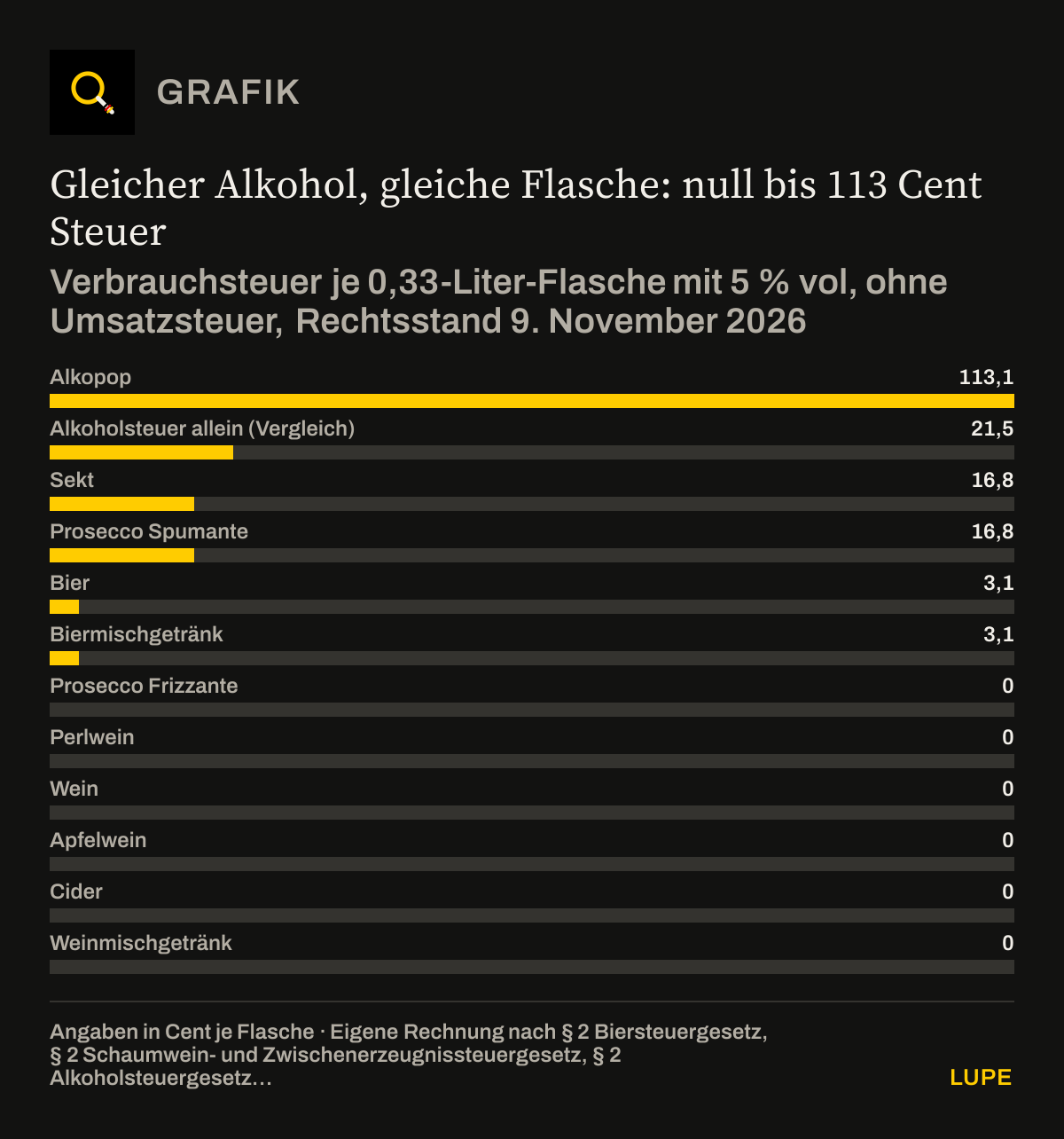
Show data table12 rows
| Excise duty (cents per bottle) | |
|---|---|
| Alcopop | 113.1 |
| Alcohol duty alone (comparison) | 21.5 |
| Sekt | 16.8 |
| Prosecco Spumante | 16.8 |
| Beer | 3.1 |
| Beer mix | 3.1 |
| Prosecco Frizzante | 0 |
| Semi-sparkling wine | 0 |
| Wine | 0 |
| Apple wine | 0 |
| Cider | 0 |
| Wine mix | 0 |
The calculation comes from an overview by my group of companies. The editorial team recalculated it and corrected it in two places; what has been changed is set out in the review note.
A wire cage adds 16.8 cents
Sparkling wine duty is payable if the drink has an excess pressure of at least 3 bar or if the bottle is closed with a sparkling wine stopper held in place by a special retaining device.[8] A Frizzante with an ordinary closure therefore carries no duty. If the same contents go under a sparkling wine cork with a wire cage, it is 16.8 cents. The same applies to cider and semi-sparkling wine.[8][5]
The range is even wider for the wine mix. Up to 10 per cent it counts as wine for tax purposes, even if alcohol has been added, and carries no duty.[3][9] But if it has lost the taste, smell and appearance of a fermented drink, customs classifies it as an alcohol product. With added alcohol it is then an alcopop and carries 1.13 euros; without added alcohol it carries 21.5 cents of alcohol duty.[9][10] Whether the same bottle costs zero or 1.13 euros is therefore decided by its classification in the customs tariff.
For the beer mix, only the original gravity of the beer used counts today.[11] From 2031 the sugar in the lemonade counts as well; that has been in the law since 2022. A beer mix at 14 degrees Plato will then carry 3.6 instead of 3.1 cents.[4][12]
What the state gets out of it
| Duty | Basis | Revenue 2025 | goes to |
|---|---|---|---|
| Alcohol duty | pure alcohol | €2,050.5m | Federal government |
| Beer duty | original gravity | €539.7m | Länder (federal states) |
| Sparkling wine duty | quantity of drink | €364.6m | Federal government |
| Intermediate products duty | quantity of drink | €23.0m | Federal government |
| Alcopop duty | pure alcohol, in addition | −€0.24m | Federal government, earmarked for addiction prevention[13][14] |
| Total | €2,977.6m | Federal government and Länder |
Together the five duties bring in just under 3 billion euros, a third of a per cent of tax revenue excluding municipal taxes. Just over two thirds of that comes from alcohol duty.[6] In 2025 the alcopop duty brought in nothing; it came to minus 237,000 euros. The finance ministry does not say why.[6] The intermediate products duty brought in 23 million euros.
All five are collected by customs, including the beer duty, which is due to the Länder.[13][15] As early as 2016 the Bundesrechnungshof (Federal Court of Audit) proposed transferring its revenue to the federal government, partly to simplify administration.[15] Customs looks after 10,057 distilleries, 1,415 breweries and 902 companies that sell sparkling wine at 6 per cent or more. Of these companies, 695 sell no more than 10,000 litres a year.[16][17][18]
„Hinsichtlich des zur Erhebung der Schaumweinsteuer anfallenden Verwaltungsaufwands liegen der Bundesregierung keine Daten vor.“
Translation: The federal government has no data on the administrative effort incurred in collecting the sparkling wine duty.
The collection of all excise duties ran on a standardised basis, the federal government wrote on this point. Alongside the large excise duties, it said, the sparkling wine duty carried no significant weight. It gave no figure.[19] What the five duties cost customs has not been published anywhere. Customs has around 49,000 employees; how many of them work on beer, Sekt and alcopops it does not publish.[20] Only a small part has been quantified: because the alcopop duty is in future to follow the procedure of the alcohol duty, customs saves 1,939 euros a year in staff costs according to the draft Haushaltsbegleitgesetz 2027 (budget accompanying act).[21] The Zoll- und Finanzgewerkschaft BDZ (customs and finance trade union) recommends also evaluating the actual administrative burden after the increase.[22] A government that wants to cut bureaucracy should first know what each tax costs.
2027: 20 per cent more, the same structure
The federal government wants to raise alcohol, sparkling wine, intermediate products and alcopop duty by 20 per cent from 1 January 2027; beer duty stays as it is. Alcohol duty would rise from 1,303 to 1,564 euros per hectolitre of pure alcohol, alcopop duty from 5,550 to 6,660 euros. Additional revenue of 455 million euros a year is expected, 380 million in the first year.[21]
That changes nothing about the structure; the range only gets wider. The alcopop from the chart would carry 1.36 euros, the Sekt below 6 per cent 20.1 cents. Wine, Frizzante and still cider would still carry nothing, beer still 3.1 cents.[21]
The Bundestag’s Finanzausschuss (finance committee) has invited experts to a hearing on these plans on 9 November 2026.[23] In the debate on 4 November the SPD spoke of very good talks with its coalition partner about the alcohol duty. A CDU/CSU speaker said that dropping insignificant taxes was open to discussion. He nevertheless rejected the AfD motion to abolish several small excise duties, among them beer, sparkling wine, intermediate products and alcopop duty. The motion, he said, named no offsetting funding, and revenue could not be given up across the board.[24][25]
How others do it
Since 1 August 2023 Britain has taxed every alcoholic drink on its pure alcohol, with the same strength bands for all types of drink. Since then still and sparkling wine have paid the same rate.[26][27] The government expected slightly lower revenue as a result.[26] With the changes after the consultation, it reckoned on 140 to 200 million pounds less a year.[28] In the financial years 2023/24 to 2025/26 revenue stayed almost level at 12.4 to 12.6 billion pounds. Over this period the rates rose three times in line with inflation.[27][29]
The official evaluation of 28 October 2026 is sober: what noticeably simplified things was above all the new online return and the single approval. Taxing by alcohol content has not significantly reduced the effort of calculation. Some wine producers report more effort, because they have to determine the alcohol content for every product.[27] A coherent reform therefore needs both: a single basis and a simple procedure.
Austria set its sparkling wine duty to zero from 1 July 2020. The reasons given included the disadvantage compared with Frizzante and semi-sparkling wine, which pay no duty, and less administrative burden for businesses.[30][31]
Germany is not entirely free in this. Under EU law, wine and sparkling wine are taxed per hectolitre of drink, and the minimum rate is zero.[32][33] Beer may be taxed by degrees Plato or by alcohol content.[33] Taxing all drinks on pure alcohol would only be possible for wine by departing from EU law; Britain could only take this step after it left the EU.[26][32] The World Health Organization considers taxes based on alcohol content the best way to reduce harm to health.[34] The health ministry’s FinanzKommission Gesundheit (health finance commission) has considered such taxation. It would require a duty on wine and higher duties on beer; the commission expressly makes no recommendation on this.[35]
My demand
Anyone who really wants to change something does not patch one spot but reorganises the alcohol duties as a whole. I call for five steps.
First: one act instead of four. Alcohol, sparkling wine, intermediate products and alcopop duty belong in one act with one procedure and one basis, pure alcohol, as far as EU law allows. Second: abolish the alcopop duty. It brought in nothing in 2025 and burdens a mixed drink at 5 per cent more heavily than one at 10 per cent.[6][7] Third: no more duties that hinge on the closure. Whether a bottle has a wire cage must not decide the duty.
Fourth: transfer the beer duty to the federal government, as the Bundesrechnungshof proposed in 2016, and compensate the Länder for it.[15] Then one level of government both collects and receives the duty. Fifth: measure first, then raise. Before any rate goes up, customs should disclose what each of these duties costs it and businesses.
My aim is a reform that relieves businesses and consumers, saves work at customs and brings the state at least as much as today. Whether even more ends up in the coffers depends on the rates and on the costs saved. That is precisely why the missing cost calculation belongs at the start. A 20 per cent increase on the old structure is not a reform. It only makes the patchwork more expensive.
Andreas W. HerbFounder and CEO MBG Group, Paderborn
What I expressly do not claim
I do not claim that a reform by itself brings in more money; that depends on the rates. What customs spends on each of these duties has not been quantified, not by me either. Taxing all drinks on pure alcohol runs up against the limits of EU law where wine is concerned, and a new duty on wine would be no relief. The calculation above is a model with 5 per cent for all drinks, not a price comparison of particular products.
METHOD
Method
Pure alcohol per bottle: 0.33 litres × 5 % = 16.5 millilitres = 0.000165 hectolitres. Alcohol duty: × 1,303 euros = 0.2150 euros. Alcopop duty: × 5,550 euros = 0.9158 euros. Together 1.1307 euros, rounded 1.13 euros. A spirit-based mixed drink at 10 % vol is not an alcopop: 0.00033 hectolitres of pure alcohol × 1,303 euros = 0.4300 euros, rounded 43 cents.
Sparkling wine duty below 6 % vol: 0.0033 hectolitres × 51 euros = 0.1683 euros, rounded 16.8 cents. Beer duty: 12 degrees Plato × 0.787 euros × 0.0033 hectolitres = 0.0312 euros, rounded 3.1 cents; at 14 degrees Plato 0.0364 euros, rounded 3.6 cents.
In 2027 under the draft: alcopop 0.000165 × (1,564 + 6,660) euros = 1.3570 euros; alcohol duty alone 0.000165 × 1,564 euros = 0.2581 euros; Sekt below 6 % vol 0.0033 × 61 euros = 0.2013 euros.
Revenue 2025: 2,050.494 + 539.713 + 364.615 + 23.011 − 0.237 = 2,977.596 million euros. Share of 901.9 billion euros of tax revenue excluding municipal taxes: 0.33 per cent. Share of alcohol duty: 2,050.5 ÷ 2,977.6 = 68.9 per cent.
CHECK
What was checked before publication
- The basis is an overview by the MBG Group dated 9 November 2026. All duty rates and cent values were recalculated on the same day against the wording of the Biersteuergesetz, the Schaumwein- und Zwischenerzeugnissteuergesetz, the Alkoholsteuergesetz and the Alkopopsteuergesetz (the German acts on beer duty, sparkling wine and intermediate products duty, alcohol duty and alcopop duty); the calculation is correct.
- Corrected compared with the source material: a wine mix with added alcohol at 5 per cent is not an intermediate product; up to 10 per cent it counts as wine for tax purposes. Depending on its classification in the customs tariff it carries zero or 1.13 euros, not 33.7 cents. For the beer mix the sugar in the lemonade only counts from 2031; the chart therefore shows today’s value.
- Clarified: at 5 per cent, alcohol duty alone is only a comparison figure, because a ready-to-drink beverage made from spirits at this strength would be an alcopop. For Sekt, Prosecco, wine and semi-sparkling wine, 5 per cent is a model assumption; wine law usually requires more alcohol.
- Not taken over: that Frizzante and Spumante are “the same wine”, and the widespread account that the sparkling wine duty was introduced in 1902 for the imperial navy. No official source was found for either.
- What the five duties cost customs is not quantified anywhere. In 2022 the federal government stated that it had no data on this for the sparkling wine duty. The text therefore claims no cost figure but calls for one.
- The revenue figures are cash receipts according to the Bundesfinanzministerium (Federal Ministry of Finance). For December 2025 the ministry reports an accounting-related increase in revenue from the alcohol duties; the annual figure for 2025 is therefore somewhat overstated. Why the alcopop duty was negative in 2025 is not explained by the ministry.
- Corrected at the second check on the same day: the British revenue shortfall including the changes after the consultation, the account of the federal government, the customs officers’ union and the British evaluation, and the alcopop comparison in the demand.
- The Bundesfinanzministerium and customs were not asked for comment.
SOURCES
Sources
Every number in the text leads to its source. The origin is given at each entry: official, media report, trade association, institute or data portal. Titles stay in the original language, so that each document can still be found.
[1] Bundesministerium der Justiz, abgerufen 09.11.2026
§ 2 Alkoholsteuergesetz: Steuertarif (Regelsatz 1.303 Euro je Hektoliter Alkohol)Official source↑ back to the text
[2] Bundesministerium der Justiz, abgerufen 09.11.2026
§ 2 Alkopopsteuergesetz: Steuertarif (5.550 Euro je Hektoliter reinen Alkohols)Official source↑ back to the text
[3] Bundesministerium der Justiz, abgerufen 09.11.2026
§ 32 Schaumwein- und Zwischenerzeugnissteuergesetz: Begriffsbestimmung (Wein)Official source↑ back to the text
[4] Bundesministerium der Justiz, abgerufen 09.11.2026
§ 2 Biersteuergesetz: Steuertarif (0,787 Euro je Hektoliter und Grad Plato)Official source↑ back to the text
[5] Bundesministerium der Justiz, abgerufen 09.11.2026
§ 2 Schaumwein- und Zwischenerzeugnissteuergesetz: Steuertarif (136 Euro, unter 6 % vol 51 Euro je Hektoliter)Official source↑ back to the text
[6] Bundesministerium der Finanzen, Stand 02.02.2026
Steuereinnahmen (ohne Gemeindesteuern) nach Steuerarten im gesamten Bundesgebiet, Übersicht 1, 1. bis 4. Quartal 2025Official source↑ back to the text
[7] Bundesministerium der Justiz, abgerufen 09.11.2026
§ 1 Alkopopsteuergesetz: Steuergegenstand (mehr als 1,2 und weniger als 10 Prozent vol)Official source↑ back to the text
[8] Bundesministerium der Justiz, abgerufen 09.11.2026
§ 1 Schaumwein- und Zwischenerzeugnissteuergesetz: Steuergebiet, SteuergegenstandOfficial source↑ back to the text
[9] Generalzolldirektion, abgerufen 09.11.2026
Besonderheiten für WeinOfficial source↑ back to the text
[10] Generalzolldirektion, abgerufen 09.11.2026
Steuergegenstand im AlkopopsteuerrechtOfficial source↑ back to the text
[11] Generalzolldirektion, abgerufen 09.11.2026
Höhe der Biersteuer (Biermischungen: Stammwürze des eingesetzten Bieres)Official source↑ back to the text
[12] Deutscher Bundestag, 15.06.2022
Drucksache 20/2247: Entwurf eines Achten Gesetzes zur Änderung von Verbrauchsteuergesetzen (Begründung zu § 2 Biersteuergesetz)Official source↑ back to the text
[13] Bundesministerium der Justiz, abgerufen 09.11.2026
Grundgesetz, Art. 106 (Verteilung des Steueraufkommens) und Art. 108 (Finanzverwaltung)Official source↑ back to the text
[14] Bundesministerium der Justiz, abgerufen 09.11.2026
§ 4 Alkopopsteuergesetz: Aufkommensverwendung (Suchtprävention)Official source↑ back to the text
[15] Bundesrechnungshof, 27.12.2016
Bericht nach § 88 Abs. 2 BHO an den Rechnungsprüfungsausschuss zur Ertragshoheit für die Biersteuer, Gz. VIII 5 - 2015 - 0644/4Official source↑ back to the text
[16] Statistisches Bundesamt, 17.03.2026, korrigiert 08.07.2026
Statistischer Bericht Alkoholsteuerstatistik 2025 (Tabellen 79941-b01 und -01)Official source↑ back to the text
[17] Statistisches Bundesamt, 25.02.2026
Statistischer Bericht Brauwirtschaft 2025 (Tabellen 79922-01 und -07)Official source↑ back to the text
[18] Statistisches Bundesamt, 16.03.2026, korrigiert 30.09.2026
Statistischer Bericht Schaumweinsteuer- und Zwischenerzeugnissteuerstatistik 2025 (Tabellen 79923-01, -04, -05)Official source↑ back to the text
[19] Deutscher Bundestag, 13.05.2022
Drucksache 20/1817: Schriftliche Fragen, Frage 29 mit Antwort der Bundesregierung (S. 20 f.)Official source↑ back to the text
[20] Generalzolldirektion, Stand 31.12.2025
Zolljahresstatistik 2025: PersonalOfficial source↑ back to the text
[21] Deutscher Bundestag, 07.09.2026
Drucksache 21/7860: Entwurf eines Haushaltsbegleitgesetzes 2027 (Artikel 1 bis 3, Erfüllungsaufwand und Finanzwirkungen)Official source↑ back to the text
[22] BDZ Deutsche Zoll- und Finanzgewerkschaft, 04.11.2026
Stellungnahme zum Haushaltsbegleitgesetz 2027 für die Anhörung des FinanzausschussesTrade association↑ back to the text
[23] Deutscher Bundestag, Finanzausschuss, abgerufen 09.11.2026
Anhörung zum Haushaltsbegleitgesetz und zur Zuckergetränkesteuer am 9. November 2026Official source↑ back to the text
[24] Deutscher Bundestag, 04.11.2026
Plenarprotokoll 21/104, Tagesordnungspunkt 6 (S. 13177 B bis 13184 D)Official source↑ back to the text
[25] Deutscher Bundestag, 15.10.2026
Drucksache 21/8637: Antrag der Fraktion der AfD „Steuererhöhung auf Tabak zurücknehmen – Keine weiteren Steuern auf Alkohol, Zucker und Plastik – Bagatellsteuern abschaffen“Official source↑ back to the text
[26] HM Treasury und HM Revenue & Customs, 23.03.2023
The new alcohol duty system: Final consultation responseOfficial source↑ back to the text
[27] HM Revenue & Customs und HM Treasury, 28.10.2026
Alcohol Duty Reforms Evaluation ReportOfficial source↑ back to the text
[28] HM Revenue & Customs, aktualisiert 18.11.2025
Policy paper: Reform of Alcohol Duty Rates and Reliefs (Tax Information and Impact Note)Official source↑ back to the text
[29] HM Revenue & Customs, 28.08.2026
Alcohol Bulletin, Kommentar und Tabellen Mai bis Juli 2026 (Tabelle 1a)Official source↑ back to the text
[30] Rechtsinformationssystem des Bundes (Österreich), abgerufen 09.11.2026
Schaumweinsteuergesetz 1995, § 3 (0 Euro je Hektoliter seit 01.07.2020)Official source↑ back to the text
[31] Parlament Österreich, 15.05.2020
184 der Beilagen XXVII. GP, Bericht des Budgetausschusses über den Antrag 537/A (19. COVID-19-Gesetz)Official source↑ back to the text
[32] Deutscher Bundestag, Wissenschaftliche Dienste, 03.09.2026
Erhöhung der Schaumweinsteuer: Finanzielle und administrative Auswirkungen sowie mögliche Ausweichreaktionen der Konsumenten, WD 4-30000-0003-0015Official source↑ back to the text
[33] Rat der Europäischen Gemeinschaften, 19.10.1992
Richtlinie 92/84/EWG über die Annäherung der Verbrauchsteuersätze auf Alkohol und alkoholische Getränke (Art. 3 bis 6)Official source↑ back to the text
[34] Weltgesundheitsorganisation (WHO), 05.12.2023
Global report on the use of alcohol taxes, 2023 (Kapitel 3 und 8)Institute or public body↑ back to the text
[35] FinanzKommission Gesundheit (Geschäftsstelle im Bundesministerium für Gesundheit), 30.03.2026, Fassung 01.06.2026
Erster Bericht (S. 430 bis 434, Reformempfehlung 65)Official source↑ back to the text
CORRECTIONS
Corrections
No corrections since publication on 09/11/2026. Every substantive change appears here with its date, reason and previous wording.
This page is opinion. Our fact checks are not.