OPINIONGUEST COMMENTARYALCOPOP DUTY
A government that does not want to learn from old mistakes. It is driving our country into the wall at full speed.
The 2004 alcopop duty missed its revenue target by 85 per cent. In 2025 it brought in minus 237,000 euros on balance. Now it is to be extended – approved in committee within five days, without an impact assessment.
By Andreas W. Herb, Founder and CEO MBG Group, Paderborn
8 minutes read14 sources0 correctionsDisclosure
Share
Contents
−85%
Revenue 2005 to 2007 compared with plan: 22.7 instead of 156 million euros{9,4}
−€237,000
Alcopop duty revenue in 2025: more refunded than collected{10}
5 days
from the first report to the decision in the finance committee{7,1}
Five days from idea to decision
On 12 November 2026 the Bundestag finance committee decided to extend the alcopop duty. In future it is to apply to spirit-based mixed drinks of up to 15 per cent alcohol by volume.[1] So far it ends at 10 per cent by volume.[5] In return, according to the CDU/CSU, the duty rate is to fall by just under 45 per cent.[2]
The reason is not a new problem in the protection of minors. The coalition itself names the reason: the planned 20 per cent increase in sparkling wine duty was dropped out of consideration for the winegrowers. The mixed drinks are now to bring in the missing money.[1][2]
On 7 November the news agency dts first reported that the CDU/CSU was considering this extension. According to the report, 100 million euros are expected.[7] Five days later it had been approved in committee.[1] There is no impact assessment. The industry association BWS complains that it was not heard.[8] Nothing is final yet: the Bundestag still has to vote, and after that the Bundesrat will deal with it.
It is absurd to deal with such a complex issue in five days. That shows: superficiality and panic rule here. This government has completely lost control. One can only ask it to resign for the sake of our country and clear the way.
Anyone reading this experiences déjà vu. In 2004 Germany already ran this experiment once. It failed, and the figures on it have been available for years.
2004: A duty against its own product
In 2004 the alcopop duty was intended as protection of minors, not as a source of revenue. Its aim was to make alcopops so expensive that young people would no longer buy them. That is how the federal government itself describes it.[4]
Since August 2004 every hectolitre of pure alcohol in an alcopop has cost 5,550 euros in special duty. It comes on top of the spirits duty. Covered are spirit-based mixed drinks below 10 per cent alcohol by volume.[5] A 0.275-litre bottle at 5.5 per cent thus carried around 84 cents of special duty (own calculation).
The money was not supposed to disappear into the budget. Section 4 of the act earmarks the net additional revenue for the addiction prevention work of the Federal Centre for Health Education.[5] The bill expected 42 million euros of alcopop duty a year. In doing so it already assumed a 75 per cent fall in sales.[9]
In 2004 an SPD-led coalition was in government. The SPD is part of the government today as well. The knowledge of the first attempt would therefore be in-house.
What came of it: 156 million planned, 22.7 collected
For 2005 to 2007 the federal government budgeted 156 million euros from the alcopop segment.[9] It took in 22.7 million.[4] That is 85 per cent less than planned.
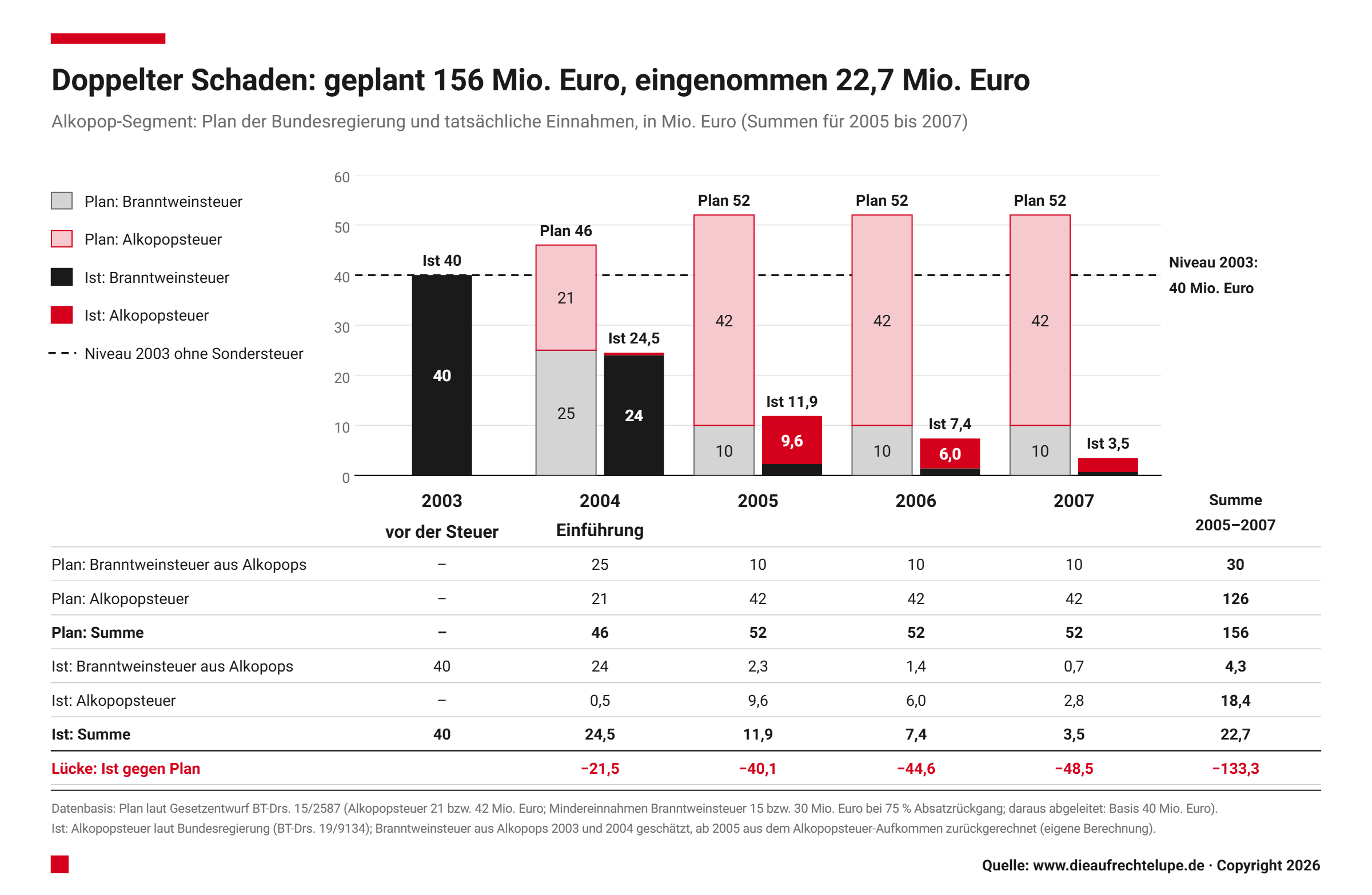
The damage was double. The new duty brought in hardly anything. At the same time the spirits duty from alcopops collapsed. In 2003 that had been at least 40 million euros. In 2007 the whole segment brought in just 3.5 million, special duty included.[9][4]
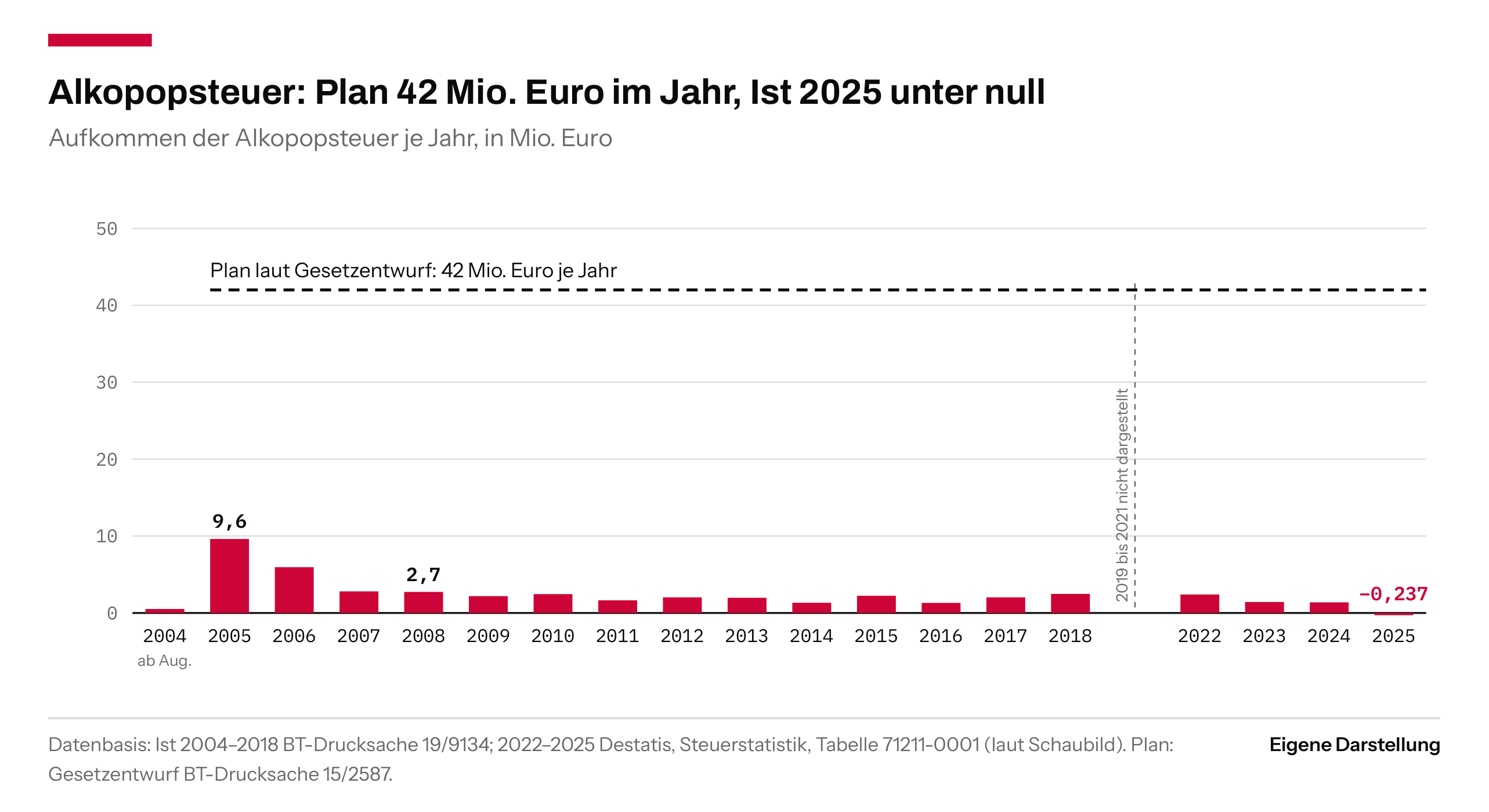
It never got better. In 2024 the alcopop duty brought in just 1.4 million euros. In 2025 its revenue was negative: the federal government refunded or offset 237,000 euros more than it took in.[10]
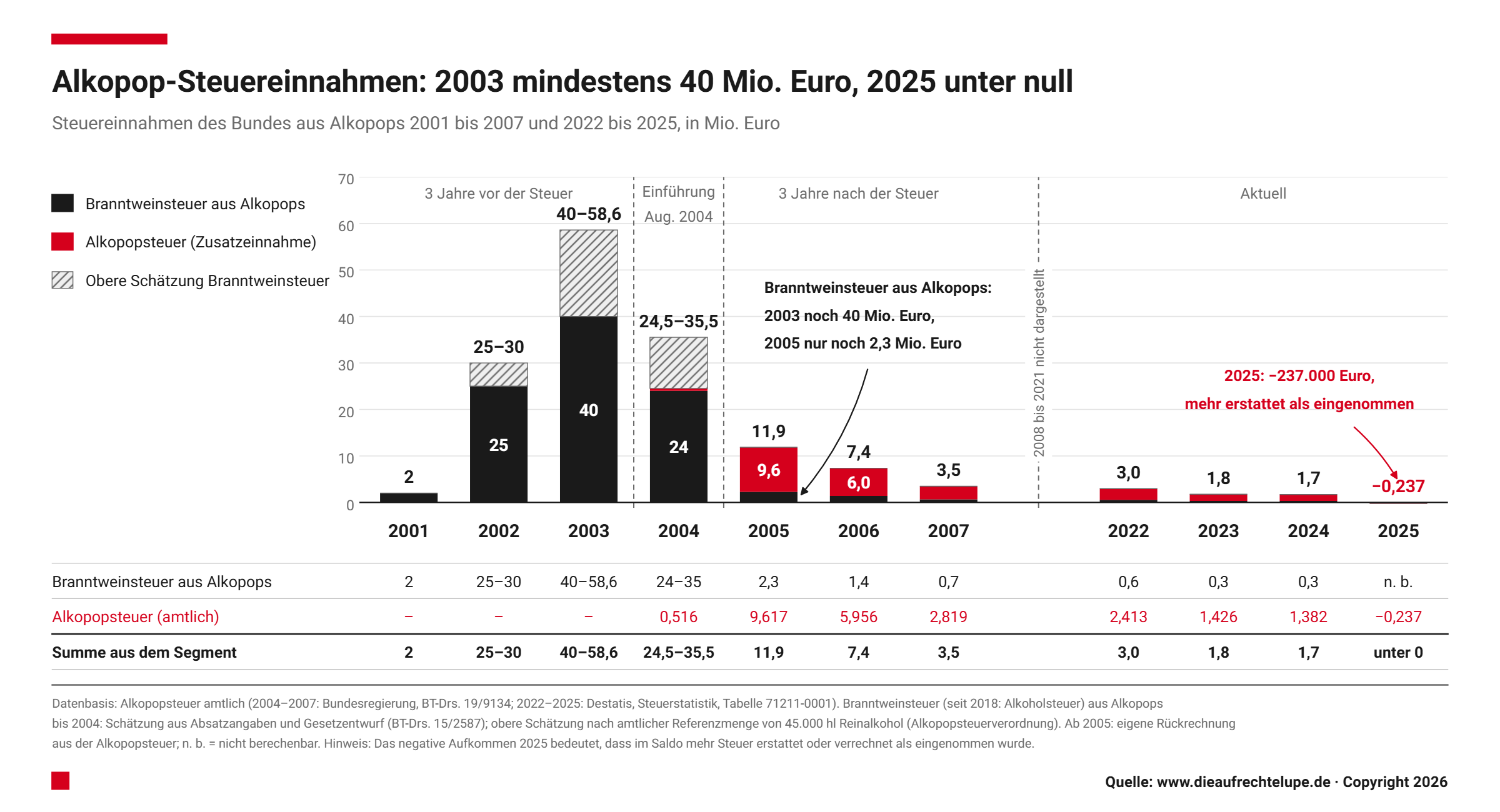
Nothing was left for addiction prevention. According to the federal government, the net additional revenue has never been positive since 2004.[4] Its conclusion from 2019:
„Finanzmittel aus der Alkopopsteuer hat die BZgA nicht erhalten.“
Translation: The BZgA has not received any funds from the alcopop duty.
And the protection of minors? Afterwards young people drank fewer alcopops. Whether that was due to the duty is disputed. The Bundestag’s research services point to Austria: there consumption fell in a similar way, without any alcopop duty at all.[6]
Today the coalition itself confirms the result. Drinks below 10 per cent, it says, have “almost entirely disappeared from the market” since the duty was introduced. That is what the finance committee’s report of 13 November 2026 states.[2]
The second mistake: the same calculation, only bigger
According to reports from CDU/CSU circles, the extension is to bring 100 million euros into the budget.[7] For comparison: in 2024 the alcopop duty brought in 1.4 million euros over the whole year, and in 2025 a minus.[10] So what is hoped for is more than seventy times the 2024 figure.
The justification contradicts itself. The drinks below 10 per cent have disappeared, says the coalition.[2] Therefore, so the logic goes, it costs little to cut the duty rate by just under 45 per cent. So the duty has already wiped out its own base once. Now the same duty is supposed to raise money from the next group.
This group is itself a consequence of 2004. Anyone who stayed below 10 per cent paid the special duty. Anyone above it did not. The SPD justifies the extension by saying that stronger mixed drinks are more widespread today.[1] That is no coincidence: the 2004 threshold rewarded everyone who went above 10 per cent.
What follows now is foreseeable. According to the amendment, a 0.33-litre can at 10 per cent carries around 1 euro more duty.[1] At a shop price of about 4 euros, that would be around 25 per cent. Manufacturers and customers are likely to switch: to above 15 per cent, to a wine or beer base, to mixing their own. Then 2004 repeats itself. The revenue fails to materialise, and the market is damaged all the same.
The procedure does not bode well either. The finance committee’s hearing on 9 November dealt with the government bill.[3] The extension was not in it. It came by way of an amendment. Three days after the hearing it had been approved. How quickly this goes wrong is shown by the tobacco duty: there the coalition has already had to repair a “technical implementation error” in parliament.[2]
The damage to the tax system
With this decision a tax meant to steer behaviour becomes a gap-filler. That affects more than just a drinks market.
The purpose is being swapped. In 2004 the word was protection of minors, and the money was earmarked for prevention. Now one per cent, at most one million euros, is to go to addiction prevention.[1] The rest plugs the hole torn by dropping the Sekt duty.
Steering and revenue rule each other out. A tax meant to push a product off the market cannot finance the budget. If the steering succeeds, the money is missing. If the money comes in, it has not steered. 2004 showed that.
Same alcohol, unequal tax. In future, alcohol from spirits in a can carries a special duty up to 15 per cent by volume. The same quantity of alcohol in Sekt is spared the increase, and in wine it remains tax-free. The yardstick is not the alcohol but who happens to deserve consideration at the moment.
There is no longer any planning certainty. Sekt out, alcopops in, within a single week. Every business learns from this: a product category can lose its basis overnight. Anyone who invests will reckon with this risk from now on.
The effort remains, the revenue does not. In the years 2008 to 2018 and 2022 to 2024 the alcopop duty brought in between 1.3 and 2.7 million euros, and in 2025 even a minus.[4][10] An expert at the hearing counted it among the dispensable micro-taxes.[3][12] Instead of abolishing it, the coalition is expanding it.
What a government willing to learn would do now
The extension is not yet law. The Bundestag can stop it in the final vote.
- 1Remove the extension from the 2027 budget accompanying act.
- 2Evaluate the first attempt. The figures are available in printed papers 15/5929 and 19/9134.[11][4]
- 3Present an impact assessment and hear those affected before any decision is taken.
- 4Enforce the protection of minors where it works: in the ban on supply to minors and its monitoring.
- 5Say openly what this is about. Anyone who needs money should say so and not use a tax for the protection of minors as a cash box.
2004 was a mistake one could learn from. In 2026 it is being repeated, with eyes wide open and in five days. That is no longer an error. A government that makes taxes like this squanders the trust on which every tax system rests.
Acknowledgement: thanks for the support in preparing the data go to Niklas Other of Inside Magazin and to the investigative portal www.dieaufrechtelupe.de.
Editor’s note: The charts leave out the years 2019 to 2021. According to the Federal Ministry of Finance, the alcopop duty brought in around 1.0 million euros in 2019, around 10.8 million euros in 2020 and minus 5.3 million euros in 2021.[13][14] For 2020 and 2021 together that is around 5.5 million euros. The ministry gives no explanation for the swings.
The commentary is also available as a video of just under 13 minutes: To the video.
METHOD
Method
Charts “Alkopopsteuer 2004”, dieaufrechtelupe.de: plan according to Bundestag printed paper 15/2587, actual figures according to Bundestag printed paper 19/9134 (2004–2007) and Destatis, tax statistics, table 71211-0001 (2022–2025), spirits duty from alcopops estimated.
Special duty per bottle: 0.275 litres × 5.5 per cent = 0.015125 litres of pure alcohol; × 55.50 euros per litre (5,550 euros per hectolitre) = 0.839 euros, around 84 cents.
Revenue against plan 2005 to 2007: 22.7 ÷ 156 = 0.146; that is 85.4 per cent less than planned.
Hoped-for revenue compared with 2024: 100 ÷ 1.382 = 72.4, so more than seventy times as much.
Additional burden per can: 1 euro on a shop price of 4 euros is 25 per cent.
Spirits duty from alcopops from 2005 onwards, as in charts 1 and 2: calculated back from the alcopop duty. Both duties fall on the same pure alcohol, one at 1,303, the other at 5,550 euros per hectolitre; for 2005 therefore 9.617 × 1,303 ÷ 5,550 = 2.26 million euros. Recalculated this way, all the totals in the charts are obtained.
Chart 1: The annual values are rounded to one decimal place. Added up, they come to 22.8 million euros; the unrounded values come to 22.7 million.
CHECK
What was checked before publication
- Text and charts stand as the author submitted them on 13 November 2026. No chart has been edited. With the author’s consent, one sentence has been changed because it did not match the official figures: instead of “In every year with official figures since 2008 the alcopop duty brought in between 1.3 and 2.8 million euros”, it now reads “In the years 2008 to 2018 and 2022 to 2024 the alcopop duty brought in between 1.3 and 2.7 million euros”. Added are the source markers and the editor’s note at the end.
- The information was checked against the originals on 13 November 2026: the Bundestag news item hib 935/2026, printed papers 21/9229, 19/9134, 15/2587 and 15/5929, the Alcopop Tax Act, the brief by the Bundestag’s research services, Dirk Meyer’s statement for the hearing, the reports by dts and about-drinks, and the Federal Ministry of Finance’s tax revenue figures for 2019 to 2025. Destatis table 71211-0001 could not be retrieved; the author’s figures for 2022 to 2025 match those of the ministry.
- The federal government’s quotation appears word for word on page 3 of printed paper 19/9134. “Almost 45 per cent” and “almost entirely disappeared from the market” are statements by the coalition parliamentary groups, reproduced on page 6 of printed paper 21/9229, the finance committee’s report on motion 21/8637; “technical implementation error” appears there on page 5. No official source gives a new tax rate in euros. From the statement that a can at 10 per cent would carry around 1 euro more, the rate would be 45.4 per cent lower.
- The report of 7 November comes from the RND; the news agency dts passed it on. Whether it was the first could not be verified. The 100 million euros are cited only by CDU/CSU circles; they have not been officially quantified. Whether there is no impact assessment could not be verified because the amendment has not been published; the industry association BWS is calling for one. The author uses the word “micro-taxes” (Kleinststeuern) for what the expert Dirk Meyer calls “Bagatellsteuern” (petty taxes).
- Derived and not officially reported are the 10 million euros of spirits duty planned per year and the 40 million euros for 2003, both taken from the bill (30 million euros in lost revenue with a 75 per cent drop in sales), as well as the spirits duty from alcopops from 2005 onwards. That the net additional revenue was never positive is stated by the federal government for the years 2004 to 2019; we found no more recent official statement on this.
- The finance ministry and the coalition parliamentary groups were not asked for comment.
SOURCES
Sources
Every number in the text leads to its source. The origin is given at each entry: official, media report, trade association, institute or data portal. Titles stay in the original language, so that each document can still be found.
[1] Deutscher Bundestag, 12.11.2026
hib 935/2026: Finanzausschuss stimmt Verbrauchsteuer-Änderungen zuOfficial source↑ back to the text
[2] Deutscher Bundestag, 13.11.2026
Drucksache 21/9229: Beschlussempfehlung und Bericht des Finanzausschusses zum Antrag 21/8637, Vorabfassung (Seiten 5 und 6)Official source↑ back to the text
[3] Deutscher Bundestag, 09.11.2026
Anhörung des Finanzausschusses zum Haushaltsbegleitgesetz 2027Official source↑ back to the text
[4] Deutscher Bundestag, 04.04.2019
Drucksache 19/9134: Antwort der Bundesregierung, Verwendung der Mittel aus der Alkopopsteuer (Seiten 2 bis 4)Official source↑ back to the text
[5] Bundesministerium der Justiz, Stand 13.11.2026
Alkopopsteuergesetz, §§ 1, 2 und 4Official source↑ back to the text
[6] Deutscher Bundestag, Wissenschaftliche Dienste, 21.08.2026
Studien zu gesundheitlichen Auswirkungen der Besteuerung von alkoholischen GetränkenOfficial source↑ back to the text
[7] dts Nachrichtenagentur (über regionalHeute.de), 07.11.2026
Union prüft Ausweitung der Alkopop-Steuer für Haushalt 2027Media report↑ back to the text
[8] about-drinks, 09.11.2026
BWS warnt vor dem Aus einer GetränkekategorieMedia report↑ back to the text
[9] Deutscher Bundestag, 03.03.2004
Drucksache 15/2587: Gesetzentwurf zur Verbesserung des Schutzes junger Menschen vor Gefahren des Alkohol- und TabakkonsumsOfficial source↑ back to the text
[10] Statistisches Bundesamt, abgerufen 13.11.2026
Steuerhaushalt, Tabelle 71211-0001: Steuereinnahmen nach SteuerartenData portal↑ back to the text
[11] Deutscher Bundestag, 18.07.2005
Drucksache 15/5929: Bericht der Bundesregierung über die Auswirkungen des AlkopopsteuergesetzesOfficial source↑ back to the text
[12] Prof. Dr. Dirk Meyer, Helmut-Schmidt-Universität Hamburg, Anhörung 09.11.2026
Schriftliche Stellungnahme Nr. 07 zur Anhörung des Finanzausschusses (Seiten 2, 4 und 5: Bagatellsteuern)Institute or public body↑ back to the text
[13] Bundesministerium der Finanzen, 20.01.2021
Steuereinnahmen Kalenderjahr 2020, Übersicht 1, Zeile Alkopopsteuer (2020: 10.764 Tsd. Euro, 2019: 1.026 Tsd. Euro)Official source↑ back to the text
[14] Bundesministerium der Finanzen, 14.01.2022
Steuereinnahmen 4. Vierteljahr und Kalenderjahr 2021, Blatt 1 Steuerarten, Zeile Alkopopsteuer (2021: −5.304 Tsd. Euro)Official source↑ back to the text
CORRECTIONS
Corrections
No corrections since publication on 13/11/2026. Every substantive change appears here with its date, reason and previous wording.
This page is opinion. Our fact checks are not.