BACKGROUNDBÜRGERGELD
What does Bürgergeld cost – and where does the money go?
Anyone talking about the cost of Bürgergeld, Germany’s basic income support, first has to clarify what is being counted. On top of subsistence come housing, insurance contributions, employment support and administration. The calculation presented here makes these items visible – and shows why not every figure can be added up into a single total.
Basis: research report provided to us
3 minutes read5 sources0 corrections
Share
Contents and Documents
The order of magnitude
Around €71.1bn
Around 59.13 billion euros of reconstructed SGB II costs for 2024 plus around 12 billion euros of estimated annual shortfall in statutory health insurance, published in 2026.
An orientation with mixed data vintages. Not an official annual account and not a sum of the payments made to households.
Administration is already contained in the 59.13 billion euros. According to the report, the additional health gap denotes costs that are not covered by the contributions for Bürgergeld recipients. It is not an additional transfer of money to recipients.
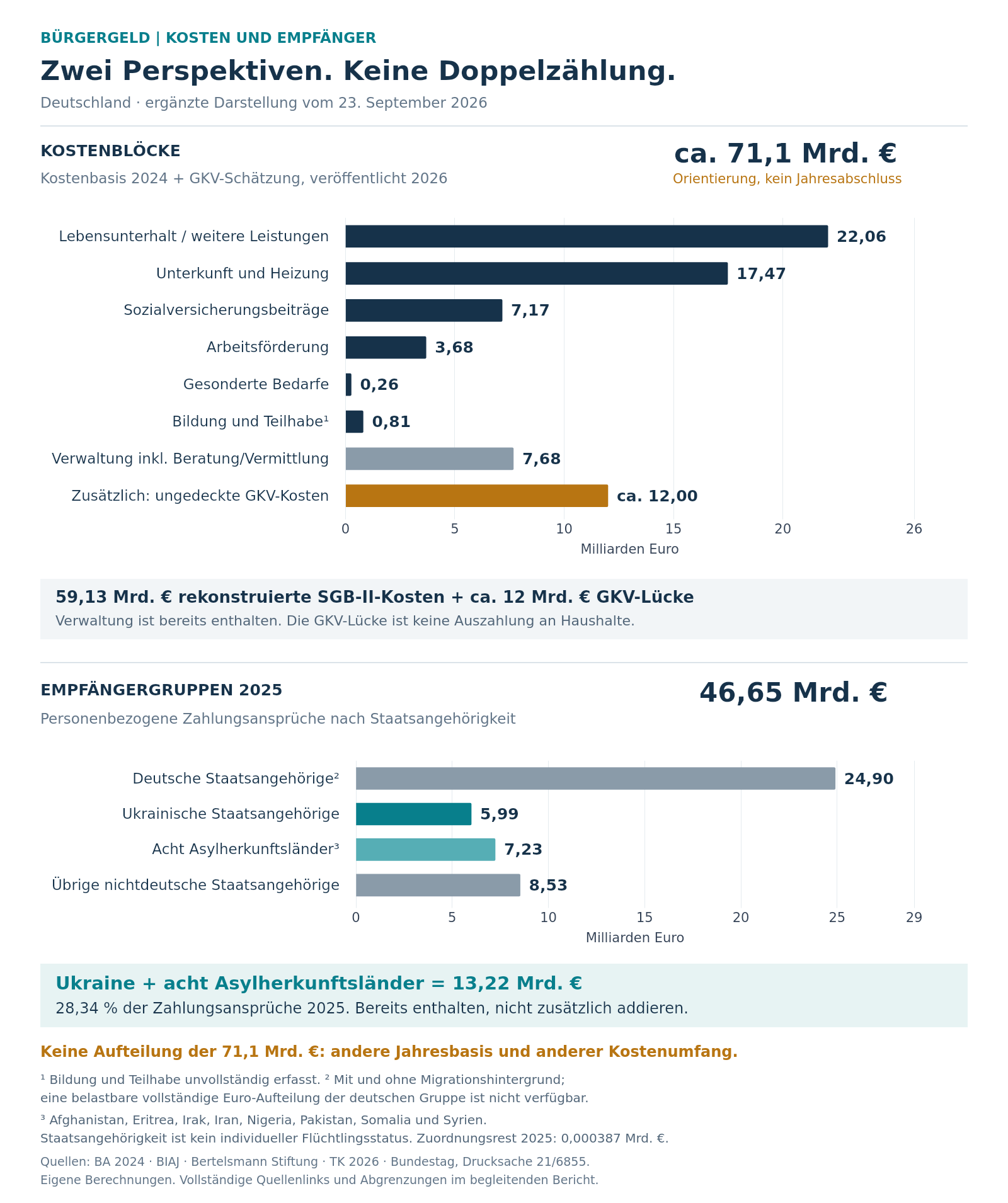
What the cost calculation contains
The report reconstructs the costs from the expenditure statistics of the Federal Employment Agency, the administrative accounts of the BIAJ and figures from the Bertelsmann Foundation on education and participation. In doing so it replaces the narrower administrative figure with a broader definition; it does not add administration twice.
| Use | €bn |
|---|---|
| Subsistence and further benefits | 22.06 |
| Accommodation and heating | 17.47 |
| Social insurance contributions and subsidies | 7.17 |
| Employment support | 3.68 |
| Separate needs | 0.26 |
| Education and participation (incompletely recorded) | 0.81 |
| Administration including advice and job placement | 7.68 |
| Reconstructed total | 59.13 |
The total is based on unrounded starting values. Education and participation is not completely recorded; municipal integration services are missing. The calculation is therefore not a complete statement of all consequential costs either.
A second perspective: who has payment entitlements?
For 2025 the federal government reports personal payment entitlements totalling 46.65 billion euros. Of this, 24.90 billion fall to German nationals, 5.99 billion to Ukrainian nationals, 7.23 billion to nationals of the eight non-European countries of asylum origin and, as a residual, 8.53 billion to the remaining non-German group. The basis is Table 1 of Bundestag printed paper 21/6855.
Ukraine and the eight countries of asylum origin together come to 13.22 billion euros, that is 28.34 per cent of these payment entitlements. This amount is already included. It may neither be added on top nor understood as a breakdown of the 71.1 billion euros: the data year and the scope of costs differ.
What the figures do not say
Nationality is neither migration background nor individual protection status. The German group includes people with and without a migration background. The report provided to us contains no robust, complete breakdown of this group in euros. The eight countries are Afghanistan, Eritrea, Iraq, Iran, Nigeria, Pakistan, Somalia and Syria.
Payment entitlements are also not the same as cash expenditure. A residual of 387,481 euros remains unallocated between the overall total and the nationality groups reported. Administration and health costs cannot simply be distributed on a per-head basis from this either.
The assessment
The documents show a broad cost base of around 59.1 billion euros for 2024. With the health insurance estimate named in the report this gives a wider orientation of around 71.1 billion euros. Neither an officially settled annual total nor a correspondingly large potential saving follows from this. Administration also covers advice and job placement; medical care does not cease to exist because it is financed differently.
CHECK
What was checked before publication
- Version based on the documents submitted.
- The amounts received were checked against Table 1 of the Bundestag printed paper.
- The reconstruction of costs is attributed to the report; a full editorial check of the sources is still outstanding.
SOURCES
Sources
Every number in the text leads to its source. The origin is given at each entry: official, media report, trade association, institute or data portal. Titles stay in the original language, so that each document can still be found.
[1] Bundesregierung
Zahlungsansprüche 2025, Tabelle 1 (Bundestagsdrucksache 21/6855)Official source
[2] Bundesagentur für Arbeit
Einnahmen und AusgabenOfficial source
[3] BIAJ
Verwaltungskosten 2005 bis 2025Institute or public body
[4] Bertelsmann Stiftung
Bildung und Teilhabe 2026Institute or public body
[5] Techniker Krankenkasse
Finanzierung der KrankenversicherungInstitute or public body
CORRECTIONS
Corrections
No corrections since publication on 24/09/2026. Every substantive change appears here with its date, reason and previous wording.